

The CT600L is the supplementary page of the Company Tax Return where a company reports an R&D expenditure credit (RDEC) or an SME payable tax credit. If your company is claiming a payable R&D credit, it goes in with the CT600. If the claim is invalid or incomplete, HMRC can reject it. This guide explains when you need the form, what goes into it, how it connects to the CT600 and the other R&D paperwork, and where claims go wrong.
TL;DR
- CT600L is the HMRC supplementary page for R&D. You complete it when claiming RDEC or an SME payable tax credit.
- For accounting periods starting on or after 1 April 2024, the merged RDEC scheme and enhanced R&D intensive support (ERIS) replace the old RDEC and SME schemes. The form follows that change.
- A CT600L alone is not a claim. You also need the Additional Information Form (box 657) and, where required, the claim notification (box 656) on the CT600.
- Missing a required form, notification or quantified figure can make the whole claim invalid.
- The claim deadline is usually 24 months from the end of the period of account, so build the CT600L into your year-end timetable.
Table of Contents
- What the CT600L actually is
- Who needs to file a CT600L
- What goes into the CT600L
- How the CT600L connects to the rest of the claim
- A practical order of work
- Deadlines and amendments
- Common CT600L mistakes that sink a claim
- Our perspective
- How we can help
- FAQ
- Sources
What the CT600L actually is
The Company Tax Return (CT600) carries the core Corporation Tax calculation. R&D does not fit in the main form, so HMRC uses supplementary pages. The CT600L is the one for research and development. According to HMRC’s guidance on completing the CT600L, it covers claims for the R&D expenditure credit and the SME payable tax credit. It also holds the calculations that decide how a credit is used: set against your Corporation Tax liability, used against other company liabilities, surrendered, carried forward or paid out in cash.
That last point matters for start-ups. Many early-stage companies make losses and owe no Corporation Tax. For them the payable element is the whole point of the claim, because it turns qualifying spend into cash. The CT600L is where that cash figure is worked out and reported.
Why it looks different from the old guidance
If you read older articles, you will see separate SME and RDEC schemes. For accounting periods starting on or after 1 April 2024, the merged scheme RDEC and ERIS replace the old RDEC and SME schemes. Two practical consequences follow:
- Most companies now claim under the merged scheme, so the RDEC sections of the form carry the weight.
- The SME section is for companies that qualify for enhanced R&D intensive support. Everyone else leaves it blank.
If you want the scheme mechanics before the form mechanics, our guides on RDEC versus SME R&D and the merged R&D scheme compliance plan cover the rates and the transition.
Who needs to file a CT600L
The rule is short. You complete the CT600L if you are claiming RDEC or an SME payable tax credit. For accounting periods starting on or after 1 April 2024, you complete the SME section only where the company qualifies for enhanced R&D intensive support. HMRC’s own manual is explicit that a completed CT600L must be included if a company claims payable ERIS or RDEC.
In plain terms:
| Situation | CT600L needed? |
|---|---|
| Claiming RDEC under the merged scheme | Yes |
| Claiming ERIS payable credit as an R&D intensive SME | Yes, SME section completed |
| Claiming a payable SME credit under the old rules | Yes |
| Not claiming any R&D relief | No |
If your position is unusual, for example a company with a long period of account, a group, or a claim that mixes both schemes, ask an adviser before you file. The form has specific instructions for combined claims. For instance, where a company claims under both RDEC and ERIS, HMRC says to skip boxes L71 to L73A and enter the combined figures in boxes L167 to L169A.
What goes into the CT600L
The form is organised in steps. You do not need to memorise box numbers, but you should know what each stage asks, because the figures come from your R&D report and your payroll records, not from the form.
The expenditure and the credit
You enter your qualifying R&D expenditure and the credit claimed. These numbers must match the supporting calculation behind the claim. Qualifying costs usually include staff, externally provided workers, software and consumables used directly in R&D. Our guide to R&D eligible costs for UK SMEs lists what tends to be challenged.
How the credit is applied
The form then walks through how the credit is used. Per HMRC’s step-by-step guidance, you show how the credit is set against Corporation Tax or other liabilities, surrendered, carried forward or paid. A loss-making start-up typically ends up in the payable section.
The PAYE and National Insurance cap
Step 3 of the form restricts the payable element. It is limited to the company’s total expenditure on R&D workers’ PAYE and National Insurance contributions for the accounting period. This catches founders out. A company can have a large qualifying spend on contractors and cloud costs, yet receive a smaller payable amount because its employee PAYE and NIC bill is small.
A simple illustration, with invented numbers for explanation only: a company calculates a credit of £60,000, but its PAYE and NIC on R&D staff for the period was £25,000. The payable element is capped by that £25,000 figure, and the remainder is dealt with according to the other steps of the form. Always run this check before you promise the board a cash figure.
Discharging other liabilities
Step 6 totals the amount used to discharge other company liabilities. HMRC tells you to enter the sum of boxes L110 and L115 in L120. It is a small piece of arithmetic, but it is a common place for a mismatch between the form and the computation.
How the CT600L connects to the rest of the claim
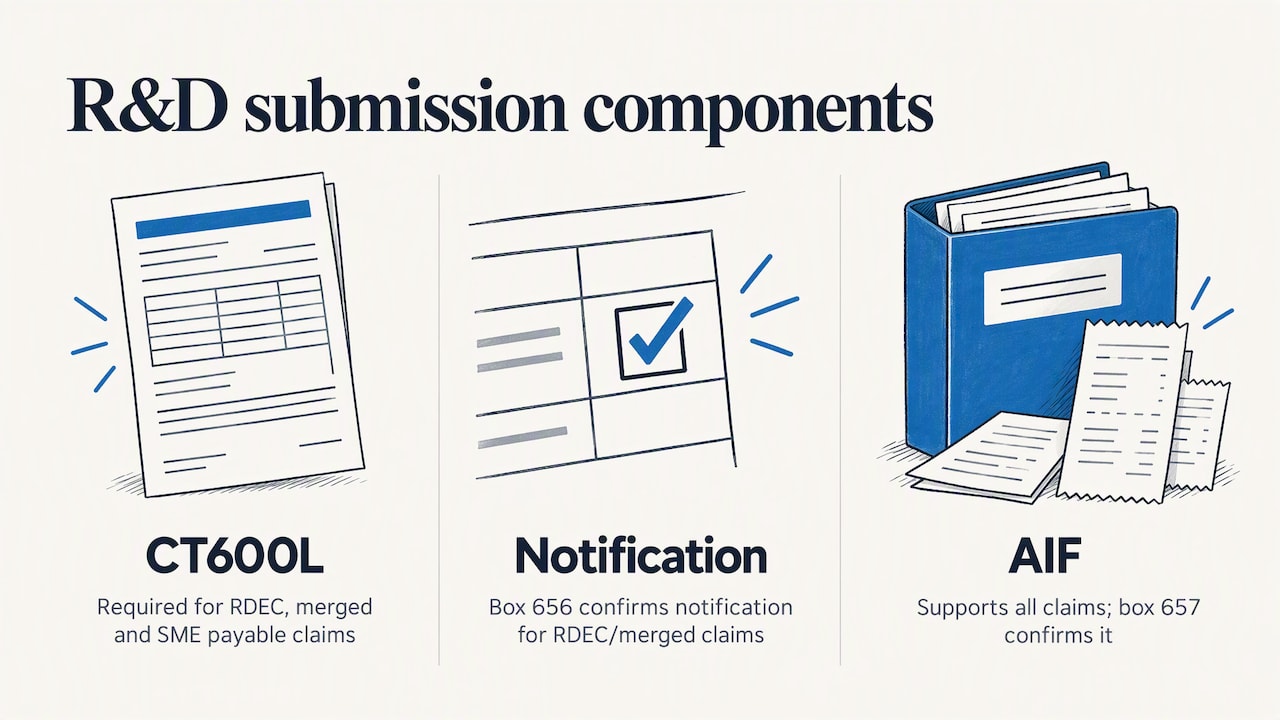
The CT600L is one piece of a three-part submission. People often file it and assume they have claimed. They have not.
Box 656: the claim notification
Where a claim notification is required, it must be submitted in advance of or at the same time as the Company Tax Return, with box 656 of the CT600 ticked. The notification tells HMRC you intend to claim. It is a separate form, not a section of the CT600L.
Box 657: the Additional Information Form
Companies must also submit an R&D Additional Information Form to support all claims, with an X in box 657. The AIF asks for details of the projects, the advances sought, the costs and who prepared the claim.
HMRC’s step-by-step instructions for claiming put these together. For RDEC and merged-scheme claims, you complete the CT600L, put an X in box 656 to confirm the notification and an X in box 657 to confirm the AIF. For an SME payable tax credit claim, the guidance also says to complete the CT600L.
Why the AIF is not optional
For claims made on or after 8 August 2023, if a required information or notification requirement is not met, the claim is invalid. There is no softer outcome in the manual. If you amend a return and switch scheme, note this point: where an AIF supported a claim to one scheme in the original return, a new AIF is required if the company claims under the other scheme in the amendment.
A practical order of work
This is the sequence we recommend to founders preparing a claim, using the HMRC requirements above as the backbone.
- Confirm the accounting period. Check the start date of the period of account. Periods starting on or after 1 April 2024 fall under the merged scheme. Our glossary entry on the accounting period explains how periods are set.
- Check whether a notification is needed and file it before or with the return.
- Prepare the technical narrative. Identify the projects, the scientific or technological uncertainty and the advance sought. Keep contemporaneous notes, including failed tests. See R&D record keeping for tech start-ups.
- Build the cost schedule from payroll, contractor invoices and software subscriptions, and quantify every line.
- Test the PAYE and NIC cap against the credit before you complete step 3 of the CT600L.
- Complete the CT600L, then the AIF.
- File through the Corporation Tax Online Service with boxes 656 and 657 marked as required.
- Diarise the deadline and keep copies of everything submitted.
Deadlines and amendments
The claim deadline depends on the length of your period of account. It is 24 months from the last day of the period of account if the period is 18 months or less, or 42 months from the first day if it is longer than 18 months. Do not treat this as a target. Notification and AIF requirements can bite earlier than the final deadline, so file with the return where you can. For the statutory limits and how they interact with the notification gateway, see our note on the R&D claim deadline.
If you need to change a claim, original returns and amendments must be made through the Corporation Tax Online Service. For claims under the rules applying to periods beginning on or before 31 March 2023, a revised CT600L is required each time a claim for payable tax credit is amended. If you have found an error after filing, read what to do about R&D claim errors before you change anything, because the route depends on whether the error is yours or HMRC’s.

Common CT600L mistakes that sink a claim
HMRC’s manual lists the issues that can make a claim invalid. Failing to meet a required AIF or pre-notification requirement, omitting a required CT600L for a payable tax credit claim, or submitting an incomplete or unquantified claim are the headline ones. In practice we see these patterns:
- Filing the CT600 without the CT600L. The claim box is ticked, but the supplementary page is missing, so the payable credit is not in the return.
- Forgetting the notification. The AIF is in, but no notification went in before or with the return.
- Unquantified costs. A narrative of the project with no figure behind it is an incomplete claim.
- Ignoring the PAYE and NIC cap. The expected payable amount turns out to be smaller than planned.
- Changing scheme in an amendment without a fresh AIF.
- Numbers that do not tie. The CT600L, the computation, the AIF and the accounts show different expenditure totals.
Most of these are process failures, not technical ones. A checklist run by someone other than the preparer catches nearly all of them.
Our perspective
The CT600L is rarely where a claim is won. It is where a good claim is lost. Founders spend weeks on the technical story and then hand the form to whoever is nearest at year end. We think of the CT600L, the AIF and the notification as a single deliverable with one owner, and we put the dates in the calendar when the accounting period starts, not when it ends.
For tech and fintech companies between pre-seed and Series A, there is a second reason to be careful. A payable credit often funds months of runway, and investors will ask how it was calculated. A claim that is tidy, quantified and consistent with the accounts reads well in due diligence. A claim that has been amended three times does not. We also tell founders to model the PAYE and NIC cap before they count R&D cash in their forecast, because it is the figure that most often surprises them.
If your company is raising under SEIS or EIS, keep the R&D position and the share structure in the same conversation. The cash from a claim, the timing of the raise and the advance assurance work all affect each other.
— Rahamut
How we can help
We prepare R&D claims for UK tech and fintech companies, from the technical narrative and cost schedule through to the filing. You can see how we handle this on our R&D tax credit service page, and our pricing page shows the monthly plans for ongoing accounting support: Core Services at £249 per month, Blue Plan at £549 per month and Black Plan from £1,999 per month. R&D claims are listed as a service on our services page, so ask us for a scope before you commit.
FAQ
Do I need a CT600L if I claim R&D relief?
If you are claiming RDEC or a payable credit, yes. HMRC’s guidance says to complete the supplementary pages for those claims, and its manual says a completed CT600L must be included for payable ERIS or RDEC. You still need the AIF and, where required, the notification.
Which boxes on the CT600 link to R&D?
Box 656 confirms submission of the claim notification form, and box 657 confirms submission of the Additional Information Form. Both sit on the CT600, while the credit figures sit on the CT600L.
How long do I have to make the claim?
For a period of account of 18 months or less, the deadline is 24 months from the last day of the period. For a longer period it is 42 months from the first day. Check the notification requirement as well, because it may need to be met earlier.
Can I fix a mistake after I have filed?
Yes, you can amend through the Corporation Tax Online Service. If you move a claim to the other scheme in an amendment, a new AIF is needed. Take advice before amending, because the right route depends on the error.
Sources
- Completing the CT600L page for research and development, GOV.UK
- Make a claim for R&D tax relief on your company tax return, GOV.UK
- Completing your Company Tax Return, GOV.UK
- CIRD81800, HMRC Corporate Intangibles Research and Development Manual
- CIRD181000, HMRC Corporate Intangibles Research and Development Manual