

The r&d claim deadline rules work on two tracks that both have to be hit. First, the statutory limit: you have 24 months from the end of your period of account to make or amend an R&D claim if that period runs 18 months or less, or 42 months from the start of the period of account if it runs longer. Second, and often missed entirely, is the Advance Notification Form (ANF): first-time claimants, or anyone who hasn’t claimed in the previous three years, must file it within six months of their period of account ending, or the claim is dead before it starts.
- Check your period of account end date now
- Confirm whether you’ve claimed R&D relief in the last three years
- If not, file the ANF before the six-month window closes
- Prepare the Additional Information Form ready to accompany your CT600
Miss the ANF deadline and no statutory time limit can rescue the claim — HMRC’s own guidance treats it as a hard gateway, not a formality.
Key Takeaways
Meeting the R&D claim deadline depends on treating the ANF, the Additional Information Form, and the CT600 as three sequenced steps, not one filing event.
PointDetailsStatutory limit varies by period length24 months from period end for periods up to 18 months; 42 months from period start for longer periods.ANF applies to new or lapsed claimantsFile within six months of period of account end, or the claim becomes invalid with no appeal.Sequencing beats speedSubmit the Additional Information Form before or on the same day as the CT600, never after.Match every date and referenceMismatched accounting dates or missing ANF reference numbers are common, avoidable rejection causes.Get deadline checks built inPriceandaccountants reviews period of account dates and manages ANF, Additional Information Form, and CT600 sequencing for clients.
Table of Contents
- Statutory time limits for making or amending an R&D claim
- The ANF: who must notify HMRC and by when
- Sequencing the Additional Information Form before your CT600
- Worked examples for common year-ends
- What happens when you miss a deadline, and what you can still do
- A practical countdown checklist
- How Price & Accountants keeps clients ahead of R&D deadlines
- Why the industry treats R&D deadlines too casually
- Get your R&D deadlines managed properly
- Frequently asked questions
- Sources
Statutory time limits for making or amending an R&D claim
HMRC applies one of two windows depending on how long your period of account runs, and getting this wrong is surprisingly easy for companies with irregular year ends.
- 18 months or less: you have 24 months from the last day of the period of account to make or amend a claim
- Longer than 18 months: the limit becomes 42 months from the first day of that period of account
Both figures come directly from HMRC’s claim guidance, and they apply equally to a brand-new claim and to an amendment of one you’ve already submitted. That second point catches people out. Directors often assume the clock only matters for the initial filing, then discover mid-review that a correction they wanted to make has fallen outside the window.
The 42-month rule exists because periods of account can legitimately exceed 12 months (a company changing its accounting date, for instance), while a Company Tax Return only ever covers a maximum of 12 months. That means a single period of account longer than 12 months needs separate CT600 filings for each accounting period within it, even though the R&D statutory deadline is calculated against the whole period of account, not each individual return.
Where periods of account run to the standard 12 months, this rarely causes confusion. The trouble starts with mergers, demergers, and accounting date changes, exactly where advisers should be double checking the maths rather than assuming a standard 24 month clock applies.
The ANF: who must notify HMRC and by when
Not every company needs to submit an Advance Notification Form, but the criteria are narrower than most directors expect. You must notify if any of the following apply:
- This is your first R&D claim ever
- You haven’t made an R&D claim in any of the three years before the last date of the claim notification period
- Your last claim was made more than three years before the last date of that period, even if you’ve claimed before
The claim notification period itself has a precise legal definition. It begins on the first day of your period of account and ends six months after that period’s last day. For a company with a 31 March 2026 year end, that means the ANF must land with HMRC by 30 September 2026, not by the time you get round to filing your CT600 months later.
HMRC’s internal manual confirms that this six month window applies to accounting periods beginning on or after 1 April 2023, and that failure to notify within it invalidates any subsequent claim for that period. There is no appeal route built into the process. The claim simply cannot proceed.
Pro Tip: Diarise the ANF deadline the moment your financial year starts, not six months in. Practitioners consistently report that ANF non-compliance is the single most common reason new claimants lose their entitlement entirely.

Sequencing the Additional Information Form before your CT600
The Additional Information Form is a separate, mandatory submission from the ANF, and it has its own strict sequencing rule that trips up companies who assume one filing covers everything.
- The form must be submitted before or on the same day as your Company Tax Return (CT600)
- If both go in on the same day, the Additional Information Form has to be sent first
- HMRC’s guidance is explicit: without it, the R&D claim will not be accepted, regardless of how complete the CT600 itself is
The form asks for the technical detail behind your claim: the qualifying projects, the uncertainties addressed, and the costs attributed to R&D activity. It’s the document HMRC actually assesses the science and the numbers against, which is why sequencing matters so much. Submit the CT600 first, even by a day, and the whole claim can bounce.
One detail that catches out even experienced finance teams: accounting period dates on the Additional Information Form must match the CT600 exactly, and where an ANF was filed, its reference number needs to appear on the Additional Information Form too. A mismatched date or a missing reference is an avoidable, entirely administrative reason for rejection, which makes it one of the most frustrating ways to lose a claim.
Worked examples for common year-ends
Working out your own deadline is mostly a matter of anchoring the right start date, then counting forward.
- 31 March year end (first-time claimant): period of account runs 1 April 2025 to 31 March 2026. ANF deadline: 30 September 2026. The statutory claim deadline is generally up to two years after the period of account ends for periods that last 18 months or less.
- 31 December year end (first-time claimant): period 1 January 2026 to 31 December 2026. ANF deadline: 30 June 2027. The statutory claim deadline depends on the length of the period of account and when it began, rather than a fixed calendar date.
- 30 June year end (repeat claimant, no ANF needed): period 1 July 2025 to 30 June 2026. No ANF required if a claim was made within the preceding three years. Statutory claim deadline: 30 June 2028.
For periods of account longer than 12 months, apply the 42-month rule from the period’s start date, and file a separate CT600 for each accounting period the period of account contains, as HMRC’s guidance on making a claim sets out. Group reorganisations and acquisitions often extend or shorten a period of account, so check the actual registered period at Companies House rather than assuming it matches the previous year’s pattern.
What happens when you miss a deadline, and what you can still do
Missing the ANF or the Additional Information Form has an immediate, blunt consequence: the claim is invalid, full stop. There’s no partial credit and no late submission route built into the standard process.
- Check whether your period falls inside a documented administrative easement
- Gather every piece of supporting evidence you have, even if the primary form was missed
- If you’re still inside the statutory 24 or 42 month window, consider whether an amendment is possible on a different basis
- Get a second opinion before assuming the claim is unrecoverable
HMRC has, in narrow circumstances, applied administrative easements. Between 1 April 2023 and 30 November 2024, HMRC’s internal manual records that certain late notifications were accepted where specific conditions were met. These easements are the exception, not a fallback plan, and HMRC has given no indication they’ll be repeated.
Pro Tip: Never treat an easement as a safety net. Build your internal deadlines around the statutory dates as if no flexibility exists, because for most companies, none does.
A practical countdown checklist
Work backwards from your period of account end date, and build in review points rather than a single last-minute push.
- 90 days out: confirm your exact period of account dates and check whether you’ve claimed R&D relief in the last three years
- 60 days out: decide definitively whether an ANF is required, and if so, draft it
- 30 days out: submit the ANF if needed, and begin compiling technical narratives and cost breakdowns for the Additional Information Form
- 7 days out: finalise the Additional Information Form, cross check every date against your CT600, and submit it ahead of or alongside the return
Gather project descriptions, staff time records, subcontractor invoices, and software or consumables costs early. The Additional Information Form guidance requires this detail in a specific structured format, and assembling it under deadline pressure is where errors creep in.
Pro Tip: Keep a single reference document listing your period of account dates, ANF status, and Additional Information Form reference number. It sounds basic, but mismatched dates across forms are one of the most common, entirely preventable reasons claims get rejected.
How Price & Accountants keeps clients ahead of R&D deadlines
Rahamut and the team at Priceandaccountants have spent over 40 years handling corporation tax and compliance work for growing companies, with R&D claims forming a core part of that practice for tech and fintech clients specifically.
- Missed ANF windows because a client assumed a repeat claim exemption applied when it didn’t
- CT600s filed before the Additional Information Form, triggering avoidable rejections
- Mismatched accounting period dates between the ANF and the Additional Information Form
Every one of these failure modes is administrative, not scientific. The claims themselves were often strong. What failed was sequencing and timing, which is entirely preventable with the right calendar in place.
Priceandaccountants runs deadline checks against each client’s actual period of account, prepares the ANF and Additional Information Form in the correct order, and confirms CT600 sequencing before anything goes to HMRC.
Why the industry treats R&D deadlines too casually
Most guidance on R&D claims still talks about “the deadline” as though there’s one date to worry about. That framing is out of date and it’s costing companies real claims. The ANF changed the shape of this process entirely: it turned R&D relief from a single filing event into a sequenced administrative workflow where the earliest step, often eighteen months before the CT600 is even due, can quietly disqualify everything that follows.
The conventional advice, “file your R&D claim with your tax return”, was never wrong exactly, but it’s now dangerously incomplete for any company claiming for the first time or returning after a gap. What the reader should prioritise first isn’t the claim narrative or the cost calculation. It’s confirming, on day one of the accounting period, whether an ANF is even required. Get that decision right early, and everything downstream (the Additional Information Form, the CT600 sequencing, the statutory deadline itself) becomes a scheduling problem rather than a legal risk.
Directors who treat the ANF as an afterthought are the ones losing genuinely qualifying claims to a paperwork technicality, which is a far more avoidable failure than a weak technical case ever was.
Get your R&D deadlines managed properly
If you’ve read this far and you’re not entirely sure whether your company needs an ANF this year, that uncertainty is exactly the problem Priceandaccountants exists to solve. Generic accountants often flag R&D relief as an afterthought at year end, by which point the ANF window may have already closed. Priceandaccountants builds the notification and sequencing checks into your ongoing compliance calendar from day one, so the six-month ANF clock and the statutory 24 or 42 month limit are never a surprise.

The team handles the full sequence: confirming your period of account, assessing ANF eligibility, preparing the Additional Information Form, and lining it up correctly ahead of your CT600. If your company is approaching a year end and hasn’t claimed R&D relief before, get in touch with Priceandaccountants’ R&D tax service now to confirm whether you’re inside or outside the notification window before it closes.
Frequently asked questions
When is an R&D claim due if my company has a standard 12-month year end?Your statutory claim deadline is 24 months from the last day of your period of account. If you’re a first-time claimant or haven’t claimed in three years, the ANF is also due within six months of that same period end, well before the statutory limit.
What is the deadline for R&D claims if my accounting period is longer than 18 months?The 42-month rule applies, counted from the first day of the period of account rather than the end date. Each accounting period within that period of account still needs its own CT600.
Does submitting the CT600 automatically count as making the R&D claim?No. You need the Additional Information Form submitted before or on the same day as the CT600, and if you’re a new or lapsed claimant, a valid ANF filed within the six-month window beforehand. Missing either invalidates the claim regardless of what the CT600 itself contains.
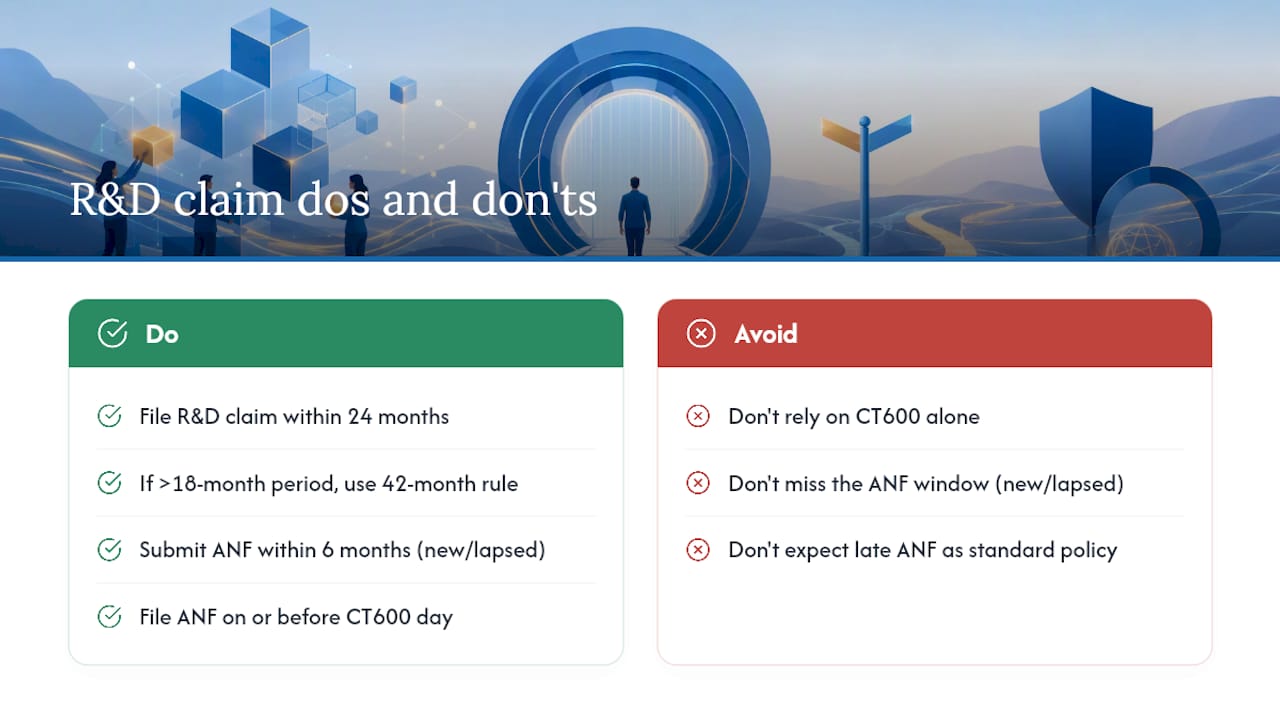
Can HMRC ever accept a late Advance Notification Form?Only in narrow, previously documented circumstances. HMRC applied an administrative easement for certain late notifications between 1 April 2023 and 30 November 2024, but this isn’t a standing policy, and companies shouldn’t plan around the possibility of another one.
Sources
- Tell HMRC you want to claim Research and Development (R&D) tax relief
Recommended
- UK R&D Claims 2026: 27% Credit Boost for Tech Startups - Price & Accountants
- UK R&D Claims 2026: 27% Credit Boost for Tech Startups - Price & Accountants
- Getting the R&D claim process right first time - Price & Accountants
- Why Report R&D to HMRC? Avoid 100% Claim Rejection in 2026 - Price & Accountants