TL;DR:
- Profits between £50,000 and £250,000 incur a marginal relief, raising the effective tax rate gradually from 19% to 25%. The marginal slice rate is 26.5%, accounting for relief withdrawal during profit growth. Accurate modelling must consider associated companies and short periods to prevent underestimating tax impacts.
Profits up to £50,000 pay corporation tax at 19% (the small profits rate). Profits above £250,000 pay the main rate of 25%. Between those two limits, marginal relief applies, and the effective rate rises smoothly from 19% to 25% rather than jumping in one go. The mechanism that creates that smooth ramp is a statutory deduction calculated using the fraction 3/200.
The single most important number to hold in your head: every extra pound of profit earned inside the £50,000–£250,000 band carries an effective marginal (slice) rate higher than 25%, due to the combined effect of the main rate and relief withdrawal. That is because each additional pound both attracts tax at 25% and withdraws a slice of the relief simultaneously.
Marginal relief is a statutory deduction from the main-rate corporation tax charge. Without it, a company earning £50,001 would pay 25% on its entire profit, producing a tax bill roughly £3,000 higher than a company earning £50,000 at 19%. That cliff-edge would create a perverse incentive to suppress profits just below the threshold. Marginal relief prevents exactly that by withdrawing the benefit gradually across the £200,000 band.
In legislative terms, the relief reduces the main-rate charge by a fraction of the difference between the upper limit and the company’s augmented profits. The result is a tax bill that rises continuously as profits grow, with no sudden jump at either boundary.
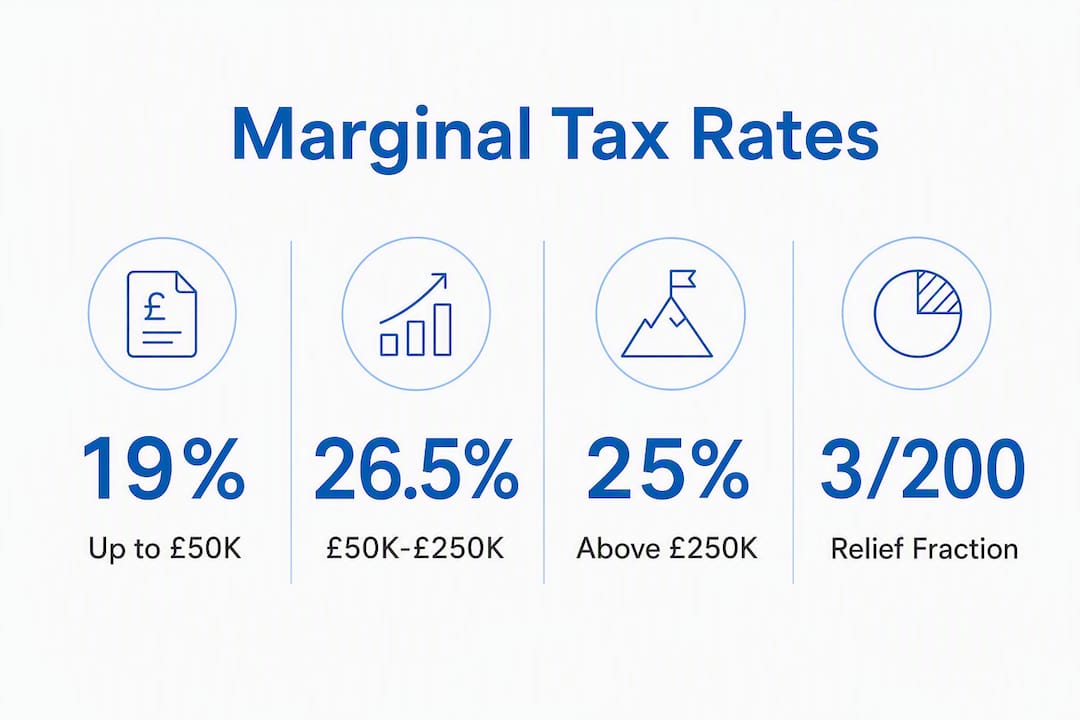
Pro Tip: When modelling incremental trading decisions inside the band, treat the marginal rate as 26.5p per extra pound of profit, not 25p. Using 25% understates the tax cost of growth and will make your cashflow forecast too optimistic.
The rates below are confirmed by the Finance Act 2025 and apply to accounting periods falling within the financial year 2026.

| Profit level | Rate | Notes |
|---|---|---|
| Up to £50,000 | 19% small profits rate | Full small profits rate; no marginal relief |
| £50,001–£250,000 | Marginal relief applies (main rate is 25% less marginal relief; average rate rises from 19% to 25%; marginal slice rate is 26.5%) | Effective rate rises from 19% to 25% across the band; marginal rate on each extra pound is 26.5% |
| Above £250,000 | 25% main rate | No relief available |
| Standard fraction | 3/200 (0.015) | Set in legislation; unchanged since April 2023 |
The fraction 3/200 is not arbitrary. It is set precisely so that the formula produces a tax charge equal to 19% at £50,000 and 25% at £250,000, with a linear ramp between them.
Short accounting periods and associated companies both reduce the limits proportionately. A nine-month accounting period, for example, reduces the lower limit to £37,500 and the upper limit to £187,500. Two associated companies halve both limits to £25,000 and £125,000 respectively. HMRC’s rates and allowances page confirms the standard fraction has been 3/200 since April 2023.
Eligibility is straightforward in principle, though the associated company rules catch many directors off guard.
Who can claim:
Who cannot claim:
The associated company trap
HMRC guidance makes clear that the £50,000 and £250,000 limits are divided by the total number of associated companies, including those that are dormant or non-trading. A founder running two active trading companies and one dormant holding company has three associated companies. Each company’s limits become £50,000 ÷ 3 = £16,667 and £250,000 ÷ 3 = £83,333.
That compression is significant. A company with £70,000 profit that would otherwise sit comfortably in the marginal band could find itself paying the full 25% main rate once the limits are divided. PwC’s tax summaries confirm that the threshold division applies to associated companies worldwide, not just UK entities.
The full statutory formula is:
MR = F × (U − A) × (N ÷ A)
Where:
When a company has no franked investment income, augmented profits equal taxable profits (A = N), and the formula simplifies to:
CT = (Profit × 25%) − ((£250,000 − Profit) × 0.015)
This simplified calculation is what most SMEs and their accountants use in practice. The 0.015 is simply 3/200 expressed as a decimal.
The marginal relief fraction 3/200 (0.015) is the statutory rate set so that the formula produces exactly 19% tax at £50,000 profit and exactly 25% at £250,000 profit.
Calculation checklist before you run the numbers:
The table below uses the simplified formula (no franked investment income, 12-month period, no associated companies).
| Taxable profit | Tax at 25% | Marginal relief | Tax payable | Average effective rate | Slice rate on next £ |
|---|---|---|---|---|---|
| £50,000 | — | £3,000 | — | 19% | 26.5% |
| — | — | — | — | — | 26.5% |
| £100,000 | £25,000 | £2,250 | £22,750 | 22.75% | 26.5% |
| £150,000 | £37,500 | — | — | — | 26.5% |
| £200,000 | £50,000 | £750 | — | — | 26.5% |
| £250,000 | — | £0 | — | 25% | 25% |
Worked example at £100,000:
The slice rate column stays at 26.5% throughout the band because every additional pound simultaneously attracts 25% tax and withdraws 1.5p of relief (0.015 × £1). Those two effects add to 26.5p per pound.
Pro Tip: When forecasting cashflow for a company sitting in the marginal band, set aside 26.5% of each incremental pound of profit, not 25%. The difference compounds quickly: on £50,000 of growth from £100,000 to £150,000, the extra 1.5% costs an additional £750 in tax that a 25%-based forecast would miss entirely.
The effective rate inside the marginal band is sometimes called the “60% trap” by analogy with the personal allowance withdrawal zone in income tax, where the effective marginal rate on earnings between £100,000 and £125,140 reaches 60%. The corporation tax version is less dramatic in percentage terms but still materially higher than the headline 25% rate, and it catches directors who model their post-tax profit using the wrong rate.
Practical planning notes:
Common forecasting mistakes to check before acting:
HMRC provides a dedicated marginal relief calculator on GOV.UK. It handles associated company adjustments and short accounting periods and is the quickest way to cross-check a manual calculation before filing. The statutory rates and the standard fraction are confirmed on the corporation tax rates page.
For accounting software, most modern packages that handle corporation tax computations (including those built on Xero’s ecosystem) will apply marginal relief automatically once the profit figure and associated company count are entered correctly. The risk is not the software’s arithmetic; it is the inputs. Incorrect associated company counts and unadjusted short-period limits are the two most common sources of error.
Pro Tip: Run a two-stage check: first, calculate the relief manually using the simplified formula for two or three profit points near your forecast. Then run the same figures through HMRC’s online calculator. If the results agree, your inputs are likely correct. If they diverge, the discrepancy almost always points to an associated company or short-period adjustment you have missed.
For a single UK company with a standard 12-month period and no associated entities, the calculation is manageable in-house. The complexity rises sharply in several situations.
Seek specialist help when:
A specialist adviser will typically: confirm the adjusted limits after associated company and short-period checks; model several profit scenarios to show the after-tax position at each; identify whether R&D or capital allowance timing can shift profits out of the 26.5% zone; and handle HMRC correspondence if the relief is queried. For director tax planning across multiple entities, that structural review often pays for itself in the first year.
Consider a company with three entities where the director assumed each had the standard £50,000–£250,000 band. After an associated company review, the correct lower limit was £16,667 per company. Two of the three companies were already paying the full 25% main rate without realising it, and the director had been forecasting cashflow at 22–23% effective rates. Correcting the model changed the retained profit forecast materially and prompted a restructure of the group’s invoicing arrangements.
The corporation tax marginal rate of 26.5% on profits between £50,000 and £250,000 is the single most important figure for any UK company director modelling growth inside that band.
| Point | Details |
|---|---|
| Three-rate structure | 19% up to £50,000; average effective rate rises from 19% to 25% between £50,001 and £250,000, with a marginal slice rate of 26.5% on each extra pound; 25% above £250,000. |
| Marginal relief fraction | The statutory fraction 3/200 (0.015) produces the smooth ramp; confirmed by Finance Act 2025. |
| Associated companies compress limits | Each additional associated company (including dormant ones) divides both thresholds, potentially pushing profits into the main-rate band. |
| Short periods reduce limits | A sub-12-month accounting period proportionately reduces both the £50,000 and £250,000 limits. |
| Priceandaccountants advisory support | Priceandaccountants provides threshold modelling, associated company reviews, and corporation tax filing support for UK directors and SMEs. |
Most of the confusion around the corporation tax marginal rate comes from a single habit: directors read the headline rates (19% and 25%) and assume one of those two numbers applies to their company. The marginal band is mentioned in passing, but the 26.5% slice rate rarely features in the summary tables that circulate in finance teams and board packs.
The practical consequence is that companies sitting between £80,000 and £180,000 profit routinely model cashflow at 22–24% effective rates, which is broadly correct for the average rate but wrong for the marginal rate on growth. When a company forecasts the after-tax return on a new contract or a price increase, it should be using 26.5%, not the average. The difference between those two numbers on a £30,000 revenue uplift is £450 in additional tax that the forecast did not account for. Multiply that across several planning decisions in a year and the cumulative error becomes meaningful.
The associated company rules compound this. Founders building a group of companies often set up holding structures, IP vehicles, or dormant entities for good commercial reasons, without realising that each new entity compresses the marginal band for every other company in the group. The rules are not punitive by design; they exist to prevent artificial profit-splitting. But the threshold dilution is real and often discovered only at the year-end, when it is too late to act.
Early modelling, using the correct 26.5% slice rate and the adjusted limits, is the single most effective thing a director can do before making growth or investment decisions inside the marginal band.
Corporation tax in the marginal band is one of those areas where getting the inputs right matters far more than the arithmetic. Priceandaccountants works with UK tech founders, SME directors, and international businesses to model the correct thresholds, run associated company checks, and time R&D and capital allowance claims to manage the effective rate on growth.

The firm’s strategic advisory and tax planning service covers the full scope of marginal relief work: adjusted limit calculations, group structure reviews, scenario modelling across multiple profit points, and corporation tax return filing. For companies with R&D activity, the team coordinates claim timing with the marginal band position so the relief lands where it saves the most. Clients also benefit from outsourced finance director support, which means the modelling feeds directly into cashflow forecasts rather than sitting in a separate tax file.
To understand how your current profit forecast interacts with the marginal band, and whether your associated company count is correct, book a tax review with the Priceandaccountants team.
| Source | What it confirms | Notes |
|---|---|---|
| GOV.UK — Corporation Tax rates | 19% small profits rate, 25% main rate, £50k/£250k limits | Primary HMRC reference; check here first |
| GOV.UK — Marginal relief guidance | Eligibility, associated company rules, short-period prorating, HMRC calculator link | Updated by HMRC; includes the online calculator |
| GOV.UK — Rates and allowances | Standard fraction 3/200 confirmed for 2023–2026; historical rate tables | Useful for confirming the fraction has not changed |
| Finance Act 2025 | Statutory confirmation of 25% main rate, 19% SPR and 3/200 fraction for financial year 2026 | Legal backing for all rate and fraction claims |
| PwC Tax Summaries — United Kingdom | Associated company threshold division; restatement of two-rate structure | Useful professional summary for advisers |
| Priceandaccountants — corporation tax guide | Practical strategies for reducing corporation tax; advisory engagement guidance | Firm content; supports planning sections |
This article provides general information about UK corporation tax marginal relief and rates. It is not professional tax advice. Confirm current rules with HMRC or a qualified tax adviser for your specific circumstances.