
TL;DR:
- Most UK businesses misunderstand their financial inefficiencies, which often stem from disconnected systems requiring manual effort. Proper integration, supported by governance, streamlines data flow, reduces errors, and accelerates financial processes, providing clarity and control. Adopting a phased approach with strong governance ensures sustainable benefits and strategic value from integrated finance solutions.
Most UK business owners assume their financial inefficiency comes from not having the right software. The real culprit is usually something far less visible: disconnected systems forcing finance teams to manually copy data between platforms, reconcile conflicting figures, and chase answers that should already be obvious. Understanding why use integrated finance solutions is not a technology question. It is a question about how much time, money, and decision-making capacity you are quietly losing every week to processes that should not exist at all.
Table of Contents
- Key takeaways
- What integrated finance solutions actually are
- The real benefits of integrated finance for UK businesses
- Governance and the single source of truth
- Adopting integrated finance solutions in practice
- Comparing integration approaches
- My perspective on integrated finance as a strategic priority
- How Priceandaccountants supports your finance integration goals
- FAQ
Key takeaways
PointDetailsIntegration reduces manual effortAPI-led integration cuts manual finance hours by 25 to 45%, freeing your team for higher-value work.Governance matters as much as softwareA single source of truth is a governance outcome, not a product you can buy off the shelf.Cash flow visibility improves significantlyMid-market firms waste 15 to 20 hours per week on manual cash flow consolidation that integration eliminates entirely.Adoption should start with pilotsIntegrating existing tools with your ERP via APIs is less disruptive and more effective than wholesale system replacements.Error rates drop sharplyUK finance teams using integrated data pipelines report 60 to 75% fewer reconciliation errors, improving compliance and audit readiness.
What integrated finance solutions actually are
The term gets used loosely, so it is worth being precise. An integrated finance solution connects your core financial systems, including your accounting or ERP platform, banking feeds, payroll, invoicing tools, and reporting dashboards, into a single coordinated data environment. Data flows between systems automatically rather than being exported, reformatted, and re-entered by hand.
The key components typically include:
- ERP or accounting platform (such as Xero, Sage, or NetSuite) as the central ledger
- Banking APIs that pull live transaction data directly into your accounts
- Reporting and analytics tools that draw from a consistent, real-time data source
- Payroll and HR integrations that sync headcount costs without manual uploads
- Invoicing and accounts receivable tools that update cash position automatically
What separates genuine integration from simple automation is the data pipeline. Automation might mean a task runs without a human pressing a button. Integration means the output of one system becomes the input of another without any manual translation in between. That distinction matters enormously when you are trying to close your books quickly or produce board-level reports.
The governance layer sits above all of this. Technology alone cannot create trust in your financial data. Your chart of accounts, cost centre definitions, and reporting cutoffs all need to be agreed and consistently applied across every connected system.
Pro Tip: Before evaluating any integration platform, write down what your finance function is trying to achieve in the next 12 months. Technology should serve those priorities, not define them.
The real benefits of integrated finance for UK businesses
The case for integration goes well beyond saving a few hours on spreadsheets. The advantages of integrated finance compound across your entire operation.
Operational time savings
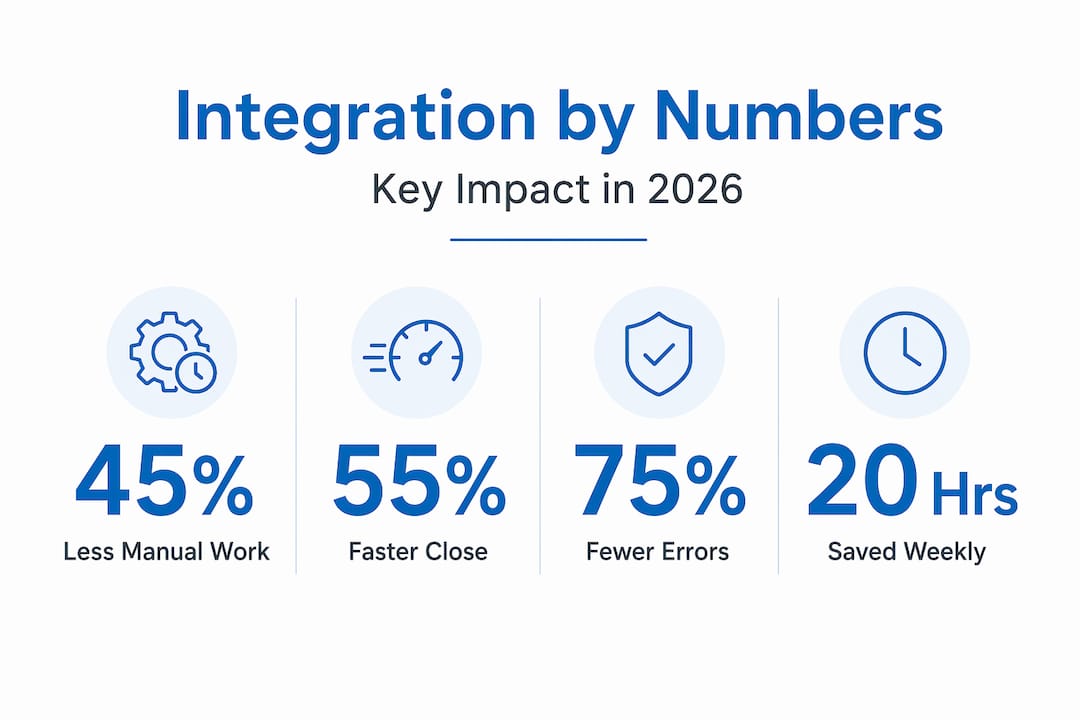
API-led integration reduces manual finance hours by 25 to 45% and accelerates the financial close cycle by 35 to 55%. For a growing UK business, that translates to annual savings of £60,000 to £300,000 or more, depending on team size and complexity. Those figures are not theoretical. They reflect what happens when your finance team stops re-entering data and starts analysing it instead.

Cash flow clarity
Mid-market companies spend 15 to 20 hours per week manually consolidating cash flow data from multiple sources. With integrated finance software, your treasury position updates in real time. You see what is coming in, what is going out, and where the gaps are, without waiting for someone to build a spreadsheet every Monday morning.
Compliance and audit readiness
UK finance teams using integrated pipelines report 60 to 75% fewer reconciliation errors. Fewer errors means fewer uncomfortable conversations with auditors, cleaner VAT returns, and faster responses to HMRC queries. For businesses managing VAT compliance across multiple revenue streams, this reduction in error risk is significant.
The table below summarises the primary benefits against the problems they solve:
ProblemIntegrated finance benefitTypical improvementManual data re-entry between systemsAutomated data pipelines25 to 45% fewer manual hoursSlow month-end closeConnected ledger and bank feeds35 to 55% faster close cycleCash position uncertaintyReal-time bank and invoicing syncNear-instant visibilityReconciliation errorsSingle data source across systems60 to 75% error reductionCompliance gapsConsistent chart of accountsCleaner audit trails
Pro Tip: The “swivel-chair tax” is the hidden cost of your team rotating between disconnected systems to copy information. It rarely appears on any budget line, but it increases effort and risk in ways that compound over time. Quantify it before your next software review.
Governance and the single source of truth
Here is where most businesses get integration wrong. They buy a platform, connect a few systems, and then wonder why the numbers in the dashboard do not match the numbers in the board report. The answer is almost always governance, not technology.
A single source of truth is not a product. It is a governance outcome that requires chart of accounts consistency, disciplined master data management, and regular reconciliation processes. Without those foundations, connecting more systems just means inconsistent data flowing faster.
The practical governance steps that make integration work are:
- Agree your chart of accounts across every department before connecting any new system. Inconsistent cost categories are the single biggest cause of conflicting reports.
- Define master data rules for customers, suppliers, and products. If the same customer appears under three slightly different names across your CRM, ERP, and invoicing tool, your reports will always disagree.
- Set reconciliation cadences formally. Weekly bank reconciliations and monthly ledger reviews are not optional extras when you rely on integrated data. They are the quality checks that keep the whole system honest.
- Co-design your KPI framework with the people who will use it. Building measurement frameworks with finance teams rather than for them means the definitions everyone uses for revenue recognition, margin calculation, and cost allocation are genuinely shared, not imposed.
Integration without governance is just faster chaos. The discipline you apply to your data definitions determines whether your integrated system becomes a strategic asset or a more expensive version of the problem you already had.
This is why the importance of integrated finance cannot be reduced to a software decision. It requires finance leaders to take ownership of data as a business asset, not just a byproduct of transactions.
Adopting integrated finance solutions in practice
Knowing the benefits of integrated finance is one thing. Getting there without disrupting your operations is another. Here is what works in practice for UK businesses:
- Start with a pilot. Choose one high-friction process, such as bank reconciliation or purchase order matching, and integrate it properly before expanding. Early wins build confidence and reveal real-world data quality issues before they scale.
- Prioritise API depth with your ERP. Confirm early that any platform you are evaluating connects at the module level with your ERP, not just at the surface. Early ERP integration verification prevents the frustrating discovery, six months into implementation, that the integration you bought does not cover the ledger module you actually need.
- Integrate, do not replace. Mid-market firms benefit more from connecting existing tools via API platforms than from disruptive full system replacements. A well-integrated legacy ERP often outperforms a poorly governed new one.
- Involve both finance and IT from day one. Integration projects that are treated as IT projects typically fail to deliver finance value. Projects treated as finance transformation initiatives with IT support tend to succeed. The finance team must own the requirements and the governance design.
- Plan for failure modes. Robust error handling including automatic retries, alerting on failures, and clear error logging is not optional. API connections fail. Month-end should not fail with them.
A practical note on tooling: low-code platforms have made it possible for finance teams to maintain their own integration workflows without depending on IT for every change. This “citizen integrator” model works well once governance is established, and it dramatically reduces the cost of keeping integrations current as your business evolves. For UK tech businesses specifically, combining this with cloud accounting practices accelerates the entire process.
Common pitfalls to avoid include expecting plug-and-play results from day one, underestimating data cleansing time before migration, and treating integration as a one-time project rather than an ongoing programme of continuous improvement.
Comparing integration approaches
Not all integration is the same. Understanding the trade-offs helps you choose the right approach for your business size and maturity.
Integration methodSpeedComplexityCostBest suited forAPI-led (real-time)HighMedium to highMedium to highGrowing businesses needing live dataBatch processing (scheduled)MediumLow to mediumLow to mediumStable, lower-volume operationsManual export and importLowLowLow (but labour-intensive)Very small businesses or short-term fixesLow-code integration platformsHighLow (post-setup)MediumFinance teams wanting operational independence
For most UK mid-market businesses, API-led integration with a low-code management layer represents the best combination of real-time capability and maintainability. Pure batch processing is cheaper to implement but leaves you working with data that is always slightly out of date, which undermines the cash flow visibility that integration is supposed to deliver.
The finance automation guidance for CFOs consistently points toward API-first architectures as the foundation for scalable financial management. The upfront investment pays back quickly when manual hours and error correction costs are properly accounted for.
My perspective on integrated finance as a strategic priority
I have worked with enough growing UK businesses to recognise a pattern. The ones that struggle to scale are rarely short of ambition or product. They are short of financial clarity. Their leadership team is making decisions based on data that is two weeks old, reconciled differently by three people, and trusted by nobody.
What I have seen is that the businesses which invest in integration early, and do it with governance at the centre, do not just get faster month-ends. They get a finance function that can sit at the senior leadership table with confidence. The CFO or FD stops being the person who explains why last month’s numbers were wrong and starts being the person who says where the business should go next.
The swivel-chair tax is real, and in my experience it is chronically underestimated. When I ask finance teams to track how many times per week they copy data between systems, the answer is almost always shocking to the business owner. That time is not just wasted. It is borrowed from analysis, planning, and the kind of forward-looking work that actually creates value.
My honest take: integration is not an IT project with finance implications. It is a finance transformation with technology requirements. Get that framing right, and everything else follows more naturally than you would expect.
— Rahamut
How Priceandaccountants supports your finance integration goals
At Priceandaccountants, we work with UK tech businesses, fintech founders, and growing SMEs who are at exactly this crossroads: they know their finance function needs to become more connected, but they are not sure where governance ends and software begins.

Our bookkeeping services are built on cloud-native platforms that integrate directly with your banking, payroll, and reporting tools, giving you the reliable data foundation that makes integration work. Beyond the numbers, our strategic advisory team acts as your outsourced Finance Director, helping you design the governance frameworks and measurement structures your integration depends on. Whether you are preparing for your first audit, planning a funding round, or simply trying to close your books in less than two weeks, we bring the practical expertise to make integrated financial management a reality, not just a goal.
FAQ
What does an integrated finance solution actually do?
It connects your accounting, banking, payroll, and reporting systems so data flows automatically between them, removing the need for manual re-entry and giving you a single, consistent view of your financial position.
Why use integrated finance solutions instead of separate tools?
Separate tools create data silos that force manual reconciliation, slow down reporting, and introduce errors. Integration eliminates those handoffs and gives your finance team real-time visibility across the business.
Is integrated finance worth it for small UK businesses?
Yes, particularly for businesses spending significant time on manual consolidation. The cost of integration is typically recovered quickly through reduced manual hours and fewer errors, with annual savings starting from £60,000 for businesses of meaningful scale.
What is the biggest risk when adopting integrated finance software?
Poor data governance before and during implementation. If your chart of accounts and master data definitions are inconsistent, integration will surface those problems at scale rather than solve them.
How do I start building an integrated finance function?
Begin with a single high-friction process, confirm your ERP integration depth early, and agree your data governance framework before connecting any new systems. Involve your finance team in the design, not just the IT team.