

Many UK tech and fintech founders believe they can handle finances independently with cloud software and a spreadsheet. This myth quickly crumbles when faced with R&D tax credit claims, EIS compliance, HMRC deadlines, and investor due diligence. Proper accounting protects startups from legal risks and penalties whilst unlocking funding opportunities that self-managed books simply cannot capture. Professional accountants transform financial complexity into strategic advantage, ensuring your startup scales compliantly from pre-seed through Series A and beyond.
Table of Contents
- Key takeaways
- The critical role of accountants in UK startup financial management
- Maximising UK funding opportunities and R&D tax credits with professional accountants
- Navigating complex UK tax compliance and deadlines for startups
- Choosing the right accounting partner for your UK startup journey
- Explore expert accounting support tailored for UK startups
- Why startups need accountants: frequently asked questions
Key Takeaways
PointDetailsTax optimisationTech startups benefit from specialist accountants who optimise tax credits and ensure regulatory compliance to avoid penalties.Precise bookkeepingAccountants implement cloud based systems that automate data capture and keep audit ready documentation.Funding guidanceThey prepare startups for funding rounds and provide strategic counsel to navigate regulatory obligations.Compliance disciplineThey maintain comprehensive compliance calendars and submission workflows to protect the startup from regulatory risk and missed deadlines.
The critical role of accountants in UK startup financial management
Founders often underestimate how quickly financial complexity escalates. What starts as simple invoicing evolves into multi-currency transactions, equity compensation, and intricate reporting requirements. Accountants establish robust accounting for start ups systems that scale with your business.
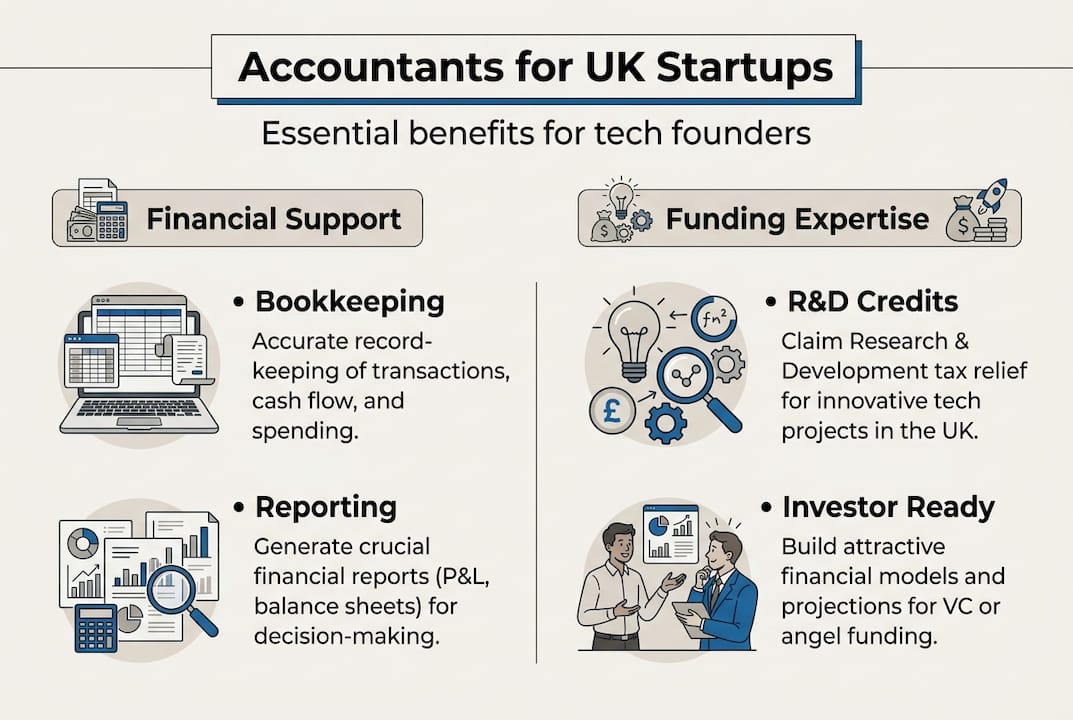
Bookkeeping forms the foundation of financial health. Accurate records track every transaction, providing real-time visibility into cash flow, burn rate, and runway. Without precise bookkeeping, you cannot identify spending patterns, forecast accurately, or make data-driven decisions. Professional accountants implement cloud-based systems that automate data capture whilst maintaining audit-ready documentation.
Compliance demands constant attention in the UK regulatory environment. Corporation tax returns, VAT submissions, payroll filings, and statutory accounts each carry specific requirements and deadlines. Missing any deadline triggers automatic penalties, increased scrutiny, and potential legal consequences. Accountants maintain comprehensive compliance calendars and submission workflows that protect your startup from regulatory risk.
Financial reporting transforms raw data into actionable intelligence. Monthly management accounts reveal profitability trends, departmental spending, and key performance metrics. Quarterly board packs present financial health to investors and advisors. Annual statutory accounts satisfy Companies House requirements. Each report serves distinct audiences and purposes, requiring professional preparation to ensure accuracy and relevance.
Pro Tip: Establish monthly financial review meetings with your accountant to discuss performance trends, identify issues early, and adjust strategy before problems escalate.
Accountants translate complex regulations into practical guidance. They explain how recent tax law changes affect your business, advise on optimal corporate structures, and recommend timing for major financial decisions. This translation service proves invaluable for founders focused on product development and customer acquisition rather than regulatory minutiae.
Key accounting functions that protect startup stability include:
- Maintaining statutory books and registers for Companies House compliance
- Processing payroll accurately with correct tax codes and pension contributions
- Reconciling bank accounts monthly to catch errors and fraud
- Managing accounts payable and receivable to optimise working capital
- Preparing year-end accounts that satisfy audit and filing requirements
Maximising UK funding opportunities and R&D tax credits with professional accountants
Funding represents the lifeblood of high-growth startups. Whether pursuing angel investment, venture capital, or government grants, transparent financials separate successful raises from rejected pitches. Accountants assist startups in claiming R&D tax credits effectively, often recovering 25-33% of qualifying expenditure that founders would otherwise miss.
R&D tax credits offer substantial cash injections for innovative startups. The UK scheme allows companies to claim relief on qualifying research and development activities, potentially recovering thousands or even hundreds of thousands of pounds. However, HMRC scrutinises claims carefully, requiring detailed technical and financial documentation that proves eligibility.

Accountants specialising in tech startups understand which activities qualify as R&D under HMRC guidelines. Software development, algorithm optimisation, and technical problem-solving often qualify, but only when properly documented. Your accountant structures claims to maximise recovery whilst maintaining defensibility during HMRC enquiries.
Funding StageAccountant’s RoleKey DeliverablesPre-seedFinancial model validationProjections, cap table setupSeedDue diligence preparationClean financials, tax clearancesSeries AInvestor reporting systemsMonthly metrics, board packsGrowthStrategic financial planningScenario modelling, treasury management
Investor due diligence demands meticulous financial records. Venture capitalists examine every transaction, seeking red flags that indicate poor financial controls or hidden liabilities. Accountants prepare data rooms with organised documentation, answer investor queries confidently, and resolve discrepancies before they derail negotiations.
EIS and SEIS schemes provide tax-efficient investment structures that attract UK investors. These schemes offer generous tax reliefs to investors whilst providing startups with growth capital. However, qualifying requires strict compliance with share structure rules, trading activities, and investor eligibility. Accountants ensure your setup meets all requirements, protecting both your company and your investors from unexpected tax liabilities.
Pro Tip: Begin R&D tax credits guide preparation early in your financial year by documenting qualifying activities monthly rather than reconstructing them retrospectively.
Funding readiness extends beyond clean books. Accountants help you:
- Develop realistic financial projections that investors trust
- Structure cap tables to accommodate future funding rounds
- Establish KPI tracking systems that demonstrate traction
- Prepare compelling financial narratives for pitch decks
- Negotiate valuation terms with financial clarity
Navigating complex UK tax compliance and deadlines for startups
Tax compliance creates constant pressure for growing startups. Corporation tax, VAT, PAYE, and other obligations each carry distinct rules, rates, and deadlines. Accountants help startups meet all UK tax deadlines and ensure compliance throughout the year, preventing penalties that drain limited resources.
Corporation tax requires annual returns filed within twelve months of your accounting period end, with payment due nine months after period end. Missing these deadlines triggers automatic penalties starting at £100 and escalating based on delay length. Late payment incurs interest charges that compound daily.
VAT obligations depend on your turnover and registration status. Once you exceed the £90,000 threshold, you must register and begin submitting returns. Making Tax Digital requirements mandate specific software and digital record-keeping. Accountants implement compliant systems and manage submissions, ensuring accuracy whilst optimising your VAT position through appropriate schemes.
Tax TypeFiling DeadlinePayment DeadlinePenalty for Late FilingCorporation Tax12 months after period end9 months after period end£100 minimum, escalatingVAT1 month + 7 days after periodSame as filing£400+ based on defaultsPAYE19th of following month22nd if paying electronicallyImmediate penaltiesSelf Assessment31 January following tax year31 January£100 immediate, then daily
Payroll taxes demand monthly attention. PAYE submissions occur through Real Time Information, requiring data submission each time you pay employees. National Insurance contributions, student loan deductions, and pension auto-enrolment add layers of complexity. Errors result in penalties, employee disputes, and HMRC investigations.
Accountants establish systematic workflows that eliminate deadline stress:
- Automated reminders trigger preparation activities weeks before deadlines
- Regular data collection ensures information availability when needed
- Review processes catch errors before submission
- Confirmation tracking provides audit trails for all filings
- Penalty monitoring identifies and resolves issues immediately
Tax planning opportunities emerge throughout the year. Accountants identify optimal timing for major expenses, advise on salary versus dividend strategies for directors, and structure transactions to minimise tax exposure legally. This proactive approach saves substantially more than reactive compliance alone.
Choosing the right accounting partner for your UK startup journey
Not all accountants understand startup dynamics. Traditional high-street firms often lack experience with venture funding, equity compensation, and rapid scaling challenges. Specialist accountants for tech startups bring sector knowledge that proves invaluable as you navigate growth.
Experience with tech and fintech startups matters enormously. Accountants familiar with your sector understand common business models, recognise typical cost structures, and anticipate challenges before they materialise. They speak your language, grasp technical concepts quickly, and provide relevant benchmarking against similar companies.
Funding expertise separates specialist startup accountants from generalists. Your accountant should understand venture capital term sheets, option pool calculations, and preference share mechanics. They must prepare financials that satisfy sophisticated investors whilst explaining implications clearly to founders.
Key criteria for selecting your accounting partner include:
- Demonstrated experience with startups at your stage and sector
- Proactive communication style that anticipates needs rather than reacting
- Technology adoption using cloud platforms for real-time collaboration
- Transparent pricing that scales predictably with your growth
- Advisory capabilities beyond compliance to support strategic decisions
- Accessibility for urgent queries during critical business moments
Tax credit specialisation delivers immediate value. Firms experienced with R&D claims understand technical documentation requirements, maintain relationships with HMRC inspectors, and maximise recovery rates. This expertise often pays for accounting fees multiple times over through increased claim values.
Scalability ensures your accounting relationship grows with your business. Early-stage needs focus on compliance and basic reporting. Series A demands sophisticated financial modelling, investor relations, and potentially CFO-level strategic input. Choose a firm capable of providing expanding services without forcing you to switch providers mid-growth.
Communication preferences matter for long-term satisfaction. Some founders prefer detailed monthly meetings, whilst others want quarterly reviews with email updates between. Clarify expectations upfront regarding response times, meeting frequency, and reporting formats to ensure alignment.
Pro Tip: Request client references from startups slightly ahead of your current stage to understand how the firm supports companies through growth transitions you will soon face.
Explore expert accounting support tailored for UK startups
Navigating the financial complexities of scaling a tech or fintech startup demands specialist expertise. Price & Accountants partners with UK founders from pre-seed through Series A, providing comprehensive accounting, tax, and advisory services designed specifically for high-growth companies.

Our team understands the unique challenges you face securing funding, claiming R&D tax credits guide, and maintaining compliance during rapid growth. We deliver proactive bookkeeping services using cloud platforms for real-time visibility, manage complex tax obligations across corporation tax and VAT, and provide strategic advisory and tax planning that supports confident decision-making. With over 40 years of experience and a proven track record supporting startups now valued over £50m, we act as your financial growth partner rather than just processing transactions.
Why startups need accountants: frequently asked questions
Can accounting software replace professional accountants for startups?
Accounting software handles transaction recording efficiently but cannot interpret regulations, optimise tax positions, or provide strategic advice. Startups benefit most from combining cloud software for data capture with professional accountants for compliance, planning, and advisory services that software alone cannot deliver.
How do accountants improve startup funding success rates?
Accountants prepare transparent financials that build investor confidence, structure cap tables appropriately for future rounds, and ensure compliance with investment schemes like EIS and SEIS. Clean books and professional presentation significantly increase the likelihood of successful raises by reducing due diligence friction.
What makes R&D tax credits valuable for tech startups?
R&D tax credits allow innovative companies to reclaim 25-33% of qualifying development expenditure, providing substantial cash injections without diluting equity. Accountants maximise claims by identifying all qualifying activities, preparing defensible documentation, and navigating HMRC requirements that founders typically miss when claiming independently.
When should startups engage professional accountants?
Startups should engage accountants immediately upon incorporation to establish proper structures, avoid early mistakes, and ensure compliance from day one. Early engagement proves far more cost-effective than retrospectively fixing problems or recovering from penalties that could have been prevented.
How do accountants help startups avoid HMRC penalties?
Accountants maintain comprehensive compliance calendars, establish systematic filing workflows, and ensure accurate submissions across all tax obligations including corporation tax, VAT, and PAYE. This proactive management eliminates missed deadlines and errors that trigger automatic penalties and increased regulatory scrutiny.
What advisory services do startup accountants provide beyond compliance?
Specialist startup accountants offer strategic financial planning, scenario modelling for growth decisions, cash flow forecasting, pricing strategy analysis, and virtual FD services. They translate financial data into actionable insights that inform product development, hiring, and expansion decisions critical to sustainable scaling.
Recommended
- Role of accountants for UK tech startups in 2026 - Price & Accountants
- Expert bookkeeping essentials for UK tech startups in 2026 - Price & Accountants
- How to Get Started with Accounting for Start-ups - Price & Accountants
- What is startup tax compliance? A UK founders’ guide for 2026 - Price & Accountants