
TL;DR:
- Financial forecasting estimates future revenues, expenses, and cash flows to help small businesses make informed decisions. Regular updates and scenario analysis prevent cash flow crises and support confident planning. Implementing simple monthly forecasts fosters better management and reduces financial risks.
Financial forecasting is the process of estimating future revenues, expenses, and cash flows to guide better business decisions and secure financial stability. For small and medium business owners across the UK, understanding why financial forecasting matters is the difference between reacting to problems and preventing them. Done well, it transforms uncertainty into a clear picture of where your business is heading, covering short, medium, and long-term horizons of 30–90 days, 6–12 months, and 1–5 years respectively. The benefits extend beyond numbers: forecasting supports liquidity management, risk mitigation, and goal alignment across every part of your operation.
What is financial forecasting and how does it work?
Financial forecasting is the structured practice of projecting financial outcomes over defined time periods using historical data, market trends, and business assumptions. The industry term is “financial forecasting,” though you will also hear it called financial projections or financial estimates. Both refer to the same core discipline: building a forward-looking view of your finances.
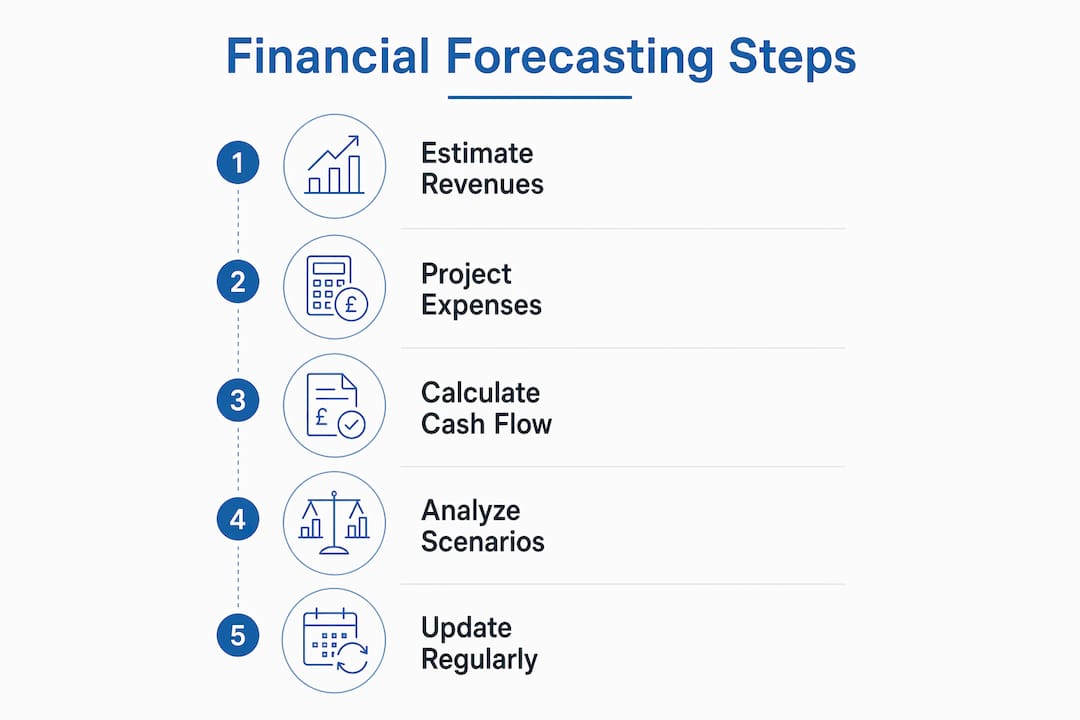
The three main forecast types every business owner should know are:
- Revenue forecasts — projecting expected income based on sales pipelines, pricing, and market conditions
- Expense forecasts — estimating costs including payroll, rent, materials, and overheads
- Cash flow forecasts — tracking when money actually enters and leaves the business, not just when it is earned
Beyond these three, scenario analysis and sensitivity analysis add real depth. Scenario analysis models what happens under different conditions, such as a 20% drop in sales or a new product launch exceeding targets. Forecasting models different scenarios to prepare you for both downturns and unexpected wins. Sensitivity analysis tests how sensitive your outcomes are to a single variable, such as a change in your supplier costs.
Forecasting differs from budgeting in one critical way. A budget is a fixed financial plan for a set period. A forecast is a living estimate that updates as new information arrives. Treating them as the same thing is one of the most common mistakes UK SME owners make.
Pro Tip: Start your forecasting with a simple 13-week cash flow model before building out longer-term projections. It gives you immediate visibility and builds your confidence with the process.
Why does financial forecasting matter for UK small businesses?
Financial forecasting gives business owners the visibility they need to make confident decisions rather than guesses. The importance of financial forecasting becomes clearest when you look at the specific problems it prevents and the opportunities it creates.
Cash flow visibility prevents business failure
A profitable business can still fail if cash inflows and outflows are not timed correctly. Profit on paper does not pay your suppliers or your staff. A cash flow forecast shows you exactly when gaps are likely to appear, giving you time to arrange a credit facility, delay a purchase, or accelerate collections before the shortfall hits.

Informed decisions on hiring and investment
Without a forecast, decisions about taking on a new member of staff or investing in equipment are based on gut feeling. With one, you can model the financial impact before committing. You can see whether your projected revenue covers the additional cost and when you expect to break even on the investment.
Investor and lender confidence
Banks and investors expect to see financial projections. A well-constructed forecast signals that you understand your business model and have thought seriously about its future. For UK tech start-ups seeking SEIS or EIS funding, a credible forecast is not optional. It is a prerequisite.
“Effective forecasting empowers proactive decisions that support long-term goals rather than reactive responses to financial problems. The business owners who forecast consistently are the ones who rarely face genuine financial emergencies.”
Risk mitigation through scenario planning
Forecasting lets you model potential downturns before they happen. If your largest client accounts for 40% of revenue, a scenario analysis showing what happens if you lose that client is not pessimism. It is preparation. You can build contingency plans, diversify your client base, or hold a larger cash reserve based on what the numbers show.
The benefits of budgeting and forecasting together are well documented. Households using budgeting tools report financial stability comparable to non-users earning 50% more income. The same structural principle applies to businesses: financial discipline creates stability that raw revenue alone cannot.
How does ongoing forecasting outperform static budgeting?
Static budgets become outdated the moment market conditions shift. Dynamic forecasting, updated monthly and compared against actual results, keeps your financial picture accurate throughout the year.
The key practice is variance analysis: comparing what you forecast against what actually happened. When your actuals diverge from your projections, that gap tells you something important. Treating forecasting as a dynamic practice and comparing projections with actual results helps you detect drift early rather than discovering a problem in your year-end accounts.
Here is a practical process for keeping forecasts current:
- Update monthly. Replace last month’s projections with actual figures and roll the forecast forward by one month.
- Investigate variances above 10%. Any line item that deviates significantly from forecast deserves a clear explanation.
- Revise assumptions when the business changes. A new contract, a price increase, or a staff departure all affect your projections.
- Run a fresh scenario analysis each quarter. Market conditions change, and your scenarios should reflect current risks.
- Share the forecast with your leadership team. Forecasting works best when it informs decisions across the business, not just in the finance function.
Financial forecasting also creates what researchers describe as financial “friction.” Forecasting creates structural friction that exposes spending trade-offs and prevents silent expense accumulation. When every cost is projected and tracked, unnecessary spending becomes visible. That visibility alone changes behaviour.
Pro Tip: Set a recurring calendar reminder on the first working day of each month to update your cash flow forecast. Consistency matters more than perfection.
Static budgets encourage a dangerous mindset: once the budget is set, the job is done. Dynamic forecasting treats financial planning as a continuous process. The businesses that update their forecasts regularly are the ones that spot problems early enough to act. Those that rely solely on annual budgets often discover issues only when the damage is already done.
What are the common pitfalls in financial forecasting?
Most forecasting errors come from a small set of recurring mistakes. Knowing them in advance saves you significant pain.
- Ignoring inflation and economic cycles. Neglecting inflation in long-term forecasts leads to unrealistic growth targets and potential failure during downturns. A forecast built in a low-inflation environment will overstate real returns if inflation rises.
- Confusing profit with cash. Many business owners forecast revenue and profit but overlook the timing of actual cash receipts. A sale invoiced in march may not be paid until may. That gap can cause a cash crisis even in a profitable month.
- Skipping scenario analysis. Building only a single “base case” forecast leaves you unprepared for disruption. Always model a downside scenario alongside your expected outcome.
- Getting lost in granular detail. Forecasting every minor expense to the penny wastes time. Focus on the metrics that drive your business: revenue, gross margin, payroll, and cash position.
- Treating the first forecast as final. A forecast is a working document. Refusing to revise it when circumstances change makes it useless.
Common pitfallPractical fixIgnoring inflationApply a realistic inflation rate to cost lines each yearProfit versus cash confusionBuild a separate cash flow forecast alongside your P&LNo scenario analysisCreate a base case, an upside case, and a downside caseOver-detailed forecastingFocus on five to eight key financial driversStatic, never-revised forecastSchedule monthly reviews and update assumptions regularly
The good news is that none of these pitfalls require advanced financial expertise to fix. Starting with manageable scopes like cash flow analysis prevents the feeling of being overwhelmed and builds comprehensive forecasting skills gradually.
How can UK SMEs implement financial forecasting in practice?
Building a forecasting process does not require a finance director or expensive software from day one. It requires a clear starting point and a commitment to consistency.
- Begin with cash flow. A 13-week cash flow forecast is the most practical starting point for any SME. It covers the period where cash risk is highest and is simple enough to build in a spreadsheet.
- Gather your historical data. Pull at least 12 months of bank statements, invoices, and expense records. Historical patterns are the foundation of any reliable projection.
- Set your assumptions explicitly. Write down the assumptions behind each forecast line. If you assume 10% revenue growth, document why. Explicit assumptions make it easier to spot errors and update the model when conditions change.
- Establish a monthly review cadence. Block one hour each month to compare actuals against your forecast, update assumptions, and roll the model forward.
- Use digital tools to reduce manual effort. Cloud accounting platforms like Xero integrate with your bank feeds and generate real-time financial data. Cloud accounting tools reduce the time spent on data entry and improve the accuracy of your inputs.
- Integrate forecasts into decisions. Every significant business decision, from hiring to capital expenditure, should be tested against your current forecast before you commit.
For business owners who want a deeper understanding of the financial forecasting process tailored to SME founders, Priceandaccountants has published a detailed guide covering the full methodology.
Key takeaways
Financial forecasting is the single most effective tool a UK SME owner has for preventing cash crises, making confident decisions, and building a business that grows on purpose rather than by accident.
PointDetailsForecasting prevents cash failureA profitable business can still fail without tracking the timing of cash inflows and outflows.Dynamic beats staticMonthly updates comparing actuals to projections catch problems before they escalate.Scenario analysis is non-negotiableModelling downside cases prepares you for disruption before it arrives.Start small and buildBegin with a 13-week cash flow forecast before expanding to longer-term projections.Inflation must be factored inIgnoring economic cycles produces unrealistic targets and undermines long-term planning.
Forecasting is a mindset, not a spreadsheet
I have worked with dozens of UK SME founders who believed forecasting was something large companies did. They thought their business was too small, too unpredictable, or too early-stage to bother. Almost every one of them changed their view after their first cash flow crisis.
The uncomfortable truth is that most cash flow emergencies are predictable. They show up in the numbers weeks before they arrive in your bank account. The business owners who see them coming are the ones who forecast consistently, not the ones with the most sophisticated models.
What I find most interesting is the cultural shift forecasting creates inside a business. When a team knows that financial targets are tracked monthly and variances are discussed openly, spending decisions change. People start asking whether a cost is in the forecast before they commit to it. That friction is healthy. It is the same principle that makes budgeting and forecasting structurally powerful: visibility changes behaviour.
My honest advice is to stop waiting until your business is “big enough” to forecast. The best time to build the habit is before you need it. A simple cash flow model, updated monthly, will tell you more about the health of your business than any annual report.
— Rahamut
How Priceandaccountants supports your financial planning
Priceandaccountants works with UK tech start-ups and growing SMEs that need more than basic bookkeeping. Financial forecasting sits at the heart of the advisory and tax planning work the team delivers, helping founders build credible projections for investors, lenders, and internal decision-making.
Whether you need help building your first cash flow model, preparing financial projections for an EIS raise, or setting up a monthly management accounts process, the team at Priceandaccountants brings over 40 years of expertise to the task. The accounting services cover everything from bookkeeping and VAT management to outsourced finance director support, giving you the financial clarity to make decisions with confidence. Get in touch to find out how Priceandaccountants can support your forecasting and planning needs.
FAQ
What is financial forecasting in simple terms?
Financial forecasting is the process of estimating future revenues, expenses, and cash flows over a defined period. It gives business owners a forward-looking view of their finances to support better decisions.
How is forecasting different from budgeting?
A budget is a fixed financial plan for a set period, while a forecast is a regularly updated estimate that reflects current conditions. Forecasts are revised as new information arrives; budgets typically are not.
Why is cash flow forecasting particularly important?
A profitable business can fail if cash inflows and outflows are not timed correctly. Cash flow forecasting shows when gaps are likely to appear, giving you time to act before a shortfall becomes a crisis.
How often should a small business update its forecast?
Monthly updates are the standard for most SMEs. Each update should compare actual results against projections, explain significant variances, and roll the forecast forward by one month.
Do I need accounting software to forecast effectively?
Not at the outset. A well-structured spreadsheet is sufficient for a basic cash flow forecast. Cloud accounting platforms like Xero improve accuracy and reduce manual effort as your business grows.
Recommended
- What is financial forecasting: a guide for SME founders - Price & Accountants
- Why Cloud Accounting Matters: Fuelling Growth for SMEs and Start-ups - Price & Accountants
- How to scale business finances: a UK SME guide - Price & Accountants
- Financial reporting best practices for UK SMEs - Price & Accountants