

TL;DR:
- UK small and medium-sized businesses must digitize finance to improve accuracy, reduce costs, and comply with the 2026 e-invoicing mandate. Prioritizing invoice processing, bank reconciliation, approvals, and reporting enables effective phased implementation. Seamless integration and ongoing process review are essential to avoid common challenges and maximize the benefits of digital transformation.
Financial digitisation is the process of replacing manual, paper-based financial workflows with integrated, automated systems that improve accuracy, speed, and regulatory compliance. For UK small and medium-sized businesses, the question of why digitise finance has moved from optional to urgent. 90% of organisations lag in growth and efficiency due to outdated financial technology, spending the equivalent of $30 million annually on legacy system maintenance. That figure represents a direct drag on competitiveness. Add the UK’s mandatory electronic invoicing reform arriving in september 2026, and the case for acting now becomes impossible to ignore.
What are the main benefits of digitising finance for UK SMEs?
The core advantage of financial digitisation is cost reduction through eliminating manual work and legacy system dependency. When your team spends hours re-keying data between disconnected spreadsheets and accounting tools, you pay twice: once in labour, and again in the errors that follow. Digitisation cuts both.

Real-time financial data is the second major gain. Automated dashboards replace the monthly reporting cycle with live visibility into cash flow, outstanding invoices, and expenditure. Business owners make faster, better-grounded decisions when they can see the numbers as they happen rather than two weeks after the fact.
Compliance is the third driver. Automated invoice issuance, electronic transmission, bank reconciliation, and digital approval workflows form the four pillars of effective finance digitalisation. Each pillar reduces the risk of human error that triggers HMRC penalties or audit findings. Staying on top of VAT compliance becomes significantly more manageable when your systems generate accurate records automatically.
The workforce benefit is less discussed but equally real. Finance professionals increasingly see digitalisation as critical for attracting and retaining talent by reducing repetitive tasks and elevating their advisory roles. Staff who spend less time on data entry spend more time on analysis, which improves both output quality and job satisfaction.
Pro Tip: Before selecting any software, list the three manual tasks that consume the most staff hours each month. Those are your first digitisation targets, not the features in a vendor’s brochure.
Finally, the economic opportunity is substantial. Research on modernising financial infrastructure through tokenisation and distributed ledgers points to a $24 billion annual economic opportunity in Australia alone. The global signal is clear: businesses that build digital finance capabilities now position themselves to capture value as payment markets evolve.
How should UK SMEs prioritise finance digitisation projects?
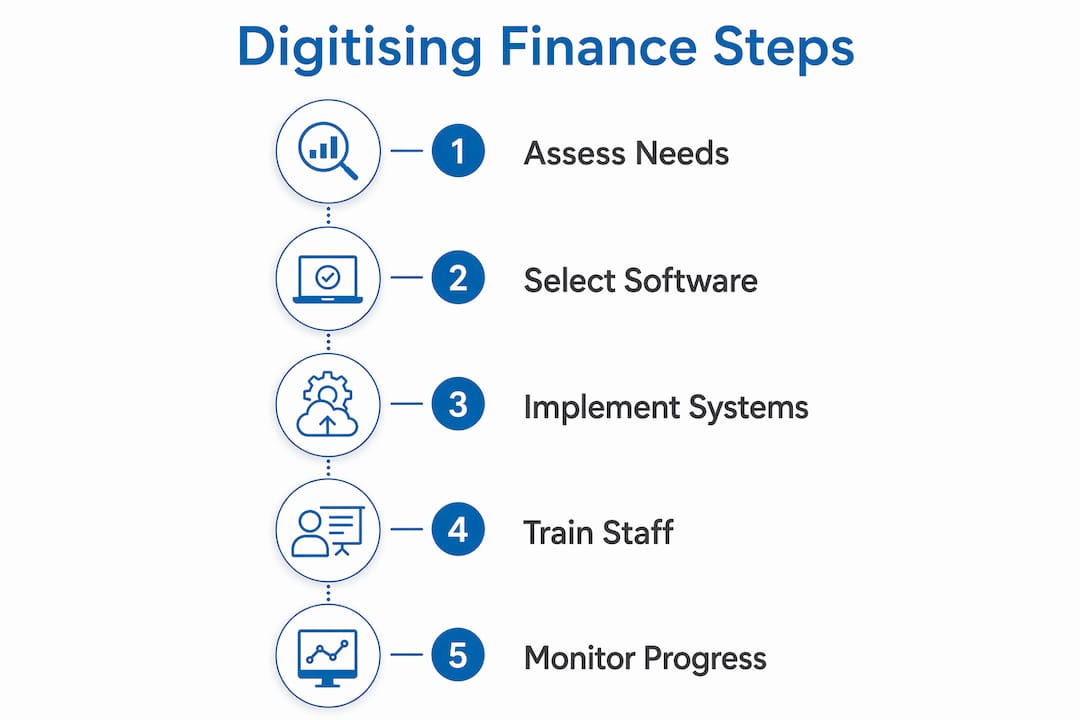
Most SMEs cannot digitise their entire finance function at once. Attempting to do so is one of the most common reasons projects stall. A phased, impact-first approach delivers faster returns and builds internal confidence.
Start by mapping where manual effort and errors are highest. Common friction points include invoice processing, bank reconciliation, expense approvals, and month-end reporting. These four areas generate the most delays and the most mistakes in a typical SME finance function.
A practical prioritisation sequence looks like this:
- Invoice processing. Automate the creation, sending, and receipt of invoices. This single step reduces debtor days and prepares you for the 2026 e-invoicing mandate.
- Bank reconciliation. Connect your accounting platform directly to your bank feeds. Reconciliation that once took half a day becomes a ten-minute review.
- Approval workflows. Replace email chains with structured digital approvals. This creates an audit trail and removes bottlenecks caused by absent approvers.
- Reporting and forecasting. Once the transactional layer is clean, build dashboards that track key performance metrics such as days sales outstanding, close cycle time, and forecast accuracy.
Data governance sits beneath all four steps. You need a single source of truth for financial data, with clear access rights and segregation of duties. Without this foundation, automation simply moves errors faster rather than eliminating them.
Finance transformation fails more often because teams focus on software features rather than the operational gaps those features should close. Define your outcome metrics first. Then select the tool that addresses them.
Pro Tip: Set a target for each project phase before you go live. A 20% reduction in DSO or a two-day shorter close cycle gives you a concrete measure of success and a clear signal if the implementation is off track.
What are the common challenges in digitising finance functions?
The biggest challenge is fragmentation. Many finance organisations appear digitised but still rely on manual interventions because their systems do not talk to each other. Data moves between platforms via spreadsheet exports, which reintroduces the human error the automation was meant to eliminate.
A second challenge is misalignment between technology and business need. Teams get excited by product demonstrations and purchase tools that solve problems they do not actually have. The result is low adoption, wasted budget, and a finance function that is more complicated than before.
“Businesses often fail by prioritising software features over operational friction points. True success comes from eliminating manual data entry and enabling faster decisions.”
Change management is the third hurdle. Finance teams accustomed to existing processes resist new systems, particularly when training is inadequate or the rationale for change is not clearly communicated. Buy-in from the finance team lead is non-negotiable before any implementation begins.
Regulatory risk grows as digitisation expands. Digital finance innovation brings new vulnerabilities, including a global surge in fraud and misuse of financial products, requiring stronger supervisory frameworks. Cyber risk, payment fraud, and data breaches all increase when financial data moves through more digital touchpoints. Every digitisation project needs a parallel review of access controls and fraud prevention measures.
The solution to fragmentation is integration. Successful finance transformation integrates ERP systems with an automation layer that eliminates manual coordination across disconnected workflows. Choosing integrated finance solutions from the outset is far cheaper than retrofitting connections between siloed tools later.
How does the 2026 UK e-invoicing mandate affect SME digitisation plans?
The UK mandatory electronic invoicing reform takes effect on 1 september 2026. It requires businesses to send and receive structured electronic invoices rather than PDF attachments or paper documents. This is not a recommendation. It is a legal requirement, and non-compliance carries enforcement consequences.
For SMEs, the mandate removes any remaining argument for delaying invoice digitisation. Businesses that have already automated their invoicing workflows will meet the standard with minimal adjustment. Those still processing invoices manually face a hard deadline with real penalties attached.
The table below summarises the key compliance requirements and their practical implications:
RequirementWhat it means for your businessStructured electronic invoicesPDFs and paper invoices no longer satisfy the legal standardSending and receiving capabilityYour system must both issue and accept e-invoicesCompliance deadline1 september 2026Audit trailDigital records must be retained and accessible for HMRC reviewIntegration with accounting systemsManual re-entry from e-invoices into your accounts is not compliant
The mandate also accelerates broader digitisation. Once invoice data flows electronically, connecting it to bank reconciliation, VAT reporting, and cash flow forecasting becomes straightforward. The compliance requirement effectively funds the business case for the wider project. Reviewing your HMRC compliance obligations now, rather than in august 2026, gives you time to implement properly rather than scramble.
Key takeaways
Financial digitisation is a compliance necessity from september 2026 and a direct driver of cost reduction, faster decisions, and stronger staff retention for UK SMEs.
PointDetailsStart with friction pointsMap manual tasks causing the most errors before selecting any software.Four core pillarsPrioritise invoicing, bank reconciliation, approvals, and reporting in that order.2026 e-invoicing mandateStructured electronic invoices become legally required from 1 september 2026.Integration over additionConnect systems through a single data layer rather than adding disconnected tools.Measure outcomesTrack DSO, close cycle time, and forecast accuracy to confirm digitisation is working.
The uncomfortable truth about finance digitisation for SMEs
Most SMEs I work with arrive at digitisation conversations the wrong way round. They have already chosen a platform, signed a contract, and are now asking how to make it fit their processes. That sequence almost guarantees a difficult implementation.
The businesses that get this right start with a single question: where does our finance function break down? Not “what software should we buy?” but “where do we lose time, make errors, or miss information?” The answer to that question dictates the technology choice, not the other way around.
The 2026 e-invoicing mandate is actually useful here. It gives SME owners a concrete, non-negotiable deadline that forces the invoicing conversation. Use it as the entry point. Get your invoice workflows digital and compliant, measure the improvement in debtor days and processing time, and then build outward from that foundation.
The other thing I would emphasise is that digitisation is not a project with an end date. Regulations change, business models evolve, and the tools available improve every year. The SMEs that treat this as a continuous programme of improvement, rather than a one-off implementation, consistently outperform those that do not. Build the habit of reviewing your finance technology annually against your current operational needs, and you will stay ahead rather than catch up.
— Rahamut
How Priceandaccountants supports SME finance digitisation
Priceandaccountants works with UK SMEs at every stage of finance digitisation, from initial compliance reviews to full implementation support.

Our strategic advisory and tax planning service helps business owners identify where digitisation delivers the highest return, structure their approach around compliance requirements including the 2026 e-invoicing mandate, and avoid the common pitfall of buying software before defining the problem. With over 40 years of expertise and a client base that includes businesses now valued at over £50m, Priceandaccountants brings practical, tested guidance rather than generic advice. Whether you need help with bookkeeping, VAT management, or acting as your outsourced Finance Director, we are ready to support your next step.
FAQ
What does digitising finance actually mean?
Digitising finance means replacing manual and paper-based financial processes with automated, integrated digital workflows covering invoicing, reconciliation, approvals, and reporting.
When does the UK e-invoicing mandate come into force?
The UK mandatory electronic invoicing reform takes effect on 1 september 2026, requiring businesses to send and receive structured electronic invoices rather than PDFs or paper documents.
What should UK SMEs digitise first?
Start with invoice processing and bank reconciliation. These two areas generate the highest volume of manual errors and deliver the fastest, most measurable efficiency gains.
How do you measure whether finance digitisation is working?
Track days sales outstanding, close cycle time, and forecast accuracy. Improvement in these three metrics confirms that digitisation is reducing delays and improving financial visibility.
What is the biggest risk in digitising finance?
The biggest risk is fragmented implementation, where disconnected tools create new manual steps rather than eliminating them. Building integrated systems from the outset prevents this outcome.