
TL;DR:
- London is Europe’s top startup hub, hosting the highest number of unicorns and raising significant funding. Its deep investor network, extensive talent pool, and dense ecosystem accelerate deal-making and support innovation clusters like the Oxford-Cambridge-London corridor. The city offers platforms, schemes, and infrastructure that foster startup growth across all stages, rewarding founders who actively engage with its networks.
London is Europe’s leading startup hub, home to 138 unicorns and a tech sector that raised $17.8 billion in 2025 alone. For founders weighing where to base their company, the question of why choose London for startups has a clear answer: no other European city combines capital depth, talent density, and ecosystem maturity at this scale. London reclaimed its top position from Paris in 2025, and the momentum has only accelerated into 2026. This guide breaks down exactly what makes London the right base for ambitious founders.
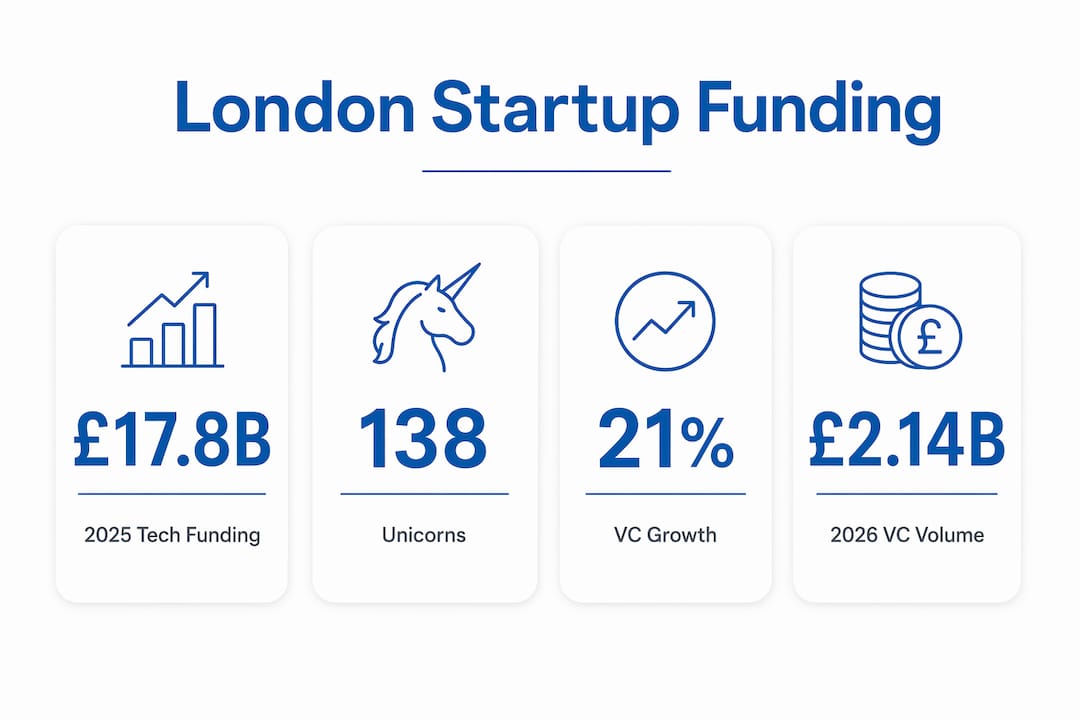
London’s venture capital environment is the strongest in Europe, and the numbers confirm it. VC funding in March 2026 reached £2.14 billion, a 21% year-on-year increase. That growth rate signals sustained investor confidence, not a one-off spike.
The funding ecosystem covers every stage of a startup’s life. Angel investors provide early capital, often through the UK’s tax-efficient Seed Enterprise Investment Scheme (SEIS) and Enterprise Investment Scheme (EIS). These government-backed schemes reduce risk for investors by offering significant income tax relief, which makes angels more willing to back pre-revenue companies. The result is a funding environment that does not force founders into premature VC-style growth targets.
London also hosts a full spectrum of later-stage funds, corporate venture arms, and growth equity firms. Founders can move from a £150,000 SEIS round to a Series A without leaving the city. Understanding your startup tax compliance obligations from day one protects your eligibility for these schemes.
| Funding type | Typical stage | Typical amount |
|---|---|---|
| SEIS angel round | Pre-seed | Up to £250,000 |
| EIS angel or syndicate | Seed | £250,000 to £5 million |
| Series A venture capital | Early growth | £5 million to £20 million |
| Growth equity | Scale-up | £20 million and above |
Pro Tip: Structure your share classes correctly before your first SEIS raise. A poorly structured cap table can disqualify investors from claiming relief, which kills deals before they start. Priceandaccountants specialises in exactly this.
London’s talent pool is the largest in Europe for tech roles. The city employs over 300,000 tech workers, supported by 40 universities including Imperial College London, University College London (UCL), and the London School of Economics (LSE). That academic infrastructure feeds a continuous pipeline of engineers, data scientists, and commercial talent directly into the startup market.

The relationship between London’s universities and its startup scene goes beyond graduate recruitment. Imperial College London runs its own accelerator, and UCL has a dedicated technology transfer office that spins out research into commercial ventures. Founders who tap into these networks gain access to cutting-edge research, co-founders with deep technical expertise, and in some cases, pre-commercialised intellectual property.
London also attracts international talent at a rate few cities match. The city’s diversity means founders can hire product managers, engineers, and sales leads from across Europe, Asia, and North America without relocating. That breadth of perspective directly improves product quality and market fit.
Pro Tip: Approach UCL’s technology transfer office or Imperial’s Enterprise team early. Even if you are not a graduate, these institutions actively seek commercial partners for their research output.
Ecosystem density is the single most underrated advantage London offers. The proximity of investors, advisers, and corporate partners within a handful of postcodes reduces the time and friction involved in closing deals. In less concentrated cities, founders spend weeks arranging introductions that London founders complete over a single lunch in Shoreditch or a morning in Mayfair.
This coordination density has a measurable effect on deal speed. Lawyers, accountants, term sheet advisers, and lead investors often share buildings or neighbourhoods. A founder can meet a VC on Monday, have legal review the term sheet by Wednesday, and sign by Friday. That pace is structurally impossible in cities where the same participants are spread across different regions.
“The density of London’s ecosystem means that the friction between idea and investment is lower than anywhere else in Europe. Investors, lawyers, and operators are all within walking distance of each other, and that proximity compounds over time.” — Quoted in The Standard, 2026
London’s ecosystem maturity and resilience also means the city has survived multiple economic cycles without losing its position. The 2008 financial crisis, Brexit uncertainty, and the pandemic all tested London’s startup environment. Each time, the city recovered faster than its European peers. That resilience is not accidental. It reflects the depth of the networks and the diversity of the capital base.
Understanding how tax compliance fuels growth is part of operating effectively within this ecosystem. Investors and corporate partners expect founders to have clean books and compliant structures before they engage seriously.
London does not operate in isolation. The Oxford-Cambridge-London corridor forms one of the most powerful innovation clusters in the world. Oxford brings deep scientific research, particularly in life sciences and quantum computing. Cambridge contributes world-class engineering talent and a dense cluster of deep-tech spinouts. London adds scale, investor depth, and international market access.
The three cities are connected by rail, with journey times under an hour between each. That physical proximity means a founder can base their company in London while drawing on research partnerships in Oxford or hiring from Cambridge’s graduate pool. The corridor functions as a single extended ecosystem rather than three competing hubs.
| City | Core strength | What it adds to the corridor |
|---|---|---|
| Oxford | Life sciences, quantum research | Scientific IP and research talent |
| Cambridge | Engineering, deep tech | Technical spinouts and specialist graduates |
| London | Capital, market access, scale | Investor networks and global visibility |
London’s regulatory fabric and technical foundations make it the natural commercial anchor for companies that originate in Oxford or Cambridge. Research-led companies that begin in university labs typically relocate their commercial operations to London once they reach the fundraising stage. The city’s investor community, legal infrastructure, and international connectivity make that transition straightforward.
The AI sector illustrates this dynamic clearly. London led European AI investment with $7 billion in 2025. Many of those companies draw on research from Oxford and Cambridge but operate commercially from London. For founders building in AI or fintech, the corridor is a genuine structural advantage.
London’s combination of capital depth, talent density, ecosystem proximity, and corridor positioning makes it the strongest startup environment in Europe for founders with global ambitions.
| Point | Details |
|---|---|
| Funding volume | London VC funding reached £2.14 billion in March 2026, growing 21% year on year. |
| Tax-efficient investment | SEIS and EIS schemes attract angel investors by reducing their risk through government tax relief. |
| Talent supply | Over 300,000 tech workers and 40 universities create a deep, continuous talent pipeline. |
| Ecosystem density | Investors, lawyers, and advisers concentrated in few postcodes accelerate deal timelines significantly. |
| Innovation corridor | The Oxford-Cambridge-London cluster combines research excellence, technical talent, and capital access. |
I have worked with founders who chose London for the numbers and stayed for something harder to quantify. The city’s ecosystem has a compounding quality that other hubs lack. Every introduction leads to three more. Every investor meeting surfaces a potential hire or a corporate partner. That network effect is real, and it builds faster in London than anywhere else I have seen.
What the data on unicorns and VC volumes does not show is how the ecosystem handles failure. London founders who have had a company fold are not written off. The community treats failure as experience, which means second-time founders get meetings faster and raise on better terms. That cultural tolerance for iteration is a genuine competitive advantage.
The one honest caveat: London’s cost base is high. Office space, salaries, and living costs are significant. Founders who treat London as a pure operational base without using its networks are paying a premium for nothing. The city rewards those who engage with it. Attend the events, use the university networks, and get in front of investors early. The advantages of startups in London are real, but they are not passive. You have to activate them.
For founders considering London as a base, my advice is straightforward. Set up your structure correctly from the start, get your SEIS eligibility confirmed before you raise, and build your network before you need it. The city will do the rest.
— Rahamut
London’s funding environment rewards founders who have their financial and compliance structures in order before they raise. Priceandaccountants works with tech and fintech startups from pre-seed through Series A, managing SEIS and EIS compliance, R&D tax credit claims, and year-end accounts.

Priceandaccountants has supported over 20 startups through the full setup and growth process, with several now valued above £50 million. The firm’s accounting services for startups cover everything from company formation to cloud bookkeeping on Xero and outsourced finance director support. For founders who want to reclaim capital through innovation, the firm’s R&D tax credit advisory identifies claims that generalist accountants routinely miss. Getting the financial foundations right is not a back-office task. It is what keeps your funding rounds on track.
London raised $17.8 billion in tech funding in 2025 and hosts 138 unicorns, more than any other European city. Its combination of capital depth, talent supply, and ecosystem density gives it a structural lead over Paris, Berlin, and Stockholm.
SEIS allows angel investors to claim up to 50% income tax relief on investments up to £200,000 per company. This significantly lowers investor risk and makes it easier for pre-revenue London startups to raise their first round.
No, but proximity accelerates results. Founders based in Oxford or Cambridge regularly access London’s investor networks, and many relocate their commercial operations to London once they begin fundraising seriously.
AI and fintech lead London’s investment activity. London attracted $7 billion in AI investment in 2025, and its fintech sector remains the largest in Europe by both deal volume and total capital raised.
Overseas founders can incorporate a UK limited company through Companies House, often within 24 hours. Priceandaccountants provides a full UK company setup guide covering structure, tax registration, and compliance requirements for international founders.