
A SEIS compliance statement (form SEIS1) is the mandatory company declaration that tells HMRC you have met the qualifying conditions, authorising it to issue SEIS3 certificates so your investors can claim their SEIS tax relief. Without a correctly submitted SEIS1, no investor receives a certificate, and no relief is claimed.
Three things to do right now:
The SEIS1 form is available on HMRC’s forms repository, and you submit it through HMRC’s online submission service. Both links are the starting point for every SEIS1 submission.
Submitting an accurate SEIS1 on time is the single action that protects your investors’ tax relief and your company’s credibility across the three-year compliance period.
| Point | Details |
|---|---|
| Two submission triggers | Submit SEIS1 after four months of qualifying trade or after spending a substantial portion (70%) of funds raised, whichever comes first. |
| Authorised submitter only | Only a director, company secretary, or properly authorised agent may sign and submit; an unauthorised submission is returned unread. |
| Accuracy protects investors | Every SEIS1 field feeds directly into SEIS3 certificates; a wrong issue date or subscriber detail can cause an investor’s relief claim to fail. |
| 60-day notification rule | Report any disqualifying event to HMRC within 60 days of it occurring throughout the three-year compliance window. |
| Priceandaccountants | Price & Accountants acts as authorised HMRC agent for SEIS1 submissions and ongoing three-year compliance monitoring for UK tech founders. |
Timing is one of the most misunderstood parts of the process. You cannot submit the SEIS1 the moment shares are issued. HMRC’s VCM35040 sets out two permitted triggers, and you need to have met at least one of them:
Whichever trigger you reach first is the one you use.
Once a trigger is met, the practical timeline looks like this:
A short example: a company issues shares on 1 March 2026 and begins qualifying trade on the same day. By 1 July 2026 the four-month test is met. The founder submits SEIS1 in July. HMRC typically responds within four to six weeks, though complex cases take longer. Investors receive their SEIS3 certificates in September and can claim relief when they file their self-assessment return.
One important point: receiving HMRC advance assurance before the share issue does not remove the requirement to submit SEIS1. Advance assurance is an advisory opinion only. The SEIS1 is the formal statutory submission that actually secures the SEIS3 certificates.
Track spend against each specific share issue, not the total funds in the bank.*
Only three categories of person may sign and submit the SEIS1:
If anyone outside these categories submits the form, HMRC will return it without processing it. That delay can push investors’ relief claims into a later tax year, which is a real problem if they were counting on the relief for a specific return.
Using an agent is common and sensible for most founders, but HMRC requires a signed authorisation letter from the company before it will accept an agent’s submission. Per VCM35030, that letter must:
A practical checklist for agent authorisation:
The risk of getting this wrong is not just administrative. An unauthorised submission means HMRC cannot process the SEIS1, investors cannot claim relief, and you may need to restart the process entirely while investors wait.
Every field on the SEIS1 feeds directly into the SEIS3 certificates your investors will use to claim relief. HMRC’s VCM35050 is explicit: inaccurate or misleading information on the SEIS1 is the most common cause of delays to investor claims. The table below maps the key fields to why they matter.
| SEIS1 field | Why it matters for SEIS3 and investor claims |
|---|---|
| Share issue date | Must match the date on the share certificate; a mismatch is the single most common cause of failed investor claims |
| Share class | Each class issued on the same day requires a separate SEIS1; grouping classes together invalidates the submission |
| Subscriber details (name, address) | Reproduced on the SEIS3; any error means the investor’s certificate does not match HMRC records |
| Amount subscribed per investor | Sets the maximum relief each investor can claim; understating it costs them money |
| Qualifying trade description | Must accurately describe the trade being carried on; vague descriptions attract HMRC queries |
| Gross assets statement | Confirms the company met the gross assets threshold at the time of issue |
| Employee numbers | Confirms fewer than 25 full-time equivalent employees at the time of issue |
| UIR (once issued) | Transferred from HMRC’s authorisation letter onto each SEIS3; without it the certificate is incomplete |
Common errors that cause downstream SEIS3 problems:
Pro Tip: Before submitting, cross-reference every subscriber entry against the company’s statutory register of members and the investor’s own confirmation of their name and address. A five-minute check at this stage saves weeks of rework later. Assign one person — ideally the company secretary or your accountant — as the sign-off owner for this cross-check.
Once HMRC is satisfied with the SEIS1, it sends the company a Unique Investment Reference and a set of blank SEIS3 certificates. The gov.uk guidance sets out the sequence clearly. Here is what you do with them:
What investors do with the SEIS3: they enter the details on their self-assessment return, attaching the certificate as evidence. HMRC may ask to see the original, so investors should keep it safe.
The obligation does not end when certificates are issued. SEIS compliance is a three-year continuing requirement. Your company must remain eligible from the date of share issue through to the third anniversary. HMRC requires you to notify it within 60 days of any event that would make the compliance statement invalid, such as a change of trade, a disqualifying disposal, or a breach of the gross assets or employee conditions. Missing that 60-day window can result in investors losing relief they have already claimed, which creates both a financial and a reputational problem for the company.
HMRC does query SEIS1 submissions, particularly where the qualifying trade description is vague, the share issue date appears inconsistent with Companies House records, or the gross assets figure is close to the threshold. When a query arrives, work through these steps in order:
Documents HMRC commonly requests during a query or audit:
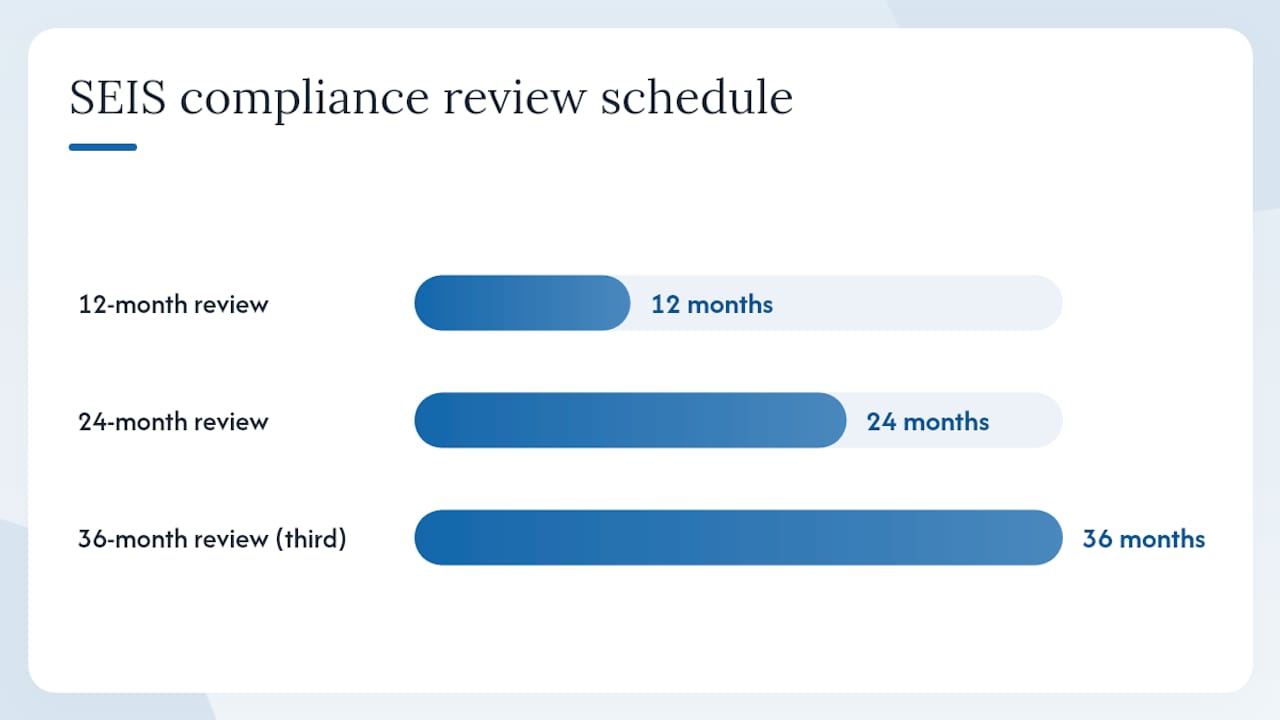
The three-year window is where ongoing risk sits. Events that can retrospectively invalidate relief include a change of qualifying trade, the company receiving a disqualifying investment, a share buyback, or the company ceasing to be a qualifying company. Build a simple monitoring calendar: note the third anniversary of each share issue date and schedule a compliance review at the 12-month and 24-month marks. For a broader view of how compliance obligations fit into your company’s overall obligations, the startup compliance process guide covers the wider picture.
Most founders submit SEIS1 once or twice in the life of their company. An accountant who handles SEIS regularly will have seen the edge cases: the share class that needs a separate statement, the trade description that triggers a query, the investor whose address changed between subscription and certificate issuance. That pattern recognition is worth paying for.
Discrete services a specialist accountant provides for SEIS compliance:
Typical deliverables from a SEIS1 engagement include a completed SEIS1 submission pack, an evidence schedule cross-referenced to the SEIS1 fields, and a set of completed SEIS3 certificate templates ready to send to investors. Some firms also provide an ongoing compliance monitoring retainer covering the three-year period.
Fee structures vary. A flat fee for a straightforward SEIS1 submission is common for single-tranche raises with a small number of investors. A retainer model suits companies with multiple tranches, complex share structures, or ongoing monitoring needs across the three-year window. For SEIS/EIS accounting guidance that covers the cap table and accounting treatment alongside the compliance process, that resource is worth reading before you engage an adviser.
Before contacting an accountant, prepare the following to keep the scope tight and fees predictable:
The conventional wisdom is that SEIS1 is an administrative formality you deal with after the raise. That framing causes most of the problems.
By the time a founder submits SEIS1, investors have often already told their accountants to expect the certificates. When certificates arrive late, or contain errors that require correction, the investor’s accountant has to reopen a completed tax return or file an amendment. That is a cost the investor bears, and it creates friction that damages the relationship between founder and investor at exactly the moment when goodwill matters most — when you are about to go back to the same people for a follow-on round.
The fix is not complicated. Assign a single sign-off owner for the SEIS1 before the share issue closes, not after. That person cross-checks every subscriber entry against the statutory register, confirms the issue date against the Companies House allotment filing, and holds the evidence file from day one. The VCM35020 internal manual notes that incorrect issue dates are a recurring cause of failed investor claims — a detail that is entirely preventable with a five-minute check at allotment.
Founders who treat SEIS1 as a post-raise admin task also tend to underestimate the three-year obligation. The HMRC guidance is clear: a disqualifying event must be reported within 60 days. Missing that window does not just affect the company; it can strip relief from investors who have already claimed it and spent the money. That is the kind of outcome that ends investor relationships permanently.
SEIS1 errors cost investors their tax relief and cost founders their investor relationships. Price & Accountants acts as your authorised HMRC agent for SEIS1 submissions, manages the entire compliance process, and monitors your three-year obligation so nothing slips through.

The service covers SEIS1 form completion and submission, SEIS3 certificate preparation once the UIR is received, cap table and share register review, evidence file maintenance, and ongoing monitoring across the three-year compliance window. Before engaging, prepare your cap table, bank statements, board minutes, and a brief description of how funds have been spent on the qualifying trade.
Price & Accountants has supported over 20 UK tech startups through the SEIS process, several now valued at over £50m. To get started, visit the accounting services page or contact the team directly to discuss your share issue and compliance timeline.
The following official resources cover the rules, forms, and submission channels referenced throughout this article:
This article is general information, not a substitute for advice from a qualified financial advisor. Consult a qualified financial professional about your own circumstances before acting on anything here.