
TL;DR:
- Startup advisory involves providing experienced strategic guidance to early-stage companies, helping founders make informed decisions on fundraising and growth. Engaged at the right stage, advisors improve profitability, reduce failure risk, and offer valuable industry insights through structured, contractual relationships. Unlike mentors or investors, advisors hold no legal authority but deliver targeted expertise, network access, and pattern recognition to support sustainable startup success.
Startup advisory is the provision of expert strategic guidance to early-stage companies by experienced professionals who help founders make informed decisions on fundraising, compliance, and scaling. The industry term is “advisory board engagement,” though “startup advisory” is now widely used to describe the full range of structured support services available to founders. According to Carta, advisors offer three core benefits: strategic business advice, industry connections, and specialist domain knowledge across fundraising, marketing, and technology. With over 70% of startups failing due to premature scaling or lack of founder experience, structured advisory support is one of the most direct ways to reduce that risk.
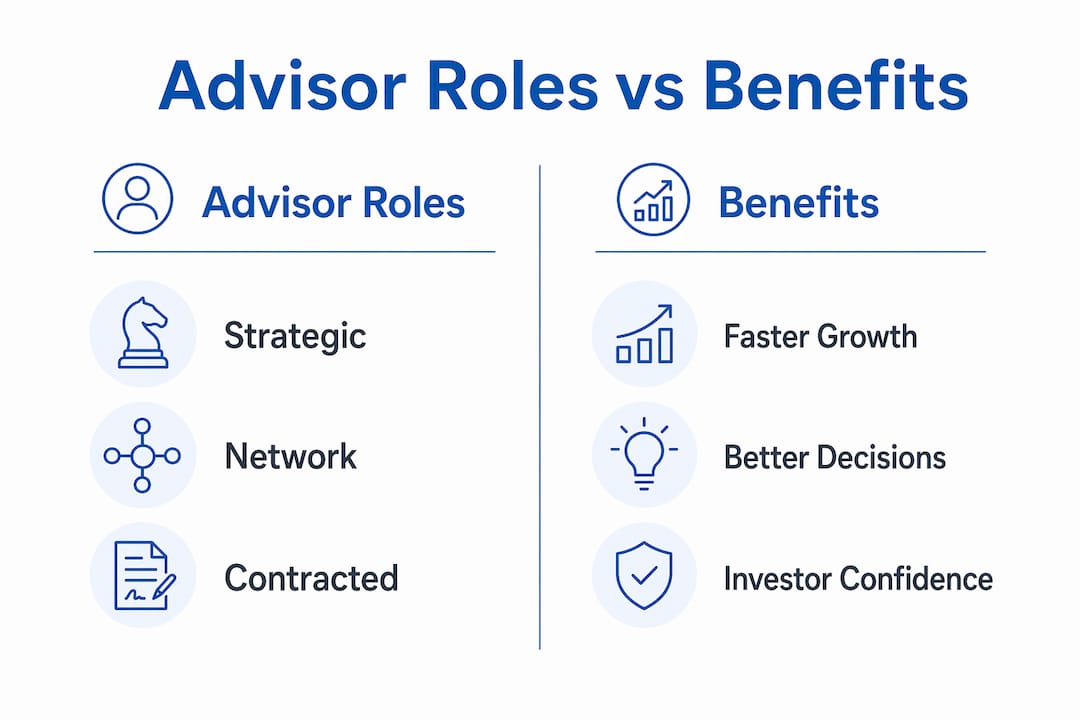
Startup advisory services cover a wide range of functions, and the specific role an advisor plays depends on your business stage and the gaps in your founding team. At its core, an advisor provides three types of value: strategic direction, domain expertise, and network access.

Strategic guidance covers decisions about your business model, fundraising approach, market entry, and compliance obligations. A finance-focused advisor, for example, might help you structure your SEIS or EIS share allocation before approaching angel investors. A go-to-market advisor might challenge your pricing assumptions before you commit to a launch strategy.
Domain expertise fills knowledge gaps the founding team does not have. Common specialist areas include:
Network introductions are often the most immediately valuable contribution. A well-connected advisor can open doors to investors, potential customers, or strategic partners that would take you months to reach independently.
Advisory boards typically consist of 3–7 members, each committing 2–8 hours per month over a 12–24 month engagement. That is a relatively modest time commitment, which is why advisors can serve multiple startups simultaneously.
Pro Tip: Before approaching any advisor, write down the three specific decisions you need help making in the next six months. If an advisor’s background does not map directly to those decisions, they are the wrong fit regardless of their reputation.
The benefits of startup advisory are not abstract. Startups with structured advisory programmes achieve median profits over twice as high and up to 24% higher sales compared to those without. That is not a marginal improvement. It represents the difference between a business that survives its first three years and one that does not.
The productivity gains are equally significant. The same data shows an 18% higher productivity rate among advised startups. Higher productivity at an early stage compounds quickly, because every efficiency gain frees up founder time for higher-value decisions.
“The primary value of advisors is pattern recognition — predicting problems based on experience rather than tactical execution.” — Connectd
This insight matters more than most founders realise. You are not paying an advisor to do work. You are paying them to have seen your situation before and to tell you what happens next. That kind of foresight is impossible to replicate through research alone.
The table below compares key outcomes for startups with and without advisory programmes:
| Metric | Startups With Advisory | Startups Without Advisory |
|---|---|---|
| Median profit level | Over 2x higher | Baseline |
| Sales growth | Up to 24% higher | Baseline |
| Productivity | Up to 18% higher | Baseline |
| Failure risk (premature scaling) | Significantly reduced | Over 70% failure rate |
Pro Tip: When pitching to investors, a credible advisory board signals that experienced operators have already stress-tested your model. Investors treat a strong advisory board as a form of third-party validation.
The qualitative benefits are equally compelling. Advisors act as objective outsiders who counterbalance founder tunnel vision. When you have spent two years building a product, it becomes very difficult to see its weaknesses clearly. An advisor with no emotional stake in your decisions will tell you what a customer or investor will think before you find out the hard way.
Founders frequently confuse advisory boards with other forms of external support. The distinctions matter because each relationship carries different expectations, compensation structures, and levels of authority.
| Role | Formal Agreement | Compensation | Authority | Time Horizon |
|---|---|---|---|---|
| Advisor | Yes, written contract | Equity and/or cash | Non-binding advice | 12–24 months |
| Mentor | No, informal | Unpaid | Informal guidance | Open-ended |
| Consultant | Yes, project-based | Cash fees | Deliverable-focused | Project duration |
| Investor | Yes, investment terms | Equity stake | Voting rights (often) | Long-term |
| Board Director | Yes, formal appointment | Fees or equity | Fiduciary, voting rights | Long-term |
Advisory boards carry no fiduciary duties and have no legal voting rights. This is a fundamental difference from a board of directors. An advisory board cannot override a founder’s decision. It can only advise, challenge, and introduce. That lack of formal authority is actually a feature, not a limitation. It means you can have frank conversations without the political dynamics that come with governance boards.
Advisors have formal written contracts and receive compensation in equity or cash. Mentors, by contrast, provide informal and unpaid guidance. A mentor might meet you for coffee once a month and share their experience. An advisor has a defined scope of work, agreed deliverables, and a stake in your success.
Consultants sit in a different category entirely. They are hired for a specific project, paid in cash, and disengage when the project ends. They bring execution capability rather than ongoing strategic accountability. If you need someone to build your financial model, hire a consultant. If you need someone to challenge your fundraising strategy over the next 18 months, engage an advisor.
Understanding these distinctions also protects you legally. For founders navigating corporate governance frameworks across multiple jurisdictions, the non-fiduciary status of advisors simplifies compliance considerably.
Timing matters as much as selection. Effective advisory relationships begin when founders reach identifiable strategic challenges, such as a fundraising milestone or a scaling decision, not at company inception. Bringing advisors in too early, before you have product-market fit or a clear direction, often results in wasted equity and unfocused conversations.
Here is a practical process for building your advisory board:
J.P. Morgan’s guidance on advisory boards is direct on this point: avoid vanity boards. An advisor with a prestigious title who never engages with your actual problems is worse than no advisor at all. The equity you grant them is real, even if their contribution is not.
Written contracts with clear responsibilities are the single most effective way to prevent ghost advisors. A ghost advisor is someone who accepts equity, attends the first meeting, and then becomes unreachable. Without a contract specifying deliverables and hours, you have no recourse. With one, you have a vesting cliff and a clear basis for ending the relationship.
Pro Tip: Use a standard FAST Agreement (Founder/Advisor Standard Template) as your starting point. It is widely recognised in the UK startup ecosystem and covers equity, time commitments, and IP ownership in a single document.
For UK tech founders, SEIS and EIS compliance is one area where specialist advisory support pays for itself immediately. Getting your share structure wrong before a funding round can disqualify investors from claiming tax relief, which kills deals.
Startup advisory delivers measurable commercial outcomes when founders engage the right advisors at the right stage with clear written agreements.
| Point | Details |
|---|---|
| Define advisory clearly | Startup advisory is structured, contracted guidance from experienced professionals, not informal mentoring. |
| Measurable impact | Advised startups achieve median profits over twice as high and up to 24% higher sales than those without. |
| Distinct from other roles | Advisors hold no fiduciary duties or voting rights, separating them from board directors and investors. |
| Timing is critical | Engage advisors only after identifying a specific strategic gap, not at company inception. |
| Contracts prevent waste | Written agreements with defined deliverables and vesting schedules protect founders from ghost advisors. |
Most founders I speak with approach advisory boards the wrong way. They think about prestige first and fit second. They want a name that impresses investors on a pitch deck, so they recruit someone with a big title and a thin connection to their actual business. The equity gets issued, the first meeting goes well, and then nothing happens.
The advisors who genuinely move the needle are rarely the most famous ones. They are the people who have solved your specific problem before, who will pick up the phone when you are about to make a costly mistake, and who have a direct line to the two or three people you actually need to meet. That kind of advisor is harder to find and less impressive on paper. They are also worth ten times more.
The pattern recognition point from Connectd is the most underrated insight in this space. You are not hiring an advisor for their opinions. You are hiring them for their ability to say, “I have seen this exact situation three times, and here is what happens next.” That is not something you can get from a consultant, a mentor, or a Google search.
My practical advice: before you issue a single share to an advisor, ask them to describe a specific situation where they helped a founder avoid a serious mistake. If they cannot give you a concrete answer, they are not the right person. The best advisors have war stories. They have been in the room when things went wrong, and they know exactly how to stop you from ending up there.
— Rahamut
Priceandaccountants works with UK tech and fintech founders who need more than a standard accountant. From pre-seed to Series A, the team acts as an outsourced Finance Director, providing high-level decision support on funding structures, tax planning, and compliance.

If you are building your advisory board and need specialist financial guidance alongside it, Priceandaccountants offers tailored startup support that covers SEIS and EIS structuring, R&D tax credits, and strategic advisory and tax planning for founders at every growth stage. Having supported over 20 startups, some now valued at over £50m, the team understands what founders actually need at each stage of growth. Get in touch to find out how Priceandaccountants can support your next funding round or scaling decision.
Startup advisory is a structured arrangement where experienced professionals provide strategic guidance to founders on fundraising, compliance, and growth decisions. Advisors are formally contracted and typically compensated with equity or cash.
Advisory boards typically consist of 3–7 members, each committing 2–8 hours per month. Fewer members with highly relevant expertise outperforms a larger board of generalists.
Advisors have formal written contracts and receive equity or cash compensation. Mentors provide informal, unpaid guidance with no defined deliverables or legal agreement.
Founders should engage advisors after identifying a specific strategic gap, such as a fundraising milestone or a scaling challenge, rather than at company inception. Bringing advisors in too early often results in wasted equity.
No. Advisory boards have no fiduciary duties and no voting rights. Their role is to provide non-binding strategic advice, which means founders retain full decision-making authority.