

TL;DR:
- Financial reporting transforms raw accounting data into standard financial statements that indicate a company’s health.
- It underpins tax compliance, attracts investors, and guides major business decisions, especially for UK SMEs.
Financial reporting is defined as the structured process of recording, analysing, and disclosing a company’s financial data to internal and external stakeholders through standardised statements. For UK small and medium business owners, understanding what is financial reporting is not optional. It underpins tax compliance, investor relations, and every significant business decision you make. The core output is three statements: the Income Statement, the Balance Sheet, and the Statement of Cash Flows. These are governed by International Financial Reporting Standards (IFRS), the principle-based framework adopted across 169 jurisdictions, including the UK.
What are the main financial statements in financial reporting?

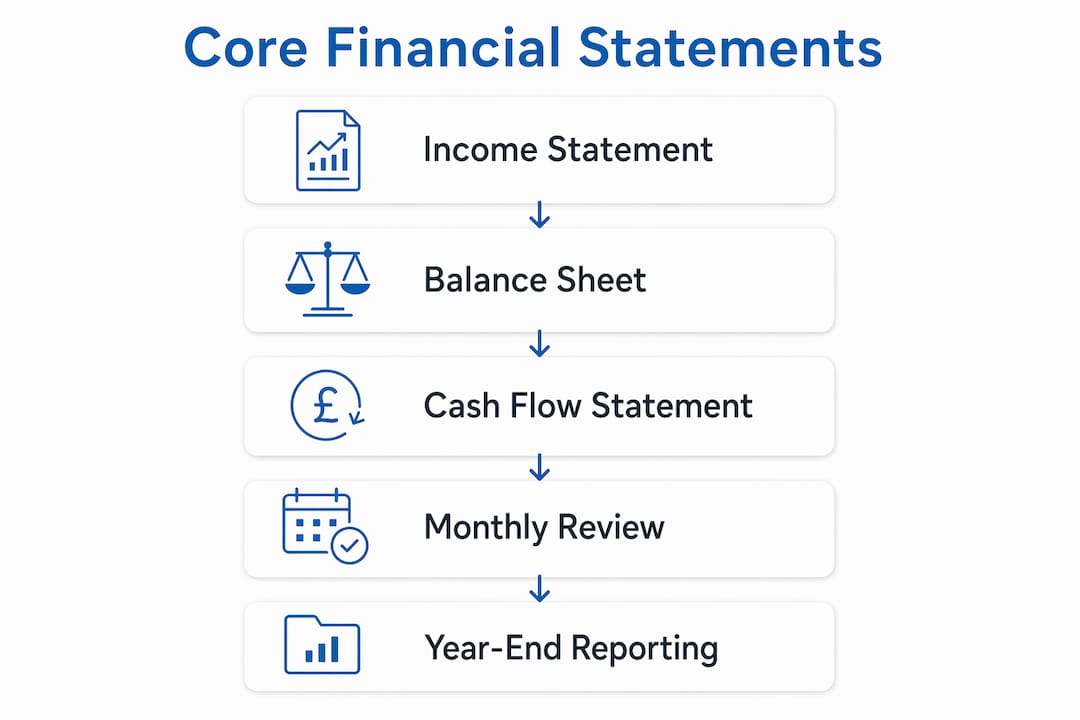
The three core financial statements each answer a different question about your business. Together, they give a complete picture of financial health to lenders, investors, and regulators.
StatementPrimary question answeredKey elementsIncome StatementIs the business profitable?Revenue, expenses, net profit or lossBalance SheetWhat does the business own and owe?Assets, liabilities, shareholders’ equityCash Flow StatementIs cash moving in the right direction?Operating, investing, and financing cash flows
The Income Statement shows sales, expenses, and profit for a defined period. It tells you whether your trading activity is generating a surplus or burning through capital. A tech startup reporting £500,000 in revenue but £700,000 in operating costs is loss-making, and the Income Statement makes that visible immediately.
The Balance Sheet captures a single moment in time. It lists everything your business owns (assets) against everything it owes (liabilities), with the difference representing equity. A healthy Balance Sheet shows assets comfortably exceeding liabilities. When a founder applies for a bank loan, the lender will scrutinise this statement first.
The Statement of Cash Flows is the most underrated of the three. A business can show profit on its Income Statement and still run out of cash if customers pay slowly or stock sits unsold. This statement tracks actual cash movements across operating, investing, and financing activities, giving you early warning of liquidity risks before they affect operations.
Pro Tip: Review your Cash Flow Statement monthly, not just at year end. Cash shortfalls rarely appear overnight. Monthly monitoring gives you time to act before a problem becomes a crisis.
You can explore the meaning of each document in more detail through the key financial statements glossary at Priceandaccountants.
What financial reporting standards apply to UK businesses?
IFRS is the global accounting framework adopted in 169 jurisdictions, including all EU nations and the UK. It is principle-based, meaning it focuses on the intent behind a transaction rather than prescribing rigid rules for every scenario. That flexibility suits growing businesses but also demands sound professional judgement.
UK businesses listed on a recognised stock exchange must use full IFRS. Smaller private companies often apply UK GAAP (Generally Accepted Accounting Practice), which is built on FRS 102, the Financial Reporting Standard applicable in the UK and Republic of Ireland. FRS 102 is broadly aligned with IFRS but includes simplifications suited to smaller entities.
FrameworkWho it applies toKey characteristicFull IFRSUK-listed and large public interest entitiesPrinciple-based, internationally comparableUK GAAP (FRS 102)Private UK companies and SMEsSimplified IFRS-aligned rulesFRS 105Micro-entities (turnover below £632,000)Minimal disclosure requirements
The 2026 IFRS Accounting Standards editions include amendments effective from 1 january 2026 relating to financial instruments and management commentary. These updates affect how businesses classify certain assets and how they present narrative information alongside their numbers. If your business is growing toward a funding round or international expansion, aligning with full IFRS now avoids a costly restatement later.
Consistent application of accounting policies is what makes your reports comparable year on year. Changing how you recognise revenue or value stock mid-year distorts trends and raises red flags with auditors and investors alike.
Pro Tip: Subscribe to the IFRS Foundation’s update alerts at ifrs.org. Standards amendments are announced months before their effective date, giving you time to adjust your reporting policies without last-minute scrambling.
Why is financial reporting important for UK SMEs?
Financial reporting serves a purpose well beyond satisfying HMRC. High-quality reports are essential for scaling companies seeking funding rounds beyond pre-seed. Investors at Series A and beyond require detailed evidence of financial health, not just a summary of last year’s turnover.
The practical benefits for UK small and medium business owners include:
- Tax and legal compliance. Accurate annual accounts form the basis of your Corporation Tax return. Errors in your financial statements translate directly into errors in your tax filing.
- Data-driven decisions. Knowing your gross margin by product line or your cost per acquisition by channel requires reliable financial data. Reports make that data visible and comparable.
- Fundraising and loan applications. Banks and investors use key ratios such as debt-to-asset and liquidity ratios to assess risk. Clean, well-prepared reports accelerate due diligence.
- Identifying problems early. A declining current ratio or rising debtor days are visible in your reports before they become crises in your bank account.
- Building credibility. Consistent, professionally prepared reports signal to partners, suppliers, and acquirers that your business is well managed.
A common mistake founders make is assuming financial reports exist only for tax compliance, ignoring their role in funding and strategy. That assumption costs businesses real money when they arrive at a funding conversation without the financial narrative investors expect.
For a forward-looking view of how reporting practices are shifting, the accounting trends for 2026 guide from Priceandaccountants covers the key changes affecting UK businesses this year.
How does financial reporting differ from bookkeeping and accounting?
Bookkeeping logs transactions daily; financial reporting synthesises that data into standardised statements for strategic use and external communication. The distinction matters because many founders conflate the two and underinvest in reporting as a result.
Bookkeeping is the foundation. It records every invoice, payment, payroll run, and bank transaction. Accounting takes that raw data and applies judgement: accruals, depreciation, tax provisions, and period-end adjustments. Financial reporting is the final layer. It packages the output of accounting into structured statements that communicate financial position to people outside your business.
Think of it this way. Bookkeeping is the daily log of what happened. Accounting is the interpretation of what it means. Financial reporting is the story you tell to the outside world, backed by numbers. Each layer depends on the one beneath it. Weak bookkeeping produces unreliable accounts, and unreliable accounts produce misleading reports.
For small business owners, the practical implication is clear. You need all three processes working well, not just the one your accountant handles at year end. Monthly management accounts, prepared from clean bookkeeping records, give you the reporting cadence that serious investors and lenders expect.
Pro Tip: Use cloud accounting software such as Xero to keep your bookkeeping current throughout the year. Real-time data means your reports reflect today’s position, not last quarter’s.
What are best practices for preparing effective financial reports?
Effective financial reporting follows a consistent cycle. Most UK SMEs benefit from monthly management accounts, quarterly reviews against budget, and annual statutory accounts. Each serves a different audience and a different purpose.
- Set a consistent reporting calendar. Choose your accounting period and stick to it. Changing your year end or reporting frequency mid-growth creates gaps that confuse investors and complicate tax filings. The accounting period you select affects everything from VAT returns to Corporation Tax deadlines.
- Apply accounting policies consistently. Revenue recognition, depreciation methods, and stock valuation must follow the same rules each period. Consistency is what makes year-on-year comparisons meaningful.
- Use technology to reduce manual error. Cloud accounting transforms reporting from a static, once-a-year exercise into a near real-time process. Dashboards reveal revenue patterns and cost inefficiencies as they emerge, not months later.
- Write clear management commentary. Numbers alone do not tell the full story. A brief narrative explaining why revenue dipped in march or why headcount costs rose in Q3 gives context that ratios cannot. Effective reports avoid excess jargon, focusing on what matters for evaluating dividend capacity, loan repayment, and cash flow resilience.
- Prepare for audit readiness from day one. Keep supporting documentation for every material transaction. If your business grows to the point where a statutory audit is required, having clean records from the start saves significant time and cost.
- Avoid common pitfalls. The most frequent errors are mixing personal and business expenses, failing to reconcile bank accounts monthly, and leaving VAT adjustments to year end. Each creates distortions that undermine the reliability of your reports.
For businesses preparing to scale, the financial reporting guide for scale-ups at Priceandaccountants covers the specific reporting requirements that apply as your business grows.
Pro Tip: Ask your accountant to produce a one-page KPI dashboard alongside your monthly management accounts. Tracking three to five metrics consistently is more useful than reading twenty pages of figures once a quarter.
Key takeaways
Financial reporting is the structured process of turning accounting data into standardised statements that communicate financial health to investors, lenders, and regulators, and it is the foundation of every sound business decision.
PointDetailsThree core statementsIncome Statement, Balance Sheet, and Cash Flow Statement each reveal a distinct aspect of financial health.IFRS and UK GAAPUK businesses apply either full IFRS or FRS 102 depending on size and listing status, with 2026 amendments now in effect.Beyond complianceFinancial reports support fundraising, loan applications, and internal decision-making, not just tax filing.Reporting vs bookkeepingBookkeeping records transactions; reporting synthesises them into structured statements for external stakeholders.Consistency is criticalApplying the same accounting policies each period makes reports comparable and credible to investors.
Financial reporting as a growth tool, not a compliance chore
I have worked with founders across London’s tech and fintech sector for years, and the pattern is consistent. The businesses that scale fastest treat their financial reports as a management tool, not a box-ticking exercise for HMRC.
The founders who struggle are the ones who view reporting as something that happens once a year, just before the tax deadline. They arrive at investor meetings with outdated numbers, inconsistent margins, and no clear narrative about where the business is heading. Investors notice immediately.
The founders who succeed use their monthly management accounts the way a pilot uses instruments. They know their burn rate, their gross margin trend, and their cash runway at any given moment. When a Series A investor asks about unit economics, they have the answer ready because they have been tracking it for twelve months.
My honest advice: do not wait until you are raising money to get your reporting right. The time to build clean financial habits is at pre-seed, when the numbers are simple and the stakes are lower. By the time you are raising a Series A, your reports should already tell a compelling story about growth, efficiency, and financial discipline.
Engaging a specialist accountant early, one who understands the reporting expectations of UK investors and the nuances of IFRS versus FRS 102, is one of the highest-return investments a founder can make. The cost of poor reporting is not just a missed funding round. It is the compounding cost of decisions made on unreliable data.
— Rahamut
How Priceandaccountants supports UK SMEs with financial reporting
Running a growing business leaves little time for mastering accounting standards and reporting cycles. Priceandaccountants works with UK tech startups and small to medium businesses to produce accurate, timely financial reports that satisfy compliance requirements and support growth decisions.

From monthly management accounts and year-end statutory filings to IFRS compliance and accounting policies setup, the team at Priceandaccountants handles the complexity so you can focus on building your business. With over 40 years of expertise and a track record supporting businesses from pre-seed to valuations above £50m, the firm brings genuine depth to every engagement. Explore the full range of accounting services or get in touch to discuss your reporting needs directly.
FAQ
What is the financial reporting definition in simple terms?
Financial reporting is the process of preparing standardised financial statements that communicate a company’s financial position and performance to stakeholders such as investors, lenders, and regulators.
What are the main types of financial reporting?
The three main types are the Income Statement, the Balance Sheet, and the Statement of Cash Flows. Together they cover profitability, financial position, and cash movement.
Which financial reporting standards apply to UK small businesses?
Most UK small and medium businesses apply UK GAAP under FRS 102. Micro-entities with turnover below £632,000 may use the simplified FRS 105 framework instead.
How often should a small business prepare financial reports?
Monthly management accounts are best practice for growing businesses. Statutory annual accounts are a legal requirement for UK limited companies, with filing deadlines set by Companies House.
How does financial reporting support investor relations?
Investors use financial reports to assess key ratios such as liquidity and debt-to-asset ratios. Regular, well-prepared reports build credibility and accelerate due diligence during funding rounds.