TL;DR:
- Specialist tax accountants provide UK tech startups with critical knowledge of SEIS, EIS, and R&D schemes.
- Early engagement ensures accuracy, enhances investor confidence, and prevents costly eligibility issues.
- Proactive, detailed record-keeping and technical narratives are essential for successful claims and compliance.
Most tech founders assume a tax accountant’s job begins and ends with filing returns. That assumption is costly. In the UK startup ecosystem, where SEIS and EIS schemes have channelled billions into early-stage companies and R&D tax credits can return significant capital to your business, the right specialist accountant is one of your most powerful growth assets. HMRC rules are tightening, investor expectations are rising, and generic financial advice simply does not cut it. This guide explains exactly how a specialist tax accountant delivers real, measurable advantage for UK tech founders at every stage of growth.
| Point | Details |
|---|---|
| Specialist advice is crucial | Tailored tax accountants maximise SEIS/EIS and R&D credits, directly influencing startup growth and funding. |
| Accurate records unlock reliefs | Meticulous documentation, not templates, is fundamental for investor and HMRC compliance. |
| Prepare for scrutiny | With 20% of R&D claims now reviewed, proactive accountant guidance protects against costly errors. |
| Choose proven expertise | Select tax partners with sector-specific SEIS/EIS and R&D record, not just general compliance skills. |
There is a significant difference between an accountant who files your annual returns and one who understands the technical and regulatory landscape that UK tech startups operate in. General accountants are skilled at what they do, but SEIS, EIS, and R&D tax credits are specialist territories that reward deep knowledge and punish guesswork.
Consider the scale of what is available. The venture capital trends data shows that SEIS and EIS have collectively channelled £34 billion to approximately 59,000 firms, and the tech sector consistently dominates R&D tax credit claims across the UK. These are not niche programmes. They are mainstream funding mechanisms that require precision to access.
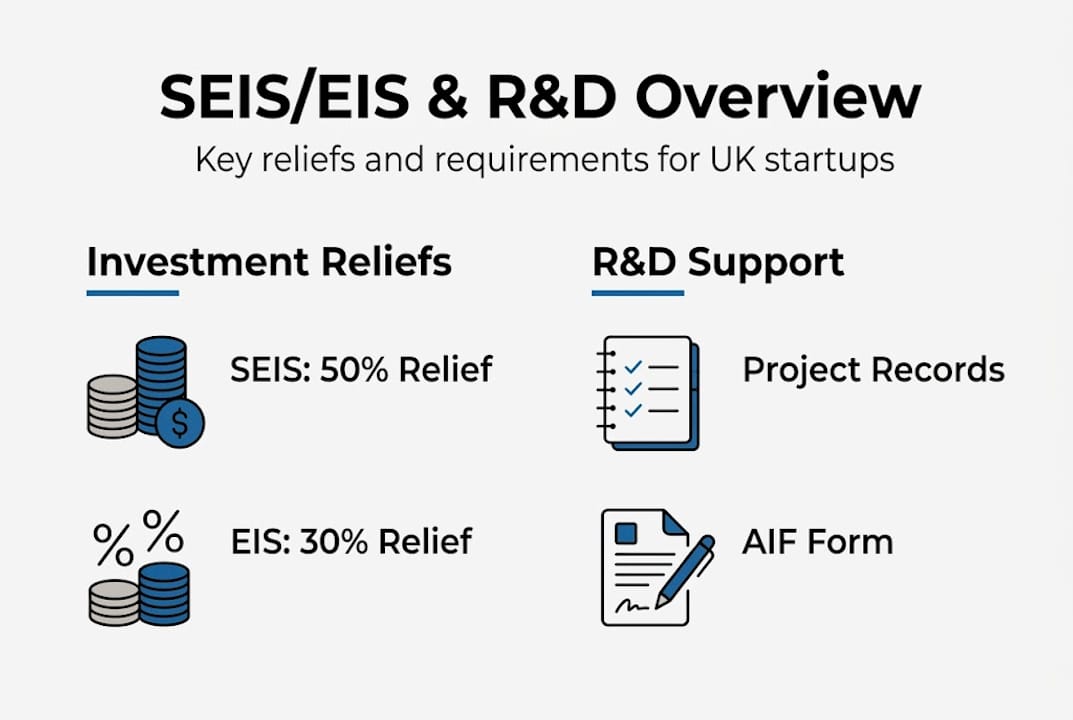
The problem is that many startups approach these schemes with generic templates or incomplete records. HMRC has significantly increased scrutiny, and a poorly prepared claim does not just get rejected. It can trigger further investigation and damage your credibility with investors. Specialist accountants who accountants unlock funding for their clients understand that contemporaneous records and detailed technical narratives are non-negotiable, not optional extras.
What does a specialist actually bring to the table? Several things that a generalist cannot reliably offer:
“Prioritise contemporaneous records and technical narratives over templates” is the benchmark that separates successful claims from rejected ones in today’s HMRC environment.
Pro Tip: Do not wait until year-end to engage a specialist. The best time to bring in expert support is before your first investor conversation or R&D project begins, not after.
Strategic guidance at the right moment saves far more than it costs. A rejected SEIS claim or a clawed-back R&D credit can set a startup back by months and erode investor confidence in ways that are difficult to recover from.
SEIS and EIS are two of the most generous tax incentive schemes available to UK startups, but they come with precise eligibility conditions that must be met and maintained. Understanding the difference between them is the first step.
| Feature | SEIS | EIS |
|---|---|---|
| Income tax relief | 50% on up to £200k per tax year | 30% on up to £1m (£2m for knowledge-intensive) |
| CGT reinvestment relief | Up to 50% | Deferral available |
| CGT on gains | Exempt after 3 years | Exempt after 3 years |
| Company trading age | Less than 3 years | Within 7 years of first commercial sale |
| Gross assets pre-issue | Up to £350k | Under £15m |
| Employee limit | Fewer than 25 | Fewer than 250 |
The SEIS income tax relief rules confirm that qualifying investors receive 50% income tax relief on investments up to £200,000 per tax year, with CGT-free gains after three years. Meanwhile, EIS income tax relief offers 30% relief on up to £1 million annually, rising to £2 million for knowledge-intensive companies, with similar CGT protections.
These reliefs are compelling for investors, which is precisely why they make your startup more attractive to early-stage backers. But eligibility is not automatic, and it is not permanent. Your accountant’s role covers several critical tasks:
Common mistakes that undermine SEIS and EIS applications include misinterpreting the trading age rules, failing to track gross asset values accurately, and overlooking the requirement that shares must be fully paid up and ordinary at the point of issue. These are not obscure technicalities. They are the kinds of details that a specialist accountant catches as a matter of course, and that a generalist may miss entirely.
For a fuller picture of how these schemes benefit investors and founders alike, the SEIS/EIS investment benefits breakdown is worth reviewing alongside the SEIS relief explained overview.
R&D tax credits represent one of the most significant government incentives available to innovative UK companies. But the landscape has changed sharply. HMRC now reviews around 20% of R&D claims, up from roughly 1% in previous years, and the most common reasons for rejection are generic project narratives, poor cost apportionment, and claims that include routine development work rather than genuine technological uncertainty.
The Additional Information Form (AIF) is now mandatory and must be submitted before your CT600 corporation tax return. This is not a minor administrative change. It requires a structured, detailed account of your R&D projects, the scientific or technological uncertainties you faced, and how your work sought to resolve them. Getting this wrong delays your claim and flags your company for closer attention.
Here is what a well-prepared R&D claim looks like in practice:
| Element | What HMRC expects | Common mistake |
|---|---|---|
| Project narrative | Specific technical challenges and uncertainties | Vague descriptions of software features |
| Cost apportionment | Clear breakdown of staff time, subcontractors, consumables | Lump-sum estimates without evidence |
| Qualifying activities | Work that advances science or technology | Including routine testing or standard development |
| Contemporaneous records | Meeting notes, technical logs, timesheets | Reconstructed records prepared at year-end |
Your accountant’s job is to ensure that reporting R&D to HMRC is done with the rigour that current rules demand. That means working with your technical team throughout the year, not just at filing time.
Pro Tip: Keep a running log of technical meetings, record the specific problems your engineers are trying to solve, and document any failed approaches. This contemporaneous evidence is far more persuasive to HMRC than a polished narrative written months after the fact.
The financial upside is substantial. A credible R&D claim can return a significant proportion of qualifying expenditure to your business, which is why the R&D credit boost for startups opportunity is one that no tech founder should overlook. The key is working with an accountant who understands both the technical requirements and the commercial context of your projects.

Red flags to watch for include accountants who rely on standard templates, do not ask detailed questions about your technical work, or promise high claim values without conducting a thorough review. These are signs that your claim may not survive HMRC scrutiny.
Finding the right tax accountant for a tech startup is not simply a matter of checking qualifications. It is about finding someone whose experience, processes, and tools align with the specific demands of your growth stage and funding ambitions.
The expert benchmarks for high-quality SEIS/EIS and R&D work emphasise the importance of contemporaneous records and technical narratives over generic templates. Use this as your filter when evaluating potential advisers.
Here is what to look for specifically:
The accounting advisors for compliance landscape has matured considerably, but quality varies. Reviewing tax compliance tips for tech companies gives you a useful benchmark for what good practice looks like, and the startup tax planning guide outlines the planning steps that the best advisers follow from the outset.
One practical approach is to treat the initial consultation as an interview. Ask how they would handle your specific situation, what records they would need from day one, and how they stay current with HMRC rule changes. The answers will tell you a great deal about whether they are the right fit.
Here is something that most articles on this topic will not tell you. The biggest reason UK tech startups fail to maximise SEIS, EIS, and R&D benefits is not ignorance of the schemes. It is treating their accountant as a reactive service rather than a proactive partner.
Founders who bring in specialist advice early, before the first investor meeting, before the first R&D project kicks off, build companies that are structurally more fundable. Their records are clean, their eligibility is confirmed, and their investor paperwork is ready. This is not luck. It is the result of treating financial strategy as a core business function from day one.
The compliance loss insight is stark: founders who treat tax accountants as box-tickers often discover eligibility gaps only when a funding round is already in progress, at the worst possible moment. A small investment in proactive guidance prevents far larger losses down the line. The most investible UK ventures are not necessarily the ones with the best technology. They are the ones with the cleanest financial foundations.
If you are building a tech startup and want to access SEIS/EIS funding, maximise your R&D tax credits, and keep your finances investor-ready, specialist support makes a measurable difference.

At Price & Accountants, we work exclusively with tech founders and growing businesses across the UK, providing hands-on support for SEIS/EIS applications, R&D tax credit support, and cloud-based company accounting solutions that keep your financials clear and compliant. Our team has guided startups from pre-seed through to Series A and beyond, with a track record that includes clients now valued at over £50 million. Get in touch today to find out how we can help your startup grow with confidence.
A tech-specialist tax accountant focuses on SEIS/EIS claims, R&D credits, and investor readiness for startups, offering expertise well beyond annual filings. The tech sector dominates R&D claims and benefits enormously from this level of specialist advice.
Eligibility depends on your firm’s trading age, gross assets, employee count, and investment thresholds, and the rules differ between the two schemes. A qualified accountant can review your SEIS and EIS eligibility details and confirm your position before you approach investors.
HMRC now checks around 20% of R&D claims and rejects those lacking technical detail or clear contemporaneous records, with the AIF required before your CT600 submission.
You should prepare up-to-date management accounts, investor records, technical project summaries, and evidence of business eligibility to enable a swift and fully compliant application process.