
TL;DR:
- UK government grants support early-stage tech and fintech startups through programs like Innovate UK Smart Grants.
- Success depends on meeting strict eligibility, demonstrating genuine innovation, and strategic application planning.
- Grants should be part of a broader financial strategy, complemented by careful tax and compliance management.
Most tech and fintech founders assume government grants are reserved for established companies with years of trading history. That assumption costs them dearly. The UK government actively funds early-stage innovation, and programmes like Innovate UK Smart Grants make significant capital available to start-ups with genuine, game-changing ideas. The challenge is not eligibility alone; it is knowing which grants exist, what they truly require, and how to position your business to win them. This guide breaks down the main options, real application requirements, and the tax and compliance strategies that help you maximise every pound of funding you secure.
| Point | Details |
|---|---|
| Major UK grants exist | Innovate UK Smart Grants and TechLocal offer substantial, non-dilutive funding to tech start-ups. |
| Strong application needed | Winning a grant requires innovation proof, a solid business plan, and evidence you can match fund. |
| Tax and compliance matter | Grant income can have tax impacts and compliance rules that founders must handle proactively. |
| Plan for growth | Use grants as a launchpad but combine with tax credits and expert advice for scaling sustainably. |
A business start-up grant is a sum of money awarded by a government body, local authority, or sector organisation that does not need to be repaid. Unlike a bank loan, there is no interest. Unlike equity investment, you give up no shares. For UK tech and fintech founders, this makes grants an exceptionally attractive source of capital, particularly at the pre-seed or seed stage when dilution is most painful.
That said, grants are not free money in the casual sense. They come with strict conditions. Most require you to demonstrate genuine innovation, submit a detailed business plan, and prove your company is financially stable. Reading your startup tax compliance guide before applying is a sensible first step, because funders often scrutinise your tax position.
Here is what most tech founders do not realise about grant eligibility:
“Success rates are low; grants require match funding, detailed business plans, and proof of innovation. A strong commercial case is non-negotiable.”
The overall funding landscape for UK tech is broader than most founders realise, but competition is fierce. Focusing on grants that match your precise business stage and sector is far more effective than applying broadly and hoping for the best.
Two programmes stand out for early-stage UK tech and fintech businesses in 2026: Innovate UK Smart Grants and TechLocal. They differ significantly in size, focus, and structure.
| Feature | Innovate UK Smart Grants | TechLocal |
|---|---|---|
| Funding range | £25,000 to £2,000,000 | £100,000 to £225,000 |
| Total pot | Varies per round | Up to £7.6M total |
| Sector focus | Broad tech and fintech R&D | AI, cyber, quantum, tech jobs |
| Match funding | Up to 30% required for SMEs | Required |
| Application status | Open in cycles | Closed March 2026 |
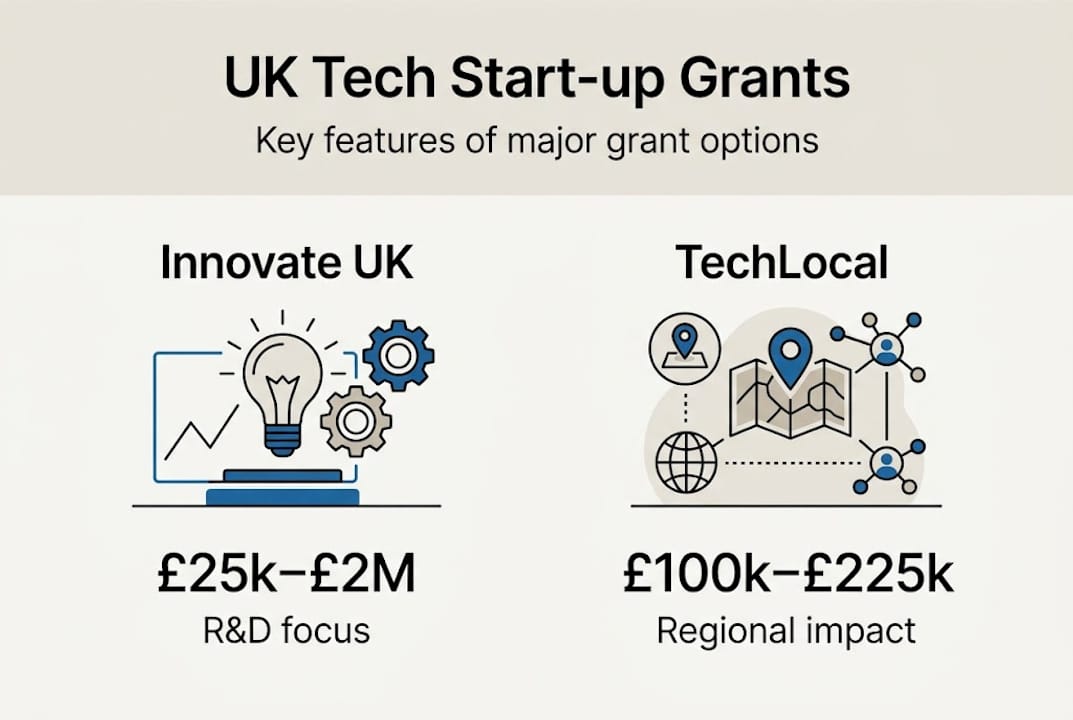
Innovate UK Smart Grants provide non-dilutive funding up to £2M for R&D projects targeting genuinely game-changing innovations, with SMEs receiving up to 70% of eligible project costs covered. This is the flagship programme for ambitious tech and fintech founders.

TechLocal targeted projects that connected people to technology careers in high-growth sectors including AI, cyber security, and quantum computing. Its applications closed in March 2026, but understanding its structure helps you anticipate similar programmes that will follow.
Key points to note when planning your approach:
Pro Tip: Set calendar reminders for Innovate UK competition windows. Rounds open and close quickly, and late applications are never accepted regardless of quality.
Winning a grant is as much about process discipline as it is about having a strong idea. Many excellent applications fail not because the technology is weak, but because the paperwork is incomplete or the commercial rationale is underdeveloped.
Here is the process you should follow:
Common mistakes that sink otherwise strong applications include insufficient evidence of innovation (generic claims do not work), weak commercial rationale (technical detail without a market), and ignoring sector-specific eligibility criteria. The success rate for competitive grants is low, which means every element of your submission must be purposeful.
Getting your accounts in order is part of the process. Our accounting tips for tech startups and accounting due diligence for startups resources cover exactly what funders look for in your financial records.
Pro Tip: Ask an experienced accountant or grant specialist to review your application before submission. A fresh pair of eyes often catches missed criteria that would otherwise result in automatic rejection.
Receiving a grant is not the finish line. What you do with the money, and how you account for it, determines whether the funding genuinely accelerates your growth or creates unexpected tax and compliance headaches.
First, understand that grant income is generally taxable in the UK. It must be included in your company’s accounts and declared to HMRC. The timing of when you recognise the income matters, so work with your accountant to handle this correctly from day one.
Second, grants and R&D Tax Credits can often be combined, but the rules require careful cost separation. You cannot claim R&D relief on the same expenditure that was funded by a grant. Keeping meticulous records of which costs were grant-funded and which were self-funded is essential. Our tax compliance tips for tech SMEs explain how to structure this correctly.
| Consideration | What to do |
|---|---|
| Grant income | Declare as taxable income in accounts |
| R&D Tax Credits | Separate grant-funded costs from self-funded costs |
| Match funding | Document source and use clearly |
| Reporting obligations | Follow grant agreement milestones |
| Record-keeping | Retain all evidence for at least 6 years |
Key ongoing obligations after a grant is awarded:
Pro Tip: Compliance breaches can trigger full or partial clawback of grant funding. A single missed report or misallocated expense can undo months of hard work. Treat compliance as seriously as the application itself.
Grants also serve as powerful signals to future investors. A company that has won competitive government funding demonstrates credibility, innovation, and operational discipline. Use that signal actively when approaching angel investors or VCs for your next round.
After working with over 20 start-ups, some now valued at well over £50m, we have seen founders treat grants as the primary growth strategy. It rarely works out that way. Grants are genuinely valuable, but they reward operational discipline as much as they reward innovation. The application process is time-intensive, success is far from guaranteed, and the compliance burden after winning is often underestimated.
The founders who benefit most from grants are those who treat them as one tool within a broader financial strategy. R&D Tax Credits, SEIS and EIS investment, and careful tax planning often deliver faster or more predictable results than waiting months for a grant decision. Understanding why accountants matter for startups is not just about compliance; it is about building the financial infrastructure that makes every funding route more accessible.
The uncomfortable truth is that many founders spend weeks on grant applications that fail, when the same energy invested in R&D claims or investor readiness would have moved the business further forward. Grants deserve a place in your toolkit, but they should complement your strategy, not define it.
Navigating grant applications, tax compliance, and R&D claims simultaneously is genuinely complex. Getting expert support at the right moment can be the difference between a successful application and a costly mistake.

At Price & Accountants, we support UK tech and fintech founders across every stage of the funding journey. From structuring your accounts to strengthen a grant application, to managing the compliance obligations that follow an award, our team brings the technical expertise and hands-on experience that generalist accountants simply cannot match. Explore our R&D tax credits guide to see how innovation spending can generate significant cash returns, review our advisory and tax planning services for strategic support, and get clear on your obligations with our corporation tax explained resource. We are here to help you build smarter, not just bigger.
Most grants require your business to qualify as an SME, demonstrate genuine innovation, and be financially stable. Eligibility criteria typically exclude businesses in financial distress, and some programmes are restricted to single-company applicants.
Innovate UK Smart Grants offer between £25,000 and £2M per project, while TechLocal provided £100,000 to £225,000 per project before its closure in March 2026. Amounts vary significantly by programme and project scope.
Yes, grant income is generally taxable and must be declared in your company accounts. Reviewing SME tax compliance tips ensures you handle this correctly and maximise any available reliefs.
In many cases, yes, but you must carefully separate grant-funded costs from self-funded ones to avoid overlapping claims. A tax planning checklist helps you structure this correctly from the outset.