
TL;DR:
- Many UK tech startups miss unclaimed grant funding due to lack of awareness or complex eligibility rules.
- Success relies on thorough preparation, understanding criteria, and precise documentation and timing.
- Expert support can significantly enhance funding chances through compliance, strategic planning, and application accuracy.
Millions of pounds in grant funding sit unclaimed every year because innovative UK tech and fintech founders either don’t know the money exists or stumble on eligibility rules they weren’t expecting. It’s a frustrating reality: the very businesses driving the country’s digital economy are often the ones missing out on capital that could accelerate their growth. Between public grant programmes, SEIS/EIS investment incentives, and R&D tax relief, there’s a powerful combination of funding tools available to you. This guide cuts through the complexity and shows you exactly what’s on offer, how to qualify, and how to apply with confidence.
Table of Contents
- Understanding small business grants in UK tech
- Maximising funding: Innovate UK and TechLocal programmes
- Compliance and eligibility for SEIS/EIS and R&D tax relief
- Practical advice: legal, tax and documentation essentials
- Why most founders underestimate the power of compliance and timing
- Get expert support for your UK tech SME grant journey
- Frequently asked questions
Key Takeaways
PointDetailsUK tech funding optionsGrants, loans, SEIS/EIS, and R&D credits help UK tech SMEs secure critical funding for growth.Eligibility mattersMeeting detailed eligibility and compliance rules is essential for successful grant or relief applications.Documentation is keyStrong paperwork, clarity on innovation, and expert support improve chances of receiving UK government funding.Application timingTargeting the right deadlines and planning submissions increases your opportunity for success.
Understanding small business grants in UK tech
Grants are fundamentally different from loans or equity investment. You don’t repay them, and you don’t give away shares to receive them. That makes them exceptionally valuable, but also highly competitive. Grant bodies are allocating public money, so they apply strict criteria and expect applicants to demonstrate clear alignment with national or regional priorities.
For UK tech and fintech SMEs, the landscape broadly splits into two categories: national innovation programmes and regional or sector-specific grants. Both reward businesses working on genuinely novel problems, particularly in areas the government has identified as strategic priorities.
Current priority areas include:
- Artificial intelligence and machine learning
- Cybersecurity and data protection
- Quantum computing
- Fintech infrastructure and open banking
- Green technology and net zero solutions
If your business operates in any of these spaces, you’re already better positioned than most. The TechLocal grant programme is one strong example: it offers up to £7.6 million across projects that connect local talent to tech jobs in SMEs, with individual grants ranging from £100k to £225k. Applications close in March 2026, so timing matters enormously.
Typical eligibility criteria across most UK tech grant schemes include being incorporated in the UK, having fewer than 250 employees, demonstrating genuine innovation rather than incremental improvement, and showing how your project serves a broader economic or social purpose. Many schemes also favour businesses with some trading history, though pre-revenue start-ups can qualify for early-stage specific funds.
Grant timelines vary widely. Some schemes run rolling applications, while others open and close within weeks. Missing a window can mean waiting six to twelve months for the next round. Exploring business start-up grants early in your planning cycle is always worthwhile.
“Grant funding rewards preparation. The businesses that win are rarely the most innovative in the room. They’re the ones who understood what the funder wanted and built their application around it.”
Pro Tip: Before writing a single word of your application, read the grant body’s published objectives in full. Every scoring criterion is a signal. Mirror their language and priorities directly in your proposal.
Maximising funding: Innovate UK and TechLocal programmes
With a sense of the landscape, you can start to compare which grant suits your business’s stage and focus best. Two programmes dominate the conversation for UK tech SMEs: TechLocal and Innovate UK.
Innovate UK is the government’s primary innovation funding agency. Its Innovation Loans programme targets SMEs at a later stage of R&D, offering between £100k and £5m in funding, covering up to 100% of eligible project costs at low interest rates. Round 25 closes in March 2026. This is not a grant in the traditional sense, as it must be repaid, but the favourable terms and scale make it a critical tool for scaling tech businesses.

ProgrammeMax fundingBest forApplication windowTechLocal£225kEarly-stage SMEs in AI, cyber, quantumCloses March 2026Innovate UK Innovation Loans£5mLate-stage R&D projectsRound 25, March 2026Innovate UK Smart Grants£2m+Disruptive innovation across sectorsMultiple rounds per year
To prepare a strong application for either programme, follow these steps:
- Confirm eligibility first. Check company size, trading history, and sector alignment before investing time in the application.
- Define your innovation clearly. Explain what problem you’re solving, why existing solutions fall short, and what’s genuinely new about your approach.
- Build a credible project plan. Include milestones, team expertise, and realistic cost breakdowns.
- Prepare financial forecasts. Funders want to see that grant money will be deployed effectively and that your business is viable beyond the grant period.
- Gather supporting evidence. Letters of support, pilot data, or early customer traction all strengthen your case.
Keeping your tax compliance in order before applying also matters. Grant bodies often request recent accounts, and any unresolved tax issues can create delays or disqualify your application entirely.
Compliance and eligibility for SEIS/EIS and R&D tax relief
Understanding the right grants is only half the battle. Maximising funding means meeting strict eligibility and compliance rules, especially for SEIS/EIS and R&D credits.
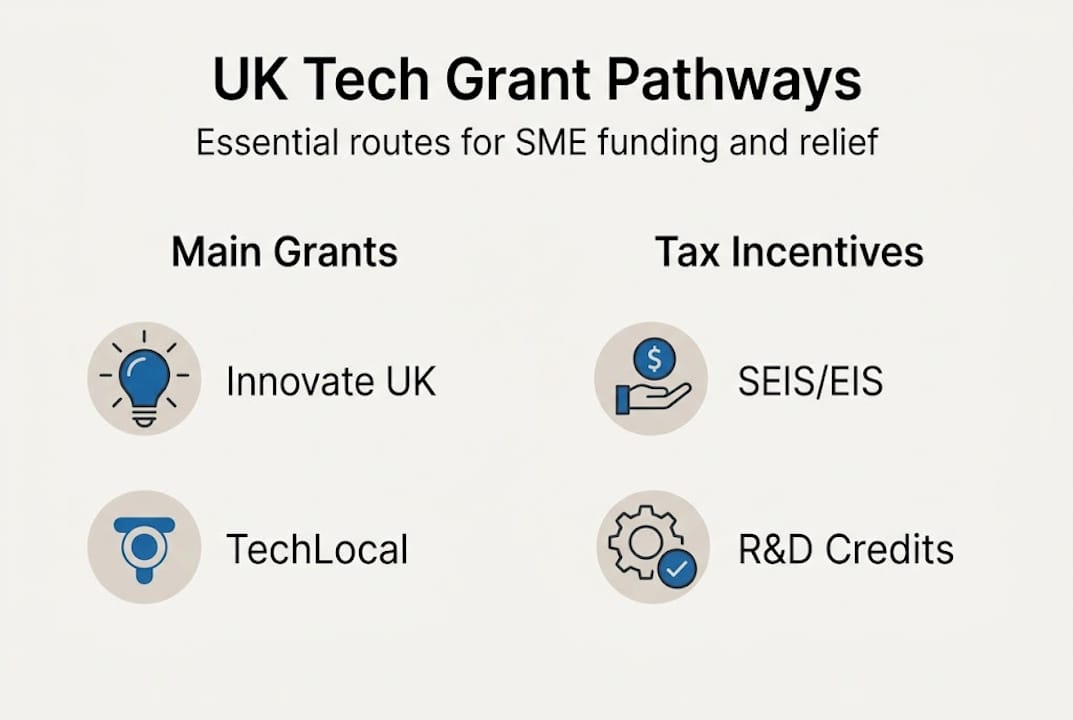
The Seed Enterprise Investment Scheme (SEIS) and Enterprise Investment Scheme (EIS) are arguably the most powerful investor incentives available to UK tech start-ups. They don’t give you money directly, but they make investing in your business far more attractive to angels and early-stage funds.
SchemeCompany ageGross assetsEmployeesMax raiseInvestor tax reliefSEISUnder 3 yearsUnder £350kUnder 25£250k50% income tax reliefEISUnder 7 yearsUnder £15mUnder 250£12m30% income tax relief
EIS investors also benefit from capital gains tax exemption after holding shares for three years, and loss relief if the investment fails. These incentives can be the deciding factor for an angel investor choosing between two similar start-ups.
Eligibility pitfalls are common. Key ones to watch include:
- Trading condition failures: Your company must be carrying out a qualifying trade. Many financial services activities are excluded, which catches some fintech founders off guard.
- Timing of share issue: Advance Assurance from HMRC is strongly recommended before issuing shares to investors.
- Mixing grant and SEIS/EIS funding: State aid rules have evolved post-Brexit, but you still need to check whether receiving a specific grant affects your SEIS/EIS status.
R&D tax credits work differently. They allow you to reclaim a percentage of qualifying R&D expenditure, reducing your tax bill or generating a cash repayment. For tech SMEs, qualifying costs often include staff time, software, cloud computing, and subcontractor fees spent on genuine technological advancement. Understanding startup tax compliance and reviewing your tax planning guide early helps you structure costs correctly from day one.
Pro Tip: Keep a contemporaneous R&D log throughout the year. HMRC increasingly scrutinises claims, and a well-documented record of your technical challenges and experiments is your strongest defence.
Practical advice: legal, tax and documentation essentials
Effective compliance and eligibility checks set you up for funding, but the application itself relies on strong planning and detailed paperwork. Getting this right is where many founders lose ground to better-prepared competitors.
Start with your legal structure. Most grants and SEIS/EIS schemes require a UK-incorporated limited company. Sole traders and partnerships are generally excluded. If you haven’t yet incorporated, do so before exploring these routes.
Here’s a numbered checklist of the steps to take before submitting any grant or relief application:
- Confirm your company structure meets the scheme’s legal requirements.
- Prepare up-to-date accounts for at least the last two financial years if trading.
- Draft a detailed business plan covering your market, technology, team, and financial projections.
- Document your innovation with technical descriptions, development timelines, and evidence of novelty.
- Obtain Advance Assurance from HMRC if pursuing SEIS or EIS investment.
- Coordinate your claims to ensure grant funding doesn’t inadvertently affect R&D relief eligibility.
- Engage a specialist accountant or legal adviser familiar with tech funding.
The documentation most commonly required across UK grant and relief applications includes:
- Certificate of incorporation and company registration details
- Latest statutory accounts or management accounts
- Evidence of innovation such as patents, prototypes, or technical reports
- CVs of key team members demonstrating relevant expertise
- Financial forecasts for three to five years
- Project cost breakdown aligned to grant-eligible expenditure
“The difference between a successful application and a rejected one is rarely the idea. It’s the evidence. Funders back teams that can prove they understand their own business inside out.”
For EIS-eligible companies, the 30% income tax relief and CGT exemption after three years are compelling incentives, but only if the paperwork is in order from the outset. Reviewing tax planning strategies and working through a tax planning checklist before you apply can save significant time and money. When in doubt, bring in a specialist tax consultant who understands the tech funding landscape specifically.
Why most founders underestimate the power of compliance and timing
Here’s an uncomfortable truth we’ve seen play out repeatedly: the founders who lose out on funding are rarely the ones with the weakest ideas. They’re the ones who treated compliance as an afterthought.
Tech founders are builders by nature. They prioritise product over process, which is admirable until it costs them a £200k grant because their accounts weren’t filed on time or their share structure disqualified them from SEIS. Funding is won and lost on details that feel administrative but carry enormous financial consequences.
Timing is equally underestimated. Innovate UK and TechLocal rounds open and close fast. SEIS Advance Assurance takes weeks to process. R&D claims must align with your accounting period. Treating these as parallel workstreams rather than last-minute tasks is what separates the founders who scale quickly from those who stall. Good accounting practices for scaling aren’t just about numbers. They’re about being ready when the opportunity arrives.
Get expert support for your UK tech SME grant journey
Navigating grants, SEIS/EIS compliance, and R&D tax relief simultaneously is genuinely complex. Most founders shouldn’t attempt it without specialist support.

At Price & Accountants, we work exclusively with tech and fintech SMEs at every stage of growth. From structuring your company to qualify for R&D tax credits to providing advisory and tax planning that keeps your funding strategy coherent and compliant, we act as your financial growth partner. Our team has helped start-ups raise millions through SEIS/EIS and claim significant R&D relief. If you’re building something innovative and want to make sure you’re not leaving money on the table, explore our support for start-ups and get in touch today.
Frequently asked questions
What is the TechLocal grant and who can apply?
The TechLocal grant offers between £100k and £225k to UK SMEs working in AI, cyber, or quantum, with applications closing March 2026. It targets businesses connecting local talent to tech roles.
What are the main eligibility criteria for Innovate UK Innovation Loans?
SMEs must be working on late-stage R&D projects and can request between £100k and £5m, with round 25 closing in March 2026. Projects must demonstrate genuine innovation and commercial viability.
How do SEIS and EIS support investment into tech SMEs?
They offer powerful tax incentives to investors, including 30% income tax relief under EIS and capital gains tax exemption after three years, making your start-up significantly more attractive to angels and early-stage funds.
Can I apply for R&D tax credits and a grant at the same time?
Yes, but you must carefully coordinate both claims to avoid double funding issues and ensure neither application undermines the other’s eligibility. Specialist advice is strongly recommended.
What documentation do I need for a UK small business grant application?
You’ll typically need your certificate of incorporation, recent accounts, a detailed business plan, evidence of innovation, team CVs, financial forecasts, and a project cost breakdown aligned to eligible expenditure.
Recommended
- Business start-up grants UK: secure funding for tech growth - Price & Accountants
- The Future of Tech Startup Companies in the UK - Price & Accountants
- Small business tax planning guide 2026 for UK tech - Price & Accountants
- How accountants unlock funding for UK tech startups - Price & Accountants
- Your guide to starting an IT or fintech business in Moldova