
A founder we spoke with recently lost a £150,000 angel investment because their company wasn’t SEIS-eligible at the point of the conversation. The investor walked. Not because the product was weak, but because the tax relief wasn’t available. That single structural oversight cost more than most founders spend on their first year of operations. Tax efficiency isn’t about finding loopholes or shaving a few hundred pounds off your bill. For UK tech founders, it’s a genuine funding advantage, and why tax planning matters from the very first day you incorporate.
Table of Contents
- Defining tax efficiency for UK tech startups
- How SEIS and EIS drive real tax efficiency
- Tax efficiency beyond SEIS/EIS: practical strategies for founders
- Navigating compliance, risks and pitfalls: what founders must know
- Benchmarking success: what does effective tax efficiency look like?
- What most guides miss about tax efficiency for founders
- Navigating tax efficiency with expert support
- Frequently asked questions
Key Takeaways
PointDetailsTax efficiency definedIt means using legal strategies to reduce startup tax and unlock better funding growth.SEIS/EIS amplify fundingThese schemes bring unmatched tax reliefs, making UK tech startups more attractive for investors.Compliance is crucialStrict rules and HMRC scrutiny mean early planning and professional advice are essentials.Integrate from day oneTax efficiency delivers best results when it’s embedded from incorporation, not as an afterthought.
Defining tax efficiency for UK tech startups
Most founders think tax efficiency means paying less tax. That’s part of it, but it’s not the whole picture. True tax efficiency means structuring your business and funding so that every pound works harder, legally and strategically.
Tax efficiency refers to strategies and structures that legally minimise tax liabilities while maximising after-tax returns, particularly through schemes like SEIS and EIS for UK tech entrepreneurs seeking funding. That’s a very different goal from simply minimising your tax bill in the current year.
Here’s where many founders go wrong. They focus on short-term savings, perhaps a small VAT saving or a director’s loan, while ignoring the structural decisions that unlock investor capital. Tax efficiency in a startup context is about long-term funding access and growth, not just compliance.
“Tax efficiency differs from simple minimisation by considering long-term funding access and compliance, not just short-term savings.”
Key methodologies for tech founders include SEIS/EIS and structures such as salary and dividend mix, pensions, and R&D credits. Together, these form a toolkit that the most successful UK tech founders use from day one.
Common misconceptions worth addressing:
- Tax efficiency is only for large companies. Wrong. SEIS was specifically designed for early-stage startups.
- It’s too complicated to set up early. In reality, getting it right at incorporation is far simpler than trying to fix it later.
- Aggressive tax planning is the same as tax efficiency. It isn’t. Efficiency uses legitimate schemes; aggressive planning courts HMRC scrutiny.
- You only need to think about it at year-end. Structural decisions made in month one affect your eligibility for schemes years later.
The founders who treat tax efficiency as a strategic tool, not an annual chore, are the ones who raise faster and retain more equity.
How SEIS and EIS drive real tax efficiency
Now that we’ve defined tax efficiency, let’s see how the SEIS and EIS can deliver it for your startup.
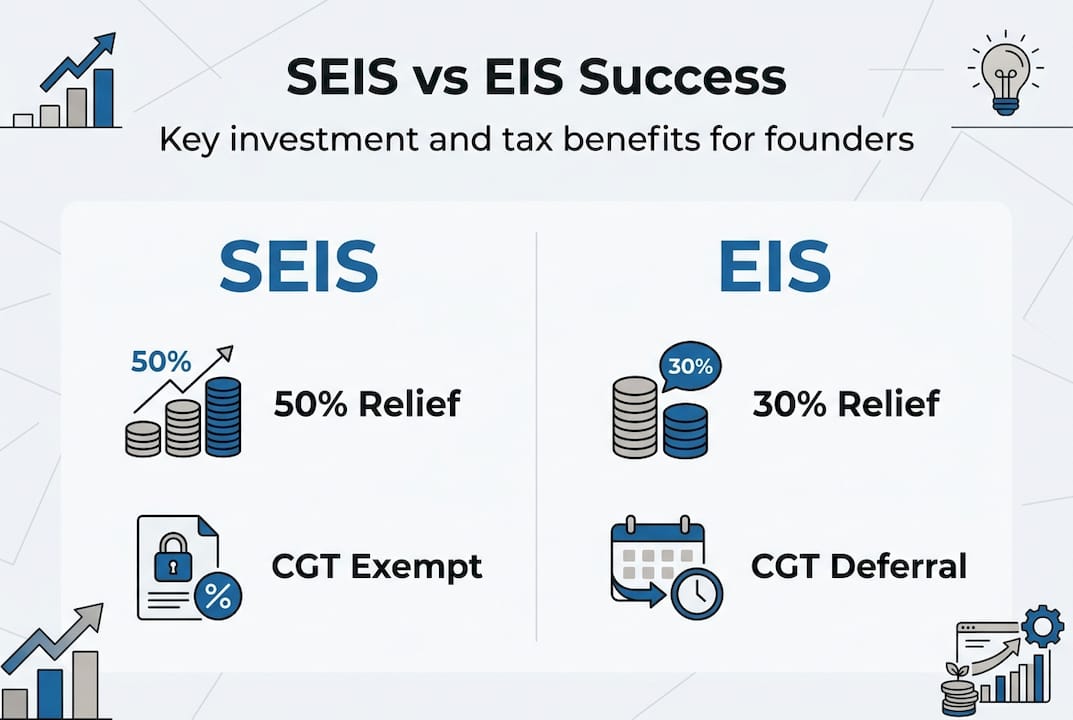
SEIS mechanics include 50% income tax relief and capital gains tax exemptions for early-stage startups. That means an investor putting in £20,000 effectively risks only £10,000 after tax relief. That changes the conversation entirely.

EIS mechanics offer 30% income tax relief and CGT deferral, with increased investment limits from April 2026. EIS suits companies that have moved beyond the seed stage and are raising larger rounds.
FeatureSEISEISIncome tax relief50%30%CGT exemptionYes (after 3 years)Yes (after 3 years)CGT deferralNoYesMax company raise£250,000£12m lifetimeMax investor relief£100,000/year£1m/yearCompany age limitUnder 3 yearsUnder 7 years
The sequencing matters too. SEIS must be fully used before EIS investment enters the same company. Getting this wrong disqualifies both sets of investors from their relief, which is a fast way to lose trust and capital.
How to access SEIS/EIS in practice:
- Confirm eligibility: check company age, employee count (under 25 for SEIS), and gross assets (under £350,000 for SEIS).
- Apply for advance assurance from HMRC before approaching investors.
- Issue shares and complete the investment round.
- Submit compliance statements to HMRC within two years of the share issue.
- Investors claim relief on their self-assessment returns.
For founders using a startup tax planning checklist, SEIS/EIS eligibility should sit at the very top.
Tax efficiency beyond SEIS/EIS: practical strategies for founders
While SEIS/EIS are powerful, the best founders combine multiple strategies for all-round tax efficiency.
Limited companies benefit from corporation tax rates between 19% and 25%, while R&D tax credits and careful remuneration planning can further reduce tax exposure for tech startups. Choosing the right structure from the start is not a formality; it’s a financial decision.
A salary and dividend mix remains one of the most effective tools for founder remuneration. Taking a low salary (typically around the National Insurance threshold) and topping up with dividends reduces both income tax and National Insurance contributions significantly.
Business Asset Disposal Relief (BADR) enables founders to pay 14% CGT on up to £1 million in gains at exit. Pair that with Enterprise Management Incentive (EMI) share options for key employees and you have a powerful retention and exit planning tool that also reduces your payroll tax burden.
StrategyTax benefitBest timingSalary/dividend mixReduces NI and income taxFrom incorporationR&D tax creditsCash refund or tax reductionEach accounting yearEMI share optionsReduced CGT for employeesPre-Series ABADR14% CGT on exit gainsPlan from year onePension contributionsCorporation tax deductionOngoing
Pro Tip: Don’t wait until your first fundraise to think about R&D credits. If you’re building software, algorithms, or novel processes, you’re likely eligible. Claims can go back two accounting periods, so even early-stage costs may be recoverable.
For a broader view of top tax strategies for startups and a detailed small business tax guide 2026, these resources map out the full picture. A tax-efficient growth guide also covers how to layer these strategies effectively.
Navigating compliance, risks and pitfalls: what founders must know
Even the best strategies are easily derailed by missteps, so mastering compliance is just as vital.
HMRC maintains strict compliance standards for SEIS/EIS, including a risk-to-capital condition, value receipt rules, and a 3-year holding period. Professional advice is strongly recommended to avoid clawbacks.
SEIS advance assurance sees an 85% approval rate, but timing and compliance issues can cause painful delays. Applying too late, or after shares have already been issued, is one of the most common and costly errors.
The most frequent compliance failures:
- Receiving value from the company during the 3-year holding period (e.g. loan repayments to investors) triggers clawback of relief.
- Changing the trade after investment can invalidate the qualifying status of the entire round.
- Issuing shares at the wrong time, such as before advance assurance is confirmed, creates uncertainty for investors.
- Failing the risk-to-capital condition, which requires genuine commercial risk and no pre-arranged exits.
- Missing compliance statement deadlines, which must be filed within two years of the share issue date.
“The intersection of legal structure, timing, and investor actions is where most SEIS/EIS issues originate. Getting one element wrong can unwind the entire round.”
Pro Tip: Engage a specialist tax consultant before you begin any fundraising conversation. The cost of advice is trivial compared to the cost of a failed compliance check. Also review director tax planning strategies to ensure your personal remuneration doesn’t inadvertently affect scheme eligibility.
Benchmarking success: what does effective tax efficiency look like?
You might wonder how these strategies actually play out in practice. Data can light the way.
SEIS comes with higher risks (a 40% higher failure rate versus EIS), but delivers average 35% returns. Overall, £34bn has been channelled into 59,000 UK firms via SEIS/EIS since inception. That is not a niche scheme. It is a cornerstone of UK startup funding.
In 2023/24, 2,290 firms raised £242m via SEIS while 3,780 raised £1,575m through EIS. Information and communications companies dominate, with London and the South East accounting for the majority of deals.
What this tells us in practice:
- Tech and software companies are the primary beneficiaries, making SEIS/EIS particularly relevant if you’re building in this space.
- London-based founders have a structural advantage in terms of investor access and deal flow, but regional founders are increasingly active.
- Early-stage risk is real. SEIS investors accept higher failure rates in exchange for better relief. Founders should be transparent about this.
- Volume matters. The sheer scale of investment through these schemes means your investors are likely familiar with them and expect you to be too.
To optimise tax planning in 2026, understanding where your company sits within these sector and stage patterns helps you pitch more credibly and structure more effectively.
What most guides miss about tax efficiency for founders
Having seen the hard numbers, here’s what truly separates the most tax-efficient founders from the rest.
Despite £34bn invested through SEIS/EIS, the compliance burden is real. For founders raising smaller rounds, the administrative cost of getting everything right can feel disproportionate. HMRC’s processes are improving, but red tape still deters some early-stage founders from pursuing schemes they’re fully entitled to use.
The bigger issue, in our experience, is sequencing. Founders who plan their SEIS/EIS eligibility, EMI options, and exit structure from incorporation outperform those who retrofit these tools later. It’s not just about having the schemes available. It’s about building a company structure where every layer, remuneration, R&D, funding rounds, and exit, works together from the start.
Most guides treat these as separate topics. They’re not. They’re one integrated strategy. The founders who grasp this early, and get accounting tips for scaling startups baked into their growth plan, are the ones who reach Series A with cleaner cap tables, better investor relationships, and more cash in the business.
Navigating tax efficiency with expert support
Tax efficiency is not a one-off project you complete at year-end. It’s an ongoing strategic advantage that compounds as your company grows.

At Price & Accountants, we work with UK tech founders from pre-seed through to Series A, helping them structure SEIS/EIS correctly, claim R&D tax credit guidance they’re entitled to, and build remuneration strategies that keep more capital in the business. Our strategic tax planning service acts as your outsourced Finance Director, giving you the high-level guidance that most early-stage founders simply don’t have access to. Pair that with our bookkeeping solutions and you have a complete financial infrastructure built for growth.
Frequently asked questions
What is tax efficiency in a startup context?
Tax efficiency means structuring your business and funding to reduce tax legally and maximise after-tax returns, using schemes like SEIS/EIS alongside remuneration planning and R&D credits.
How do SEIS and EIS schemes help founders raise more funding?
SEIS grants 50% income tax relief and CGT exemptions, while EIS offers 30% relief and capital gains deferral, both of which substantially reduce investor risk and make your round more attractive.
What is the difference between tax minimisation and tax efficiency?
Tax efficiency considers long-term funding access and compliance alongside reducing tax, whereas minimisation focuses only on lowering the current year’s bill without regard for structural or investor implications.
Do I need advance assurance before raising under SEIS/EIS?
Yes, most investors expect it before committing funds. Over 85% of requests are approved, but applying after shares have already been issued creates serious compliance risks.
What are the top mistakes in pursuing tax efficiency?
Missing SEIS/EIS eligibility through poor structuring, leaving planning too late, and ignoring compliance rules around value receipts and holding periods are the most common and costly errors founders make.
Recommended
- Step-by-step tax planning guide for UK startups 2026 - Price & Accountants
- What Is a Tax Consultancy? 50% SEIS Relief Explained - Price & Accountants
- Optimise your UK startup tax planning workflow in 2026 - Price & Accountants
- Tax planning checklist for UK tech startups to maximise savings - Price & Accountants