
TL;DR:
- UK startups must complete multiple registration steps with Companies House, HMRC, and the ICO before trading to avoid penalties. Sector-specific approvals, such as FCA or CQC registration, can take months and require early planning. Proper legal and compliance documents, along with ongoing monitoring, ensure growth without costly enforcement issues.
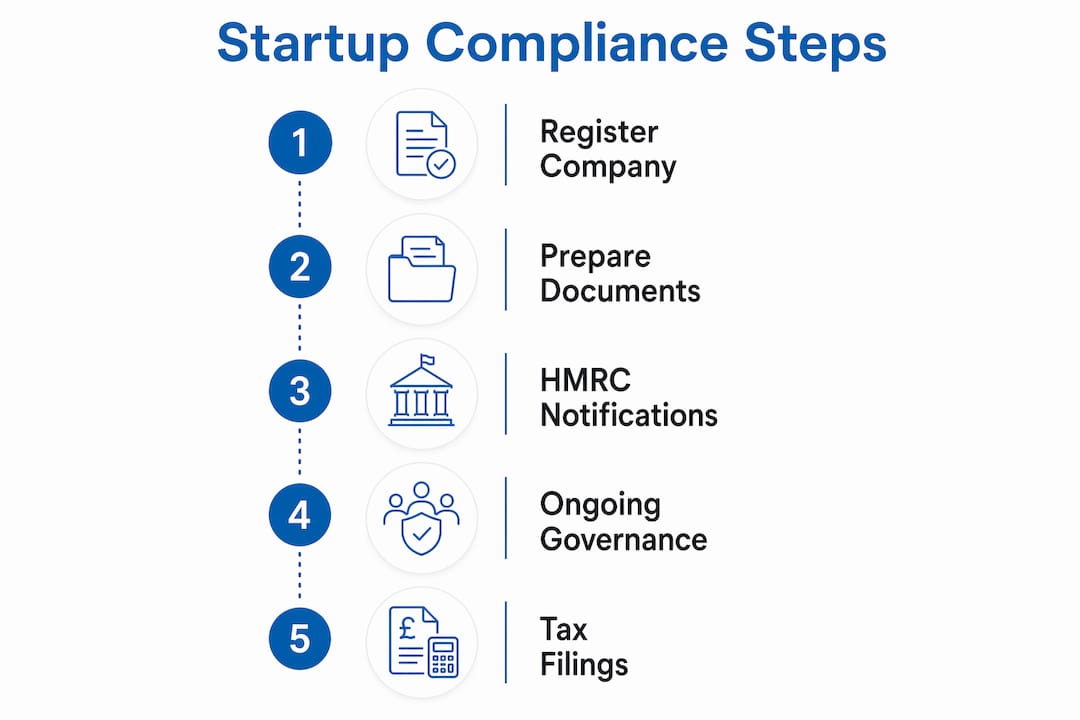
Before your company trades a single pound, you must register with Companies House, notify HMRC for Corporation Tax (within three months of starting to trade), register for PAYE if you are employing anyone, take basic data-protection steps with the ICO, and secure any sector-specific authorisation your business requires. Miss any of these and you are not just disorganised — you are exposed to penalties, director liability, and in some sectors, criminal sanction.
Before you trade: your immediate actions
Who does what? The founder handles the company registration and opens the business bank account. Your accountant (or an outsourced provider such as Priceandaccountants) manages HMRC registrations, VAT, PAYE set-up and SEIS/EIS compliance. A solicitor drafts your shareholder agreement, IP assignments, and employment contracts. Everything else — payroll, pension auto-enrolment, ongoing filings — belongs on a recurring calendar, not a one-off to-do list.
The compliance process is not a single event. It runs in four phases: incorporation, the first 30 days, the first three months, and the first 12 months. Each phase has distinct tasks, owners, and documents.
| Task | Deadline | Owner |
|---|---|---|
| Company registration (Companies House) | Day one | Founder / formation agent |
| PSC register completed | Day one | Founder / solicitor |
| Corporation Tax notification (HMRC) | Within 3 months of trading | Accountant |
| PAYE registration | Before first payroll run | Accountant / payroll provider |
| VAT registration (if applicable) | Before threshold is exceeded | Accountant |
| ICO registration and data-protection fee | Within first 3 months | Founder / data-protection lead |
| Shareholder/co-founder agreement signed | Within 30 days | Solicitor |
| IP assignments executed | Within 30 days | Solicitor |
| SEIS/EIS advance assurance application | Before closing investment round | Accountant |
| First confirmation statement | Within 12 months of incorporation | Accountant / founder |
| First annual accounts filed | 9 months after accounting reference date | Accountant |
| CT600 filed | 12 months after accounting period end | Accountant |

Documents checklist. Prepare these before or immediately after incorporation: memorandum and articles of association, PSC statements, shareholder/co-founder agreement, IP assignment deeds, employment contracts (with IP and restrictive covenant clauses), director service agreements, data-processing records (Article 30 GDPR register), and board minutes for all key decisions.
Pro Tip: Download the GOV.UK model articles as a starting point, but have a solicitor review them before you file — the default articles do not include drag-along rights, pre-emption clauses, or vesting provisions that investors will expect.
For most tech startups, the checklist above covers the core. But certain sectors layer on additional authorisation, anti-money laundering (AML), or safety obligations that can take months to satisfy and cannot be retrofitted after launch.
Fintech and financial services. If your product involves payment processing, lending, investment advice, insurance, or any activity that falls under the Financial Services and Markets Act 2000, you need FCA authorisation before you operate. The Money Laundering Regulations 2017 also apply to many fintech and crypto businesses, requiring you to appoint a Money Laundering Reporting Officer (MLRO), implement customer due diligence (CDD) procedures, and maintain transaction records. Crypto-asset businesses must register with the FCA under the Money Laundering, Terrorist Financing and Transfer of Funds Regulations. The FCA’s regulatory sandbox (discussed in a later section) offers a route to test products under supervised conditions before full authorisation.
Healthcare and medical devices. Regulated healthcare providers must register with the Care Quality Commission (CQC) before delivering services. Medical device manufacturers face MHRA registration requirements. Neither can be deferred — operating without registration is a criminal offence.
Food and beverage. Food businesses must register with their local authority at least 28 days before opening. The Food Standards Agency (FSA) sets hygiene and labelling rules; certain products (supplements, novel foods) require additional approvals.
Gambling. Any business offering gambling services to UK consumers needs a licence from the Gambling Commission. The application process is lengthy and detailed; plan for at least six months.
Legal services. Providing reserved legal activities without authorisation from the Solicitors Regulation Authority or another approved regulator is a criminal offence. Legal tech products that stray into advice territory need careful scoping.
Estate agency. Estate agents must register with HMRC under the Money Laundering Regulations 2017 and comply with AML obligations including CDD.
When to pause and get specialist advice. If your product touches any of the above sectors, pause product development before launch and commission a regulatory gap assessment. The red flags that should trigger immediate specialist counsel are: handling client money, processing sensitive personal data at scale, providing advice that could be construed as regulated, or operating in a sector where a competitor has recently faced enforcement action.
Practical next steps for regulated sectors:

Getting the legal architecture right at formation costs a fraction of what it costs to fix later. Investors conducting due diligence will scrutinise every document listed below; gaps discovered at Series A regularly delay or kill rounds.
Priority order for legal documents:
Off-the-shelf templates are a reasonable starting point, but they routinely cause problems in three areas. First, vesting: many templates use cliff-and-vest schedules that do not reflect UK market norms or HMRC’s EMI option rules. Second, IP assignment: US-origin templates often use US jurisdiction clauses and miss the specific requirements of UK employment law for pre-incorporation IP. Third, dispute resolution: generic templates default to arbitration clauses that are expensive and slow for a startup dispute; English courts are often faster and cheaper.
What to change immediately (before you sign anything): jurisdiction clause (must be England and Wales), IP assignment scope (must cover pre-incorporation work), vesting schedule (align with any HMRC EMI option grant), and dispute resolution mechanism. What can wait until fundraising: drag-along thresholds, anti-dilution provisions, and information rights.
The Economic Crime and Corporate Transparency Act 2023 introduced identity verification requirements for persons with significant control and changes to Companies House filing obligations. PSC records must be accurate and current; filing a false PSC statement is a criminal offence. Board meeting cadence matters too: hold formal board meetings at least quarterly, keep minutes for every meeting, and store them at your registered office or a SAIL address notified to Companies House.
Pro Tip: Appoint a company secretary (even informally) from day one. The role is optional for private companies, but having one person responsible for filing deadlines, PSC records, and board minutes prevents the “nobody checked” failures that generate most Companies House late-filing penalties.
Tax compliance for a UK startup is less complicated than founders fear, but the deadlines are unforgiving and the consequences of missing them compound quickly.
Corporation Tax registration must happen within three months of starting to trade. HMRC will then issue a Unique Taxpayer Reference (UTR) and set your accounting period. Your CT600 return is due 12 months after the end of that period, but the tax itself is due nine months and one day after the period ends — a distinction that catches many first-time founders.
PAYE registration is required before you run your first payroll. RTI (Real Time Information) submissions must be made to HMRC on or before each payday. Late RTI submissions attract automatic penalties.
VAT registration is mandatory once taxable turnover exceeds the current threshold in any rolling 12-month period. Voluntary registration below the threshold makes sense if your customers are VAT-registered (you reclaim input VAT) and if you want to appear more established. The downside is the administrative burden of quarterly VAT returns and Making Tax Digital (MTD) compliance.
MTD for VAT is already mandatory for all VAT-registered businesses. MTD for Income Tax Self Assessment (ITSA) is being phased in for sole traders and landlords from April 2026. For limited companies, MTD for Corporation Tax is still in consultation. The practical implication now: use MTD-compatible software from day one. Xero integrates directly with HMRC’s MTD APIs and is the platform Priceandaccountants uses for client bookkeeping and tax compliance workflows.
Auto-enrolment applies from the first day you employ an eligible worker (aged 22–66, earning above the earnings trigger). You must enrol eligible employees into a qualifying pension scheme and make employer contributions. The Pensions Regulator enforces this; non-compliance fines escalate daily.
If your startup is developing new technology, processes, or software, you may be eligible for R&D tax relief. The merged R&D scheme (effective for accounting periods beginning on or after 1 April 2024) consolidates the previous SME and RDEC schemes. Claims require detailed technical and financial records — start keeping them from day one, not retrospectively.
SEIS and EIS are the most tax-efficient ways to raise early-stage equity in the UK. SEIS compliance requires a compliance statement (SEIS1) submitted to HMRC after shares are issued, plus records demonstrating the qualifying trade and how funds were spent over three years post-investment. Plan your share structure before you raise — issuing shares in the wrong order or at the wrong price can disqualify investors from relief.
| Obligation | Registration / filing deadline | Owner |
|---|---|---|
| Corporation Tax registration | Within 3 months of trading | Accountant |
| PAYE registration | Before first payroll run | Accountant / payroll provider |
| VAT registration | Before threshold exceeded | Accountant |
| RTI payroll submissions | On or before each payday | Payroll provider |
| Auto-enrolment pension set-up | From first eligible employee | Accountant / pension provider |
| VAT returns (MTD) | Quarterly | Accountant |
| CT600 and accounts | 12 months after period end | Accountant |
| R&D tax credit claim | Within 2 years of period end | Accountant |
| SEIS1 compliance statement | After shares issued | Accountant |
Where Priceandaccountants adds the most value: R&D claims require technical narratives that satisfy HMRC’s post-April 2023 additional information requirements; SEIS/EIS compliance requires share-structure planning that most generalist accountants miss; and ongoing tax planning for UK startups directly affects how much runway you retain between funding rounds.
Compliance that lives only in a spreadsheet or a solicitor’s filing cabinet will fail. The founders who avoid enforcement problems are the ones who make compliance a routine, not a crisis response.
Every startup needs someone accountable for compliance, even if that person wears several hats. Directors carry personal liability for many compliance failures — late filings, PAYE errors, and data breaches can all result in personal liability or disqualification. Appoint a data-protection lead (who may also be the MLRO if AML applies) and make their responsibilities explicit in their job description or service agreement.
For payroll, pension administration, and tax filings, outsourcing to a specialist provider is almost always more cost-effective than hiring in-house at the early stage. Priceandaccountants handles all of these as part of its recurring service packages, which means founders get professional-grade compliance without the overhead of a full finance team.
Pro Tip: Run a five-minute PSC check every quarter. The most common Companies House enforcement action against early-stage startups is an inaccurate or outdated PSC register. It takes minutes to verify and costs nothing to fix proactively.
Remote and hybrid working introduces specific compliance considerations that many founders overlook. Under UK employment law, you must carry out a display screen equipment (DSE) assessment for home workers. Data security policies must cover personal devices if employees use them for work (a BYOD policy). GDPR obligations apply regardless of where data is processed — a team member working from a café in Berlin is still processing data under UK GDPR if they are employed by a UK company.
Most startups can complete their compliance set-up without ever speaking to a regulator directly. But there are specific triggers that require formal engagement, and getting the timing wrong is expensive.
The FCA sandbox allows firms to test innovations under modified rules with regulatory oversight, reducing uncertainty for high-risk products while preserving consumer safeguards. Participation is time-limited and does not replace full authorisation, but it gives firms a supervised environment to validate their compliance approach before committing to the full application process.
Eligibility: your product must be genuinely innovative, offer consumer benefit, and be ready for live testing. The FCA publishes cohort application windows; check the FCA Innovation Hub for current dates.
Benefits: direct access to FCA supervisors, the ability to test under modified rules, and a clearer path to full authorisation based on real operating data.
How it differs from full authorisation: sandbox participation is temporary and scoped to specific test parameters. You cannot operate commercially at scale under sandbox conditions alone.
Advance assurance for SEIS/EIS is a separate but related process: submit a written application to HMRC’s Small Company Enterprise Centre before issuing shares, and HMRC will confirm (non-bindingly) that your company and proposed share issue appear to qualify. This gives investors confidence before they commit.
Compliance costs in the first year are predictable if you plan for them. The surprises come when founders underestimate lead times and then pay premium rates for urgent work.
| Item | Typical lead time | Indicative cost range |
|---|---|---|
| Company formation (Companies House) | Same day | £50–£100 (DIY via GOV.UK) |
| Business bank account opening | 1–4 weeks | Free to £20/month |
| HMRC registrations (CT, PAYE, VAT) | 2–4 weeks for UTR/VAT number | Included in accountancy package |
| Shareholder/co-founder agreement | 1–3 weeks (solicitor-drafted) | £1,500–£3,000 |
| Employment contracts (standard) | 1 week | £500–£1,000 per set |
| ICO registration | Same day online | £40 per year |
| FCA authorisation (full) | 6–12 months | £5,000+ in advisory fees |
| FCA sandbox application | 3–6 months | Advisory fees vary |
| SEIS/EIS advance assurance | 4–8 weeks | Included in accountancy package |
| Auto-enrolment pension set-up | 1–2 weeks | £200–£400 (one-off set-up) |
| Accountancy package (ongoing) | Immediate | £300–£1,000/month depending on scope |
Costs vary significantly by complexity and provider. The figures above are indicative ranges, not guarantees.
Save money on company formation (DIY via GOV.UK is perfectly adequate for a straightforward limited company) and on ICO registration (the online process takes ten minutes). Use standardised but solicitor-reviewed templates for employment contracts rather than bespoke drafting for each hire.
Spend on your shareholder agreement. A poorly drafted agreement discovered at Series A can cost ten times the original legal fee to unpick. Spend on specialist regulatory advice if you are in a regulated sector — the FCA application process is not something to attempt without a compliance consultant who has done it before.
Pro Tip: Ask your accountant to include SEIS/EIS advance assurance in your onboarding scope. The application is straightforward for an experienced adviser and the cost is negligible compared to the tax relief it unlocks for your investors. Founders who apply after closing a round sometimes find they cannot retrospectively qualify.
Non-compliance is not a theoretical risk. Companies House, HMRC, the ICO, and the FCA all have active enforcement programmes, and early-stage startups are not exempt.
If you discover a compliance gap or breach, act in this order:
Early voluntary disclosure consistently results in lower penalties across all UK regulatory regimes. The ICO’s own guidance confirms that organisations that self-report and cooperate receive materially more favourable outcomes than those where breaches are discovered through complaints or third-party reports.
Getting the startup compliance process right in the UK requires acting on company registration, HMRC notifications, data-protection steps, and sector-specific authorisations before you trade, not after your first problem arises.
| Point | Details |
|---|---|
| Register before you trade | Companies House registration, HMRC Corporation Tax notification, and ICO data-protection fee must all be in place before trading begins. |
| PSC records are a legal obligation | Under ECTA 2023, PSC identity verification is mandatory; an inaccurate register is a criminal offence, not just an administrative error. |
| Sector-specific rules can take months | FCA authorisation, CQC registration, and Gambling Commission licences have lead times of six months or more — start the process before you build the product. |
| Use a compliance calendar | Monthly bank reconciliations, quarterly VAT returns and PSC checks, and annual accounts filings prevent the compounding penalties that catch most early-stage founders. |
| Priceandaccountants as your compliance partner | Priceandaccountants handles HMRC registrations, SEIS/EIS compliance, R&D claims, and ongoing filings for UK tech and fintech startups, with extensive combined expertise. |
Most founders who end up with compliance problems are not ignorant of the rules. They know they need a shareholder agreement. They know they should register for VAT. They know they need to sort out PAYE. The problem is that they treat compliance as something to do once the product is built, the team is hired, and the first customers are signed. By that point, the window for doing things cleanly has often closed.
The shareholder agreement that was not signed in month one becomes a negotiation between co-founders who now have different ideas about equity. The IP assignment that was not executed before incorporation means the company does not legally own its own codebase when a VC’s lawyers come looking. The SEIS advance assurance that was not applied for before the round closes means investors cannot claim their relief. None of these are complicated problems to prevent. They are all timing problems.
The other thing worth saying plainly: the compliance burden for a UK startup is genuinely manageable. Companies House registration takes a few hours. HMRC registrations take a few weeks. ICO registration takes ten minutes online. The documents that matter most — shareholder agreement, IP assignments, employment contracts — cost a few thousand pounds to get right with a solicitor. For a business raising even a modest seed round, that is not a significant cost relative to the risk it eliminates.
Where founders genuinely need specialist help is in regulated sectors (FCA, CQC, Gambling Commission) and in tax structuring (SEIS/EIS, R&D claims, share option schemes). These are areas where the rules are complex, the stakes are high, and the cost of getting it wrong is not just a penalty — it is a lost funding round or a criminal investigation. That is where experienced advisers pay for themselves many times over.
The compliance process is not a barrier to building a great company. Treated as a foundation rather than a formality, it is what makes the company fundable, scalable, and defensible.
Founders who have worked through the checklist above know what needs doing. The harder question is who does it, and how quickly. Priceandaccountants is the specialist accounting and compliance partner for UK tech and fintech startups — not a generalist firm that handles startups as a side line, but a team that has guided over 20 companies through the full startup compliance process, several of which are now valued at well over £50m.

The services most relevant to founders reading this guide: company set-up and Companies House filings, HMRC registrations (Corporation Tax, PAYE, VAT), SEIS/EIS advance assurance and compliance statements, R&D tax credit claims, payroll and auto-enrolment pension management, outsourced finance director services, and ongoing strategic tax planning and advisory as you scale from pre-seed to Series A.
Before you get in touch, gather the following: your certificate of incorporation (or your intended company structure if not yet incorporated), a draft cap table or shareholder list, any existing shareholder agreement or term sheet, your latest payroll summary if you are already employing, and a brief description of your product and sector. The more context you provide upfront, the faster the initial compliance review moves.
To request your initial compliance review, contact Priceandaccountants directly via the website. The review covers your current compliance position, identifies gaps, and sets out a prioritised action plan — so you leave knowing exactly what needs to be done and in what order.
The sources below are listed in the order a founder should read them, from formation through to funding compliance.
This article is general information for UK founders and does not constitute legal, tax, or regulatory advice. Confirm current rules and thresholds with the relevant primary source or a qualified professional before acting on your specific situation.