

A software R&D claim succeeds when your developers were trying to solve a genuine technological problem that a competent professional could not have solved off the shelf. Building a useful product is not enough. If your team had to experiment, prototype and test to find out whether something could be done at all, that work can qualify. You then claim the relief through your Company Tax Return, within a fixed deadline, with records that show what was uncertain and how you tackled it.
This guide is for UK limited company founders and finance leads at software, SaaS and fintech businesses. It covers what counts, what does not, which costs go in, how the merged scheme and ERIS work, and how to build a claim that stands up to an HMRC enquiry.
TL;DR
- Software qualifies when the project seeks an advance in the field’s overall capability by resolving technological uncertainty, not when you simply build something new to your company.
- Routine coding, maintenance, requirements gathering, confirmatory testing and deployment generally do not qualify, but they can sit inside a project that does.
- Staff, software, data licences, cloud computing, externally provided workers and contractor payments can all be claimable costs, subject to the rules for each.
- For accounting periods starting on or after 1 April 2024, the merged scheme and ERIS apply, and you must notify HMRC and submit an additional information form with your claim.
- Most claims are due within 24 months of the end of the accounting period, so late discovery can cost you the relief.
Table of Contents
- What HMRC means by R&D in software
- Software projects that tend to qualify
- Work that usually does not qualify
- Which costs can go into a software claim
- The merged scheme and ERIS for software companies
- How to build a claim step by step
- Deadlines and notification
- Records HMRC may ask for
- Our perspective
- Getting help with your claim
- FAQ
- Sources
What HMRC means by R&D in software
HMRC’s test is not whether your product is clever or commercially new. The official guidelines say a project must seek an advance in the overall knowledge or capability of a field of science or technology, and that advance must be in the field itself, not just in your company’s own position. Something that is new to you but already known to competent professionals elsewhere is not an advance.
The second leg is uncertainty. HMRC’s manual describes qualifying work as a systematic project that resolves scientific or technological uncertainty through activities such as technical analysis, design, development and testing, going beyond routine coding or adaptation. HMRC’s identification guidance puts it plainly: uncertainty exists when an expert cannot say whether something is technologically possible, or how to do it, even after reviewing the available evidence.
Two practical consequences follow:
- Commercial uncertainty is not enough. Not knowing whether customers will buy a feature is a business risk, not a technological one.
- Creating new functionality is not enough. The same HMRC guidance says building new functions or computer environments does not qualify if it is routine replication of existing methods in a new context.
Technological advance versus innovation
Founders often conflate the two. HMRC specifically advises claimants not to confuse innovation or cutting-edge work with seeking a scientific or technological advance, and to set out what the field knew when the project began. A beautifully designed app using well-understood frameworks is innovative. It is rarely R&D.
Software projects that tend to qualify
The pattern is always the same: a technical problem with no known solution that your team had to work out. Typical examples for UK tech and fintech companies include:
- Performance at scale. Designing a data pipeline or matching engine that must process volumes or latency targets that existing architectures and published approaches cannot demonstrably reach.
- Novel algorithms. Building a fraud-detection or risk-scoring model where it is genuinely unclear whether the accuracy you need is achievable with current techniques.
- Integration where no documented route exists. Making incompatible systems, protocols or legacy platforms work together when the interfaces are undocumented or the required behaviour has not been achieved before.
- Security and cryptography problems. Developing a way to deliver a capability, such as privacy-preserving computation, where the technical feasibility is in doubt.
- Machine learning under constraints. Getting a model to run reliably on limited hardware or with sparse data, where competent engineers would not know in advance whether it can be done.
These are illustrations of the test, not guarantees. Whether your own project qualifies depends on the facts: what you knew at the start, what you tried, and what failed.
Work that usually does not qualify
HMRC’s manual lists the categories that generally fall outside the relief:
- routine maintenance or minor fault fixing where no uncertainty arises
- gathering business requirements with no technological questions attached
- confirmatory functional testing
- deployment
In practice that means a standard CRUD application, a website built on a template, a routine mobile port, UI redesigns and customer-specific configuration are weak candidates. Adding another payment provider through a well-documented API is the typical case: useful, commercial, but not an advance.
Can you claim the whole project?
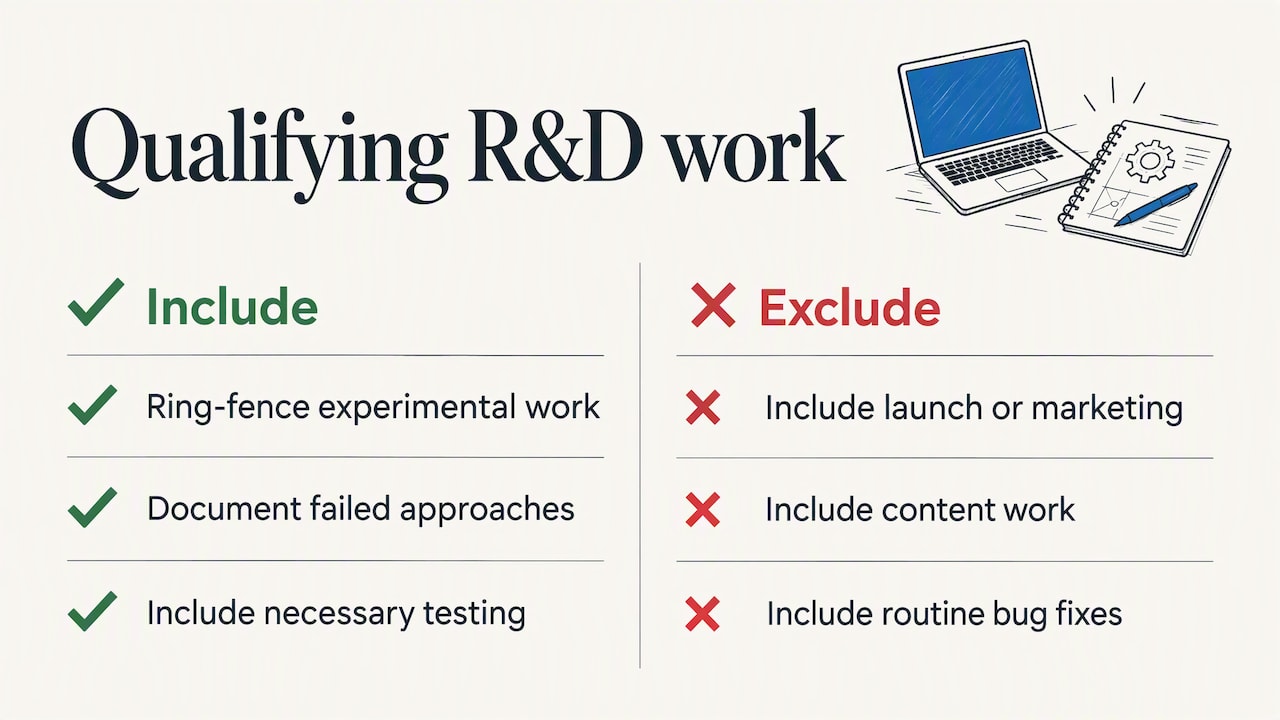
Usually not, and this matters for the size of your claim. The same manual notes that a commercial project may contain non-qualifying work alongside the qualifying R&D, so you need to identify the activities within the project that resolve the uncertainty. A sensible claim ring-fences the experimental core: the prototypes, the failed approaches, the testing that was needed to learn whether something works. It excludes launch, marketing, content and routine bug fixes.
This is also the cleanest way to protect yourself. Over-claiming the whole product build is the quickest route to a challenge. Our own piece on R&D eligible costs for UK SMEs goes deeper on how to keep the cost side defensible.
Which costs can go into a software claim
The cost categories are set out in HMRC’s manual on qualifying expenditure. They include staffing costs, software, data licences, cloud computing services, externally provided workers and contractor payments. Each has conditions.
| Cost type | What to watch |
|---|---|
| Staff | Only the time spent on qualifying activities. Developers who split time between R&D and routine work need an honest apportionment. |
| Software | Must be used directly in the R&D, not general business tools. |
| Data licences | Same direct-use test as software. |
| Cloud computing | Test environments, training runs and compute used for the R&D itself. |
| Externally provided workers | Agency or contractor staff working under your direction have their own rules. |
| Contractor payments | Subcontracted R&D has restrictions on what can be claimed. |
One rule catches companies out. For accounting periods beginning on or after 1 April 2023, software, data licence and cloud computing costs must be paid before the claim can be valid. A large unpaid AWS invoice at year end is not claimable until it is settled, so check your payment timing before you file.
Overseas contractors are a recurring question for startups with distributed engineering teams. There is a narrow easing for qualifying Northern Ireland SMEs claiming ERIS, set out in HMRC’s ERIS manual, but for most companies the standard restrictions on overseas work still apply. Check where the work was done before you include any contractor invoice.
The merged scheme and ERIS for software companies
For accounting periods beginning on or after 1 April 2024, the old SME and RDEC schemes were merged. HMRC’s guidance on the merged scheme explains that the merged RDEC is a taxable credit, and that loss-making, R&D-intensive SMEs can claim Enhanced R&D Intensive Support (ERIS). Under ERIS, a company can deduct 186% of qualifying costs and claim a payable credit of up to 14.5% of the surrenderable loss.
For a pre-revenue or early-revenue software company, ERIS is often the route that matters, because the payable credit turns a loss into cash during the runway. The intensity condition, which compares R&D spend to total spend, decides whether you get there. We cover the mechanics in our article on how the intensity rule can fund a startup without dilution, and the merged scheme compliance plan sets out what finance teams need to do in practice.

The rates and thresholds can change with each Budget, so always confirm the current position on the official GOV.UK page before you forecast a cash benefit.
How to build a claim step by step
- List your projects and their start points. For each, write down what the field knew or could do when you began.
- Name the uncertainties. State the specific technical question: could latency be brought under a given threshold, could two systems be made to interoperate, and so on.
- Document what you tried. Keep the failed prototypes, the experiment logs, the architecture decision records and the pull requests that show iteration.
- Apportion the costs. Match developer time and cloud spend to the qualifying activities only.
- Notify and submit the forms. Complete the claim notification and the additional information form, then claim through the Company Tax Return.
- File on time. Check the deadline for each accounting period.
On the forms: HMRC’s claim guidance states that companies must submit the claim notification form and the additional information form, then claim through the Company Tax Return, and that a period of account longer than 12 months needs a separate claim for each accounting period. HMRC’s manual on claims adds that companies claiming under new RDEC or ERIS must submit the additional information through HMRC’s online form.
Writing the technical narrative
HMRC asks claimants to set out the field’s level of knowledge or capability when the project started and explain why resolving the uncertainties would advance the field. Write it so a non-specialist inspector can follow it. A good paragraph names the problem, says why published approaches did not solve it, describes the attempts and records the outcome, including failure. HMRC also says you can explain the uncertainties through the professionals who worked on the project, so involve your lead engineer rather than leaving the narrative to finance alone.
Deadlines and notification
The time limits are strict. For a period of account of 18 months or less, the claim is due within 24 months of its last day. For a longer period, the limit is 42 months from its first day.
There is also a notification step. HMRC’s claims manual says companies generally need to notify HMRC within the six-month claim notification period, unless they made an R&D claim in the relevant three-year period. Missing this is one of the avoidable mistakes we see, because it can invalidate a claim that is otherwise sound. Our guides on the statutory claim deadline and on amending or disclosing errors cover what to do if you are already out of step.
Records HMRC may ask for
If HMRC opens an enquiry, it will want evidence behind the numbers. HMRC’s examination manual lists useful records such as staff timesheets, PAYE and pension records, contracts, software receipts, and subcontractor invoices with proof of payment. HMRC also notes that keeping records showing the company or its agent followed HMRC’s steps can help reduce the risk of incorrect claims.
For a software team the practical set is:
- sprint boards or tickets tagged to R&D projects
- repository history showing experiments and abandoned branches
- timesheets or a consistent method for allocating developer time
- cloud billing exports linked to test and training environments
- contractor agreements and payment confirmations
Start this on day one of the project. Reconstructing a year of developer time from memory is slow, weak and expensive.
Our perspective
After more than 40 years in accounting and having taken over 20 start-ups through their early processes, we see the same pattern in software claims. The strong ones are narrow and honest: a few well-evidenced projects, a clear statement of what was unknown, and costs that match the story. The weak ones try to claim the entire engineering payroll.
We also see founders undersell themselves. A team that spent six months finding out whether a real-time reconciliation engine could hit the throughput its customers needed has often done qualifying work, but nobody wrote down the dead ends, so the claim looks thin. A simple habit of logging technical uncertainties as they appear, in the same tool your engineers already use, changes the quality of the claim more than any later polishing.
For funded companies, the cash matters as much as the compliance. R&D relief sits alongside SEIS and EIS in the planning of a runway, and getting the sequence right between funding rounds, accounts and claim timing is where an adviser who understands tech businesses earns their fee. Be sceptical of anyone who promises a figure before they have spoken to your engineers.
— Rahamut
Getting help with your claim
We prepare R&D claims for UK tech and fintech companies, working from the technical detail through to the Company Tax Return and the HMRC forms. Our R&D tax credit service explains how we approach software claims. If you want ongoing support with accounts, bookkeeping and payroll alongside the claim, our pricing page lists the Core Services plan at £249 per month, the Blue Plan at £549 per month and the Black Plan from £1,999 per month. R&D claims are listed as a separate service on our services page, and that service has no published price, so talk to us about your project first.
FAQ
Can I claim R&D tax relief for a SaaS product that uses existing frameworks?
Possibly, but the framework itself is not the point. The question is whether you faced a technological uncertainty that a competent professional could not resolve using existing knowledge. If you only assembled known components in a known way, it will not qualify. If you had to solve an unresolved technical problem within the build, that part can.
Does a failed software project still qualify?
Yes. Qualification depends on whether the work sought an advance by resolving technological uncertainty, not on whether it succeeded. Failed prototypes are often the best evidence that the uncertainty was real, so keep them.
Can I claim for cloud hosting and software tools?
Software, data licences and cloud computing are listed as qualifying cost categories, but they must relate directly to the R&D. For accounting periods beginning on or after 1 April 2023, they must also have been paid before the claim is valid. Production hosting for live customers is a different matter from test environments used for the R&D.
How long do I have to make a claim?
For a period of account of 18 months or less, the limit is 24 months from its last day. You may also need to notify HMRC within the six-month claim notification period, unless you made a claim in the relevant three-year period. Check the official guidance for your accounting period before you rely on either.
Sources
- CIRD81960: R&D tax relief conditions to be satisfied
- Meaning of research and development for tax purposes: guidelines
- How to identify qualifying R&D activities (part 4)
- Expectations of claimants (part 2)
- CIRD131000: categories of qualifying expenditure
- CIRD82100: categories of qualifying expenditure, payment rules
- CIRD125000: ERIS
- R&D tax relief: the merged scheme and enhanced R&D intensive support
- Make a claim for R&D tax relief on your company tax return
- CIRD181000: claims
- CIRD183000: claim notification
- CIRD80570: examining a claim, expense records