
TL;DR:
- Getting basic structures like reverse vesting, an adequate reserve option pool, and dilution modeling correct helps ensure a smooth fundraising process.
- Mistakes such as issuing shares at nominal value without proper agreements or neglecting formal documentation can cause delays and legal issues.
Issue founder shares subject to reverse vesting, reserve an option pool sized to sufficiently incentivize employees, typically a moderate proportion of total equity, and model dilution for at least two funding rounds before you take a penny from investors. Get those three things right and the rest of the structure falls into place. Get them wrong and you will spend the first six months of a fundraise untangling a cap table that should have taken an afternoon to set up.
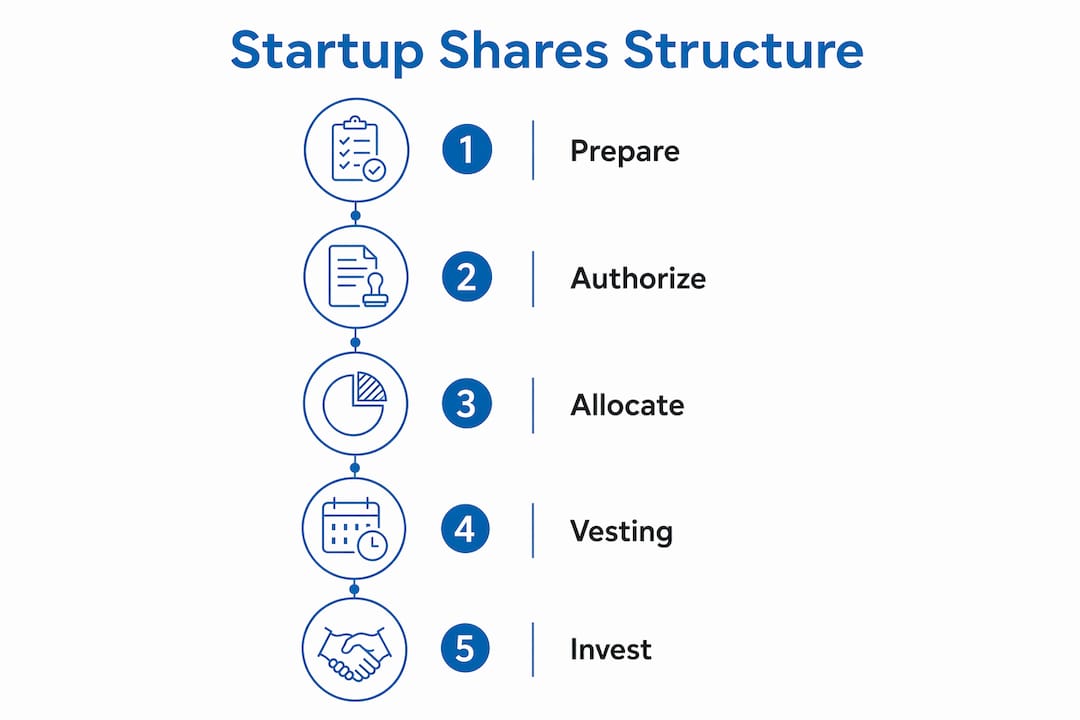
Here is the immediate action plan:
The worked cap table, UK legal checklist, and EMI guidance are all below.
Share capital is the foundation of your company’s ownership structure, and the terminology matters more than most founders realise until a lawyer asks them to explain it.
Ordinary shares are the default for UK startups. They carry one vote per share and equal rights to dividends and proceeds on a sale. Most founding teams start with nothing but ordinary shares, which keeps things clean for early SEIS investors.

Preference shares come in at Series A and beyond. Investors use them to secure a liquidation preference (the right to get their money back before ordinary shareholders see a penny on exit) and sometimes anti-dilution protection. You will not need to create preference shares at incorporation, but you should understand what you are agreeing to when you do.
Options and warrants are rights to buy shares at a fixed price in the future, not shares themselves. Options are the standard tool for employee equity; warrants are more common in debt instruments. A convertible note or SAFE (Simple Agreement for Future Equity) is a loan or agreement that converts into shares at a future round, usually at a discount.
Fully diluted is the number that actually matters to investors. It counts every share that exists today plus every share that could exist if all options, warrants, and convertibles were exercised. When an investor says they want 15%, they mean 15% of the fully diluted total, not just the shares currently issued.
Under the Companies Act 2006, the old concept of “authorised share capital” was abolished for UK companies. What matters now is whether your directors have the authority to allot shares under Sections 550 or 551 of the Act. Check your Articles of Association before you issue a single share. If the authority is not there, a board resolution granting it must come first.
Voting rights and economic rights can be separated. Two founders can hold 50/50 economically but have very different control depending on what their share class says about voting, reserved matters, and director appointment. That distinction becomes critical the moment you bring in outside investors.
The maths here is simpler than most founders expect, but the choice of total share number has lasting consequences.
Authorising 10 million shares makes the arithmetic clean: 0.1% equals exactly 10,000 shares, 1% equals 100,000, and so on. That precision matters when you are granting options to employees or negotiating with an investor who wants a specific percentage. Starting with 1,000 shares forces you into awkward fractions almost immediately.
Ownership percentage = shares owned ÷ total fully diluted shares × 100.
That is it. The complexity comes from keeping the denominator accurate as you issue new shares, create an option pool, and convert instruments.
Pro Tip: Set the vesting commencement date to the day each founder actually started working on the business, even if that predates incorporation. This is legitimate and avoids a cliff that feels arbitrary to the person vesting through it.
If one founder began work six months before the company was incorporated, their vesting schedule can start from that earlier date. Document it in the SHA with a clear rationale. Investors will ask, and “we agreed it at the time” is not an answer.
A notable portion of two-person founding teams opt for an equal equity split. That figure is not a ringing endorsement of the 50/50 split; it mostly reflects how many founders avoid the conversation.
Equal splits work when contributions genuinely are equivalent: both founders are full-time from day one, both bring comparable skills, and neither has contributed significant IP or capital. Even then, the split needs vesting behind it, because equivalence at founding rarely survives the first two years intact.
The governance risk is real. A 50/50 split without a casting vote or deadlock mechanism in the SHA can paralyse the company on any contested decision. Investors notice this. Some will insist on a resolution before they close.
A scoring approach forces the conversation without making it personal. Assign points across five dimensions, then convert points to percentages:
| Dimension | Founder A | Founder B |
|---|---|---|
| Time commitment (full-time from day one) | 30 | 20 |
| Capital contributed | 10 | 5 |
| IP / product creation | 20 | 10 |
| Network and sales access | 5 | 15 |
| Role difficulty / replaceability | 15 | 10 |
| Total | 80 | 60 |
Founder A: 80 ÷ 140 = 57%. Founder B: 60 ÷ 140 = 43%. The numbers are less important than the conversation they force. Both founders now have a documented rationale, which is what investors and lawyers actually want to see.
Stripe’s guidance on co-founder splits identifies four common approaches: equal splits, weighted contributions, dynamic or adjustable equity, and points-based systems. Each has trade-offs. Dynamic models, where the split adjusts based on ongoing contribution, sound fair in theory but create administrative complexity and can breed resentment when the formula produces unexpected results. For most early-stage UK startups, a fixed weighted split with vesting is cleaner and easier to defend.
Governance disputes between co-founders are one of the most common reasons UK startups stall before Series A. A properly drafted SHA with reserved matters and a dispute resolution clause is the structural fix. The legal risks of scaling without these protections are well documented: a departing founder who holds 30% with no vesting and no drag-along right can block a sale or a funding round indefinitely.
A four-year vesting schedule with a one-year cliff is market standard for founders and early employees. After 12 months, 25% of the shares vest in one go. The remaining 75% vest monthly over the following 36 months. Miss the cliff and you leave with nothing.

For founders, the mechanism is slightly different from employee options. You issue all the shares upfront (because you need them to exist for SEIS purposes, among other reasons), but the company retains a repurchase right over the unvested portion at the original issue price. If a founder leaves in month eight, the company buys back the unvested shares at £0.001 each. That is reverse vesting.
Issuing founder shares without a vesting schedule is one of the most common early equity mistakes, and institutional investors flag it immediately during due diligence. A co-founder who leaves after 18 months but keeps 40% of the company is dead equity: it sits on the cap table, it votes, and it scares off every subsequent investor.
These definitions determine what happens to unvested shares when someone exits. The standard positions are:
The negotiation usually centres on two points. First, what counts as a “good leaver” trigger. Founders should push to include “constructive dismissal” scenarios, where the company effectively forces them out. Second, acceleration: if the company is acquired, do unvested shares vest immediately (single trigger) or only if the founder is also dismissed post-acquisition (double trigger)? Investors prefer double trigger; founders prefer single. Double trigger is the more common outcome in UK seed deals.
The employee option pool at seed stage typically sits at 10–15% of fully diluted shares. That range is not arbitrary. Too small and you cannot attract the first five hires without going back to shareholders for approval. Too large and you are giving away founder equity before you know who you are hiring.
The pre-money versus post-money pool question is where founders consistently lose ground. If an investor asks for a 15% option pool to be created before the investment (pre-money), the dilution falls entirely on the founders. If it is created post-money, the investor shares the dilution. Most term sheets default to pre-money. Push back, or at least model both scenarios before you sign.
The Enterprise Management Incentive (EMI) scheme is the most tax-efficient way to grant options to UK employees. Under EMI, employees pay Income Tax and National Insurance only on any discount to market value at grant, and Capital Gains Tax (at the lower entrepreneurs’ rate) on the gain when they sell. For a startup with a low current valuation, that means an employee can receive options worth tens of thousands of pounds with minimal immediate tax cost.
EMI eligibility has conditions. The company must have gross assets under £30 million, fewer than 250 full-time equivalent employees, and must carry on a qualifying trade (financial services and property development are excluded). Options must be granted over shares in an independent trading company. HMRC offers an advance assurance process that confirms eligibility before you grant, which is worth doing for tax-efficient option grants.
Every funding round dilutes existing shareholders. The question is not whether you will be diluted but by how much, and whether the dilution is structured fairly.
If your pre-money valuation is £2 million and an investor puts in £500,000, the post-money is £2.5 million and the investor owns 20%. Your existing shares are now worth 80% of a larger pie.
SAFEs and convertible notes delay the valuation conversation. They convert into equity at the next priced round, usually at a discount (typically 15–20%) or subject to a valuation cap. The dilution is real; it just happens later. Model the conversion before you issue them, because a stack of SAFEs converting at a seed round can leave founders with far less than they expected.
Preferred shares at Series A typically carry a 1x non-participating liquidation preference. That means investors get their money back first on a sale before ordinary shareholders see anything. Participating preferred shares, where investors get their money back and share in the remaining proceeds, are more aggressive and worth resisting at seed.
The way you draft your SHA and investment agreements directly shapes what investors can and cannot do with their shares. Anti-dilution provisions, information rights, and pro-rata rights all live in these documents. Get them reviewed by a startup-specialist solicitor before you sign, not after.
Corporate hygiene is not glamorous, but a messy cap table is the single most common reason UK funding rounds slow down or collapse at due diligence. Here is the checklist.
Before you issue any shares:
At the point of issue:
For vesting and leaver terms:
Never backdate documents. Investors demand dated board consents and share purchase agreements. Backdating documents can kill or delay a funding deal. If you missed the formalities at incorporation, the correct fix is to document the current position accurately with a clear rationale, not to create documents that purport to be from an earlier date.
Pro Tip: Correct documentation is also the gateway to SEIS and EIS relief. SEIS investors can claim 50% Income Tax relief on investments up to £200,000 per company. If your share structure or filing history is incorrect, HMRC can deny the advance assurance, and the investor loses the relief. Get the paperwork right before you approach investors, not after they have committed.
For the statutory accounting and compliance obligations that sit alongside share issuance, including how share-based payments appear in your accounts, the requirements are set out under FRS 102.
This example uses round numbers so you can reproduce it in a spreadsheet.
| Shareholder | Shares issued | % (basic) | % (fully diluted) |
|---|---|---|---|
| Founder B | — | 40% | — |
| Founder C | — | 5% | 4% |
| Option pool (unissued) | — | — | 20% |
| Total | 10,000,000 | 100% | 100% |
Founders A, B, and C hold 8,000,000 issued shares. The — share option pool is reserved but unissued. On a fully diluted basis, the pool represents 20% of the total.
The investor receives 20% of the post-money company. Post-money valuation: £2.5 million. New shares issued to investor: — (calculated as 20% of the new fully diluted total of 12,500,000).
| Shareholder | Shares | % fully diluted |
|---|---|---|
| Total | — | 100% |
Calculation notes:
Notice that the option pool dilutes founders, not the investor, because it was created pre-money. If the pool had been created post-money, each founder’s percentage would be approximately 2–3 percentage points higher. That is the pre/post-money pool negotiation in numbers.
For a deeper look at how seed funding mechanics interact with financial statements, the investor readiness guide covers what angels and VCs actually check.
Structuring startup shares correctly from day one protects founders, attracts investors, and keeps SEIS, EIS, and EMI options open throughout the company’s growth.
| Point | Details |
|---|---|
| Issue with reverse vesting | All founder shares should carry a four-year vesting schedule with a one-year cliff and a company repurchase right over unvested shares. |
| Reserve a 10–15% option pool | Create the pool at incorporation and model whether it sits pre-money or post-money before negotiating with investors. |
| File at Companies House promptly | Return of allotment (Form SH01) must reach Companies House within one month of any share issuance. |
| Document every equity act formally | Board resolutions, share purchase agreements, and an updated register of members are the minimum for each issuance. |
| Use Priceandaccountants for SEIS/EIS/EMI | Priceandaccountants advises UK tech founders on cap table structure, SEIS/EIS advance assurance, and EMI scheme setup to keep fundraising on track. |
The cap table problems Priceandaccountants sees most often in UK startups are not complicated. They are almost always the same two things: shares issued at incorporation with no vesting, and a shareholders’ agreement that was never drafted because “we trust each other.”
Both of those are understandable. Founders are busy, the legal fees feel disproportionate at pre-seed, and the relationship is good. The problem surfaces 18 months later when one founder wants to leave, or when a Series A investor’s lawyer runs due diligence and finds that 35% of the company is held by someone who stopped contributing two years ago.
The conventional wisdom is that you need the “perfect” split before you issue shares. That is wrong. What you need is a defensible split with documented rationale and vesting behind it. Investors do not expect perfection; they expect evidence that the founders thought about it seriously and put protections in place. A 60/40 split with a clear scoring rationale and a four-year vest is far more fundable than a 50/50 split with no documentation and no leaver terms.
The other thing worth saying plainly: the SHA is not a sign of distrust between co-founders. It is the document that lets you resolve disputes without litigation. Every founder who has been through a co-founder exit will tell you the same thing. Draft it early, when everyone is aligned, because that is the only time it is easy.
Getting the share structure right is one thing. Keeping it compliant, tax-efficient, and ready for the next funding round is another.

Priceandaccountants works with UK tech and fintech founders from pre-seed through Series A, handling the practical work that sits between “we agreed the split” and “the investor signed.” That includes company formation with the right Articles, cap table and dilution modelling across multiple funding scenarios, SEIS and EIS advance assurance applications, EMI scheme setup and HMRC valuation agreements, and the ongoing accounting and compliance that keeps your statutory records clean between rounds.
Founders who come to Priceandaccountants before their first fundraise typically move through due diligence faster, because the paperwork is already in order. Those who come after a messy incorporation spend the first few weeks of the engagement fixing what should have taken an afternoon. The advisory and tax planning service covers SEIS/EIS eligibility checks, EMI structuring, and director tax planning so your equity grants are as tax-efficient as the law allows.
If you want a second pair of eyes on your current cap table or are setting up a new company and want to get the structure right from day one, get in touch with Priceandaccountants at priceandaccountants.com.
GOV.UK: Changes to your company’s share structure — the official Companies House guidance on filing obligations, including the one-month deadline for returns of allotment and what a statement of capital must contain. Essential reading before you issue any shares.
Brodies: How to issue shares in a private limited company — clear explanation of directors’ allotment authority under Sections 550/551 of the Companies Act 2006, correcting the common misconception about “authorised share capital.” Relevant to the legal checklist section above.
HMRC: Enterprise Management Incentives — the primary source for EMI eligibility criteria, the advance assurance process, and the annual return obligations. Check this before setting up any option scheme.
HMRC: SEIS and EIS guidance — official advance assurance application process and qualifying conditions. Confirms what share structure requirements apply for SEIS/EIS compliance.
Priceandaccountants: UK startup funding process guide — step-by-step overview of how UK funding rounds work and where cap table decisions intersect with investor negotiations.
Priceandaccountants: Director tax planning for tech founders — covers the tax implications of share awards, option exercises, and how to structure founder remuneration tax-efficiently alongside equity.