

TL;DR:
- Proper UK company formation is essential to avoid costly delays and compliance issues.
- Fintech founders must prepare legal, regulatory, and structural decisions early for smooth growth.
- Early expert support helps navigate FCA licensing, SEIS/EIS schemes, and ongoing regulatory obligations.
Getting your UK company formation wrong is more costly than most founders expect. A mismatched share structure can block SEIS eligibility. A poorly chosen SIC code can raise HMRC eyebrows. A missing registered office address can delay your incorporation by weeks. For tech and fintech founders, these are not abstract risks; they directly affect your ability to raise capital, stay compliant, and move fast. This guide walks you through every critical stage, from preparation and registration to funding readiness and fintech-specific regulation, so you can incorporate with confidence and build on a solid foundation.
Table of Contents
- What you need to prepare before setting up
- Step-by-step guide to registering your UK company
- Funding options and tax compliance essentials
- Fintech-specific compliance: FCA authorisation and sandbox testing
- The uncomfortable truth most founders miss about UK company setup
- Next steps: expert support for startup success
- Frequently asked questions
Key Takeaways
PointDetailsChoose the right company type‘Limited by shares’ suits tech/fintech startup ambitions and facilitates investor funding.Budget for registration and annual feesExpect a £100 setup fee and £50 yearly confirmation, plus possible extra costs for compliance support.Prioritise compliance from day oneDirectors must verify ID, file annual returns and tax statements on time to avoid penalties.Know fintech regulatory requirementsFintechs must follow FCA authorisation, have minimum capital, and use supervised sandbox testing.Professional support streamlines successAccountants and advisers help startups stay compliant and optimise funding strategies.
What you need to prepare before setting up
Before you open the Companies House portal, several decisions need to be locked in. Rushing this stage is where most founders lose time later.
Choose the right company type
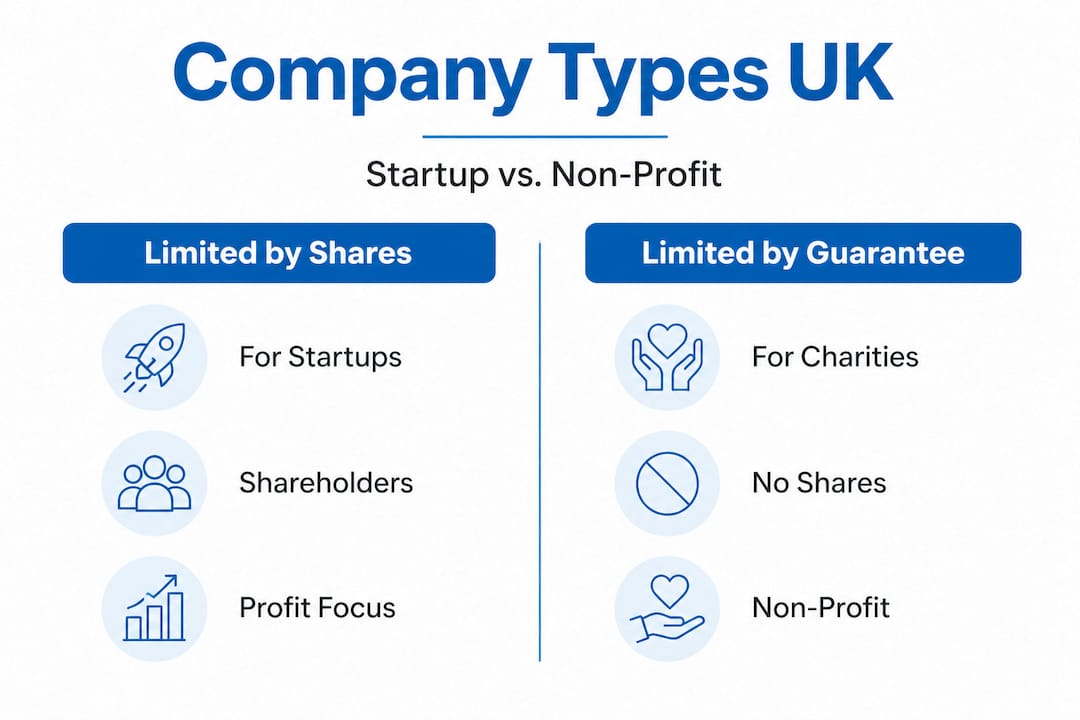
The vast majority of UK tech and fintech startups incorporate as a private company limited by shares. This structure gives you the flexibility to issue different classes of shares, bring in investors, and qualify for tax-advantaged schemes. As noted in fintech regulatory guidance, a company limited by shares is ideal for founders planning to raise via SEIS or EIS, because it supports the share structures those schemes require. A company limited by guarantee, by contrast, is designed for non-profits and membership organisations. It has no share capital, which means no equity for investors. For future tech startups planning any form of external funding, limited by shares is almost always the right choice.
Select a unique, compliant company name
Your company name must be unique within the Companies House register and cannot be misleading or offensive. Certain words, such as “bank,” “insurance,” or “royal,” require special permission. Fintech founders often want names that imply financial services, so check the UK company formation legal steps for restricted terminology before you fall in love with a brand name. You can check name availability directly on the Companies House website.
Appoint directors, shareholders, and PSCs
Every UK company needs at least one director. There is no minimum age for a corporate director, but there must be at least one natural person on the board. Shareholders (also called members) own the company through their shares. You also need to identify your Persons with Significant Control, or PSCs. A PSC is anyone who holds more than 25% of shares or voting rights, or who otherwise exercises significant influence. This information is publicly available on the Companies House register, so be prepared for transparency from day one.
Prepare your memorandum and articles of association
The memorandum of association is a short legal statement signed by all founding shareholders. The articles of association are your company’s internal rulebook, covering how decisions are made, how shares are transferred, and how directors are appointed. You can use the standard model articles, but most tech founders benefit from tailored articles that accommodate investor rights, drag-along and tag-along provisions, and different share classes. Getting this right from the start avoids expensive amendments later, as covered in our Ltd company accounts guidance.
Gather your registered office details and SIC code
Your registered office must be a physical address in the UK where official correspondence can be delivered. PO Boxes are not permitted. You also need a registered email address for Companies House communications. Finally, you must select a Standard Industrial Classification (SIC) code that best describes your business activity. For tech companies, codes in the 62000 range (computer programming and consultancy) are common. Fintech firms may use codes from the 64000 or 66000 financial services range.

Here is a quick comparison of the two most relevant company types:
FeatureLimited by sharesLimited by guaranteeSuitable forTech/fintech startupsNon-profits, charitiesCan issue sharesYesNoSEIS/EIS eligibleYesNoInvestor-friendlyYesNoProfit distributionVia dividendsReinvested only
Pro Tip: Draft your articles of association with future funding rounds in mind. Standard model articles rarely accommodate the share class complexity that angel investors and VCs expect.
According to GOV.UK, setting up a UK private limited company involves choosing the correct type, selecting a unique name, appointing directors, and preparing all legal documents before submission.
Step-by-step guide to registering your UK company
With your prerequisites assembled, here is how to officially incorporate your company step by step.
- Create a Companies House account. Go to the Companies House web filing service and register for an account. You will use this to submit your application and manage filings going forward.
- Complete Form IN01. This is the standard incorporation form. It captures your company name, registered office, director details, shareholder information, PSC data, and articles of association. Online submission via the web service is faster than paper.
- Verify director identities. From November 2025, directors must verify their identity with Companies House before or shortly after incorporation. This is part of the Economic Crime and Corporate Transparency Act reforms. Verification can be done directly through Companies House or via an Authorised Corporate Service Provider (ACSP).
- Provide your registered email address. This is now a mandatory field. Companies House will use this address for official communications, and it will not be published on the public register.
- Select your SIC code. Choose the code that most accurately reflects your primary business activity. You can select up to four codes if your business spans multiple sectors.
- Pay the incorporation fee. As of 1 February 2026, the digital incorporation fee is £100. Paper submissions cost £124. Online applications are typically processed within 24 hours; paper applications can take several days.
- Receive your Certificate of Incorporation. Once approved, you will receive a digital certificate confirming your company number and the date of incorporation. This is your legal proof of existence.
Here is a summary of the key registration details:
MethodFeeProcessing timeOnline (web service)£100Within 24 hoursPaper (Form IN01)£124Several working daysSame-day serviceAdditional feeSame business day
Pro Tip: Use the online service unless you have a specific reason not to. The cost saving is modest, but the speed advantage is significant, especially if you have investor meetings or contract signings lined up.
To streamline company accounts from day one, set up your cloud accounting software immediately after incorporation. Waiting until your first VAT return or year-end creates a backlog that is genuinely painful to untangle.
Funding options and tax compliance essentials
Once registered, your first priorities shift to staying compliant and attracting investors. These two goals are more connected than most founders realise.
Corporation Tax registration
HMRC is automatically notified when you incorporate, but you still need to register for Corporation Tax within three months of starting to trade. Your first Company Tax Return is due 12 months after your accounting period ends, and the tax itself must be paid within nine months and one day of your period end. Critically, you must file even if your company makes a loss. Missing this deadline triggers automatic penalties.
Annual filings you cannot skip
Every UK company must file the following each year:
- Annual accounts: A financial snapshot of your company’s performance, filed with Companies House.
- Company Tax Return (CT600): Filed with HMRC, detailing your taxable profits or losses.
- Confirmation statement: An annual confirmation that your Companies House records are accurate. The digital confirmation statement costs £50 per year.
SEIS and EIS: your funding superpower
The Seed Enterprise Investment Scheme (SEIS) and Enterprise Investment Scheme (EIS) are arguably the most powerful tools available to early-stage UK tech founders. SEIS allows investors to claim 50% income tax relief on investments up to £200,000 per company. EIS offers 30% relief on investments up to £12 million. To qualify, your company must meet specific criteria around size, age, and the nature of its activities. Getting your share structure and articles right from incorporation is essential for startup tax compliance.
Budgeting for ongoing costs
Beyond the £50 confirmation statement, budget for accountancy fees, payroll if you have employees, and potential VAT registration once your turnover approaches the £90,000 threshold. Good bookkeeping essentials from day one will save you significantly at year-end.
ObligationFrequencyCost/deadlineCorporation Tax registrationOnce, within 3 monthsFreeAnnual accountsYearlyAccountant fees varyCompany Tax ReturnYearly12 months after period endConfirmation statementYearly£50 digitalVAT registrationWhen turnover hits £90kFree to register
Fintech-specific compliance: FCA authorisation and sandbox testing
Fintech startups face a unique regulatory journey alongside standard company formation. If your product touches payments, e-money, lending, or crypto assets, standard incorporation is just the beginning.
FCA authorisation: plan for the long game
The Financial Conduct Authority (FCA) is the UK’s primary financial services regulator. If you are offering regulated activities, such as payment services, electronic money issuance, or investment management, you need FCA authorisation before you can operate. This process typically takes six to twelve months and requires substantial documentation, including your business plan, risk frameworks, and governance policies.
Capital requirements are non-trivial. A Payment Institution licence requires a minimum of £20,000 in capital. An Electronic Money Institution (EMI) licence requires €350,000. These are not optional buffers; they are regulatory minimums that must be maintained.
AML, KYC, and BWRA obligations
Anti-Money Laundering (AML) and Know Your Customer (KYC) protocols are mandatory for most fintech firms. You will also need to comply with the Business-Wide Risk Assessment (BWRA) requirement, which involves documenting the money laundering and terrorist financing risks your business faces. These are ongoing obligations, not one-off exercises.
“The FCA Regulatory Sandbox allows fintech firms to test innovative products and services in a controlled environment, with real consumers, under supervised conditions. It reduces the risk of regulatory breach during early-stage product testing.”
Using the FCA Regulatory Sandbox
The Regulatory Sandbox is one of the most valuable tools available to UK fintech founders. It allows you to test your product with real customers under a relaxed regulatory framework, with FCA oversight. This does not mean you can ignore governance; if anything, the FCA scrutinises sandbox participants closely. But it does give you a legitimate route to market before full authorisation is in place.
Working with accountants for tech founders who understand FCA timelines can help you plan your cash runway accordingly. Many fintech founders underestimate how long authorisation takes and run into funding gaps as a result.
Pro Tip: Apply for FCA authorisation as early as possible, ideally before you have a finished product. The application process will force you to clarify your business model in ways that are genuinely useful for investor conversations.
The uncomfortable truth most founders miss about UK company setup
Most founders treat company formation as a checklist. Tick the boxes, get the certificate, move on. The reality is that the certificate is just the start of an ongoing compliance relationship with Companies House, HMRC, and, for fintech firms, the FCA.
We have seen founders miss their first confirmation statement deadline because they did not realise it was a separate obligation from their tax return. We have seen SEIS applications rejected because the articles of association were not structured correctly at incorporation. These are not obscure edge cases; they are common mistakes that cost real money and time.
For fintech founders specifically, the FCA authorisation timeline is the single most underestimated variable in business planning. Twelve months is a realistic minimum. During that period, you cannot legally offer regulated services, which means your revenue model may be on hold. The compliance burden can slow innovation, but the Regulatory Sandbox exists precisely to bridge this gap. Use it strategically, not as an afterthought.
The deeper issue is that corporate accounting compliance is not a finance team problem. It is a founder problem. Until you have a CFO or Finance Director on board, the responsibility sits with you. The founders who scale fastest are the ones who build compliance into their operating rhythm from month one, not the ones who scramble to catch up at year-end.
Next steps: expert support for startup success
Navigating incorporation, SEIS structuring, and FCA timelines simultaneously is a significant undertaking for any founding team. Getting specialist support early is not a luxury; it is a practical way to protect your funding eligibility and avoid costly corrections later.

At Price & Accountants, we work exclusively with tech and fintech founders at every stage from pre-seed to Series A. Whether you need help structuring your shares for R&D tax credits, building a tax-efficient growth strategy through advisory tax planning, or setting up clean, audit-ready records through our bookkeeping services, we provide the practical, sector-specific expertise that generalist accountants simply cannot match. With over 20 startup clients now valued above £50 million, we know what good looks like from day one.
Frequently asked questions
Do I need a UK-resident director to set up a company?
No, a UK-resident director is not required to incorporate a private limited company. However, fintech firms seeking FCA authorisation may find that having a UK-based director strengthens their application significantly.
How much does it cost to set up a UK company in 2026?
The digital Companies House fee is £100 as of 1 February 2026, up from the previous £50. Paper submissions cost £124, with longer processing times.
What ongoing filings are required after company setup?
You must file annual accounts and a Company Tax Return with HMRC each year, even if your company made no profit. A confirmation statement costing £50 must also be filed annually with Companies House.
What are the main fintech regulatory hurdles?
Fintech companies must obtain FCA authorisation for regulated activities, meet minimum capital requirements (£20,000 for Payment Institutions, €350,000 for EMIs), and implement robust AML and KYC protocols before operating.
Recommended
- Ltd company accounts: expert guide for UK startups - Price & Accountants
- What is startup tax compliance? A UK founders’ guide for 2026 - Price & Accountants
- Streamline company accounts in the UK: A guide for tech startups - Price & Accountants
- Step-by-step tax planning guide for UK startups 2026 - Price & Accountants