TL;DR:
- Building a proactive tax compliance system is essential for scaling UK startups and avoiding penalties.
- Digital workflows and timely submissions improve efficiency, accuracy, and investor confidence.
- Treat tax compliance as a core business operation, not just an annual administrative task.
Picture this: it’s the night before a VAT return deadline, your bookkeeping is spread across three spreadsheets, and you’re not entirely sure whether your latest funding round has triggered a new HMRC obligation. For too many UK tech founders, this isn’t a hypothetical. Tax compliance gets treated as a reactive chore rather than a planned discipline, and the consequences range from penalty charges to stalled investor rounds. This guide gives you a structured, repeatable workflow that covers every major obligation, from Corporation Tax to SEIS/EIS submissions, so you can stop firefighting and start scaling with confidence.
| Point | Details |
|---|---|
| Map obligations early | Identify all obligations by company type before setting compliance routines. |
| Digitise compliance tasks | Use HMRC-compatible software for records, submissions, and routine monitoring. |
| Control VAT and invoicing | Accurate invoices and VAT controls are essential to prevent compliance failure or funding delays. |
| Stay funding-ready | Build SEIS/EIS, tax, and investor milestones into your workflow for smooth investment rounds. |
| Own the verification process | You are responsible for accuracy in filings—regular reviews and disclosure safeguard compliance. |
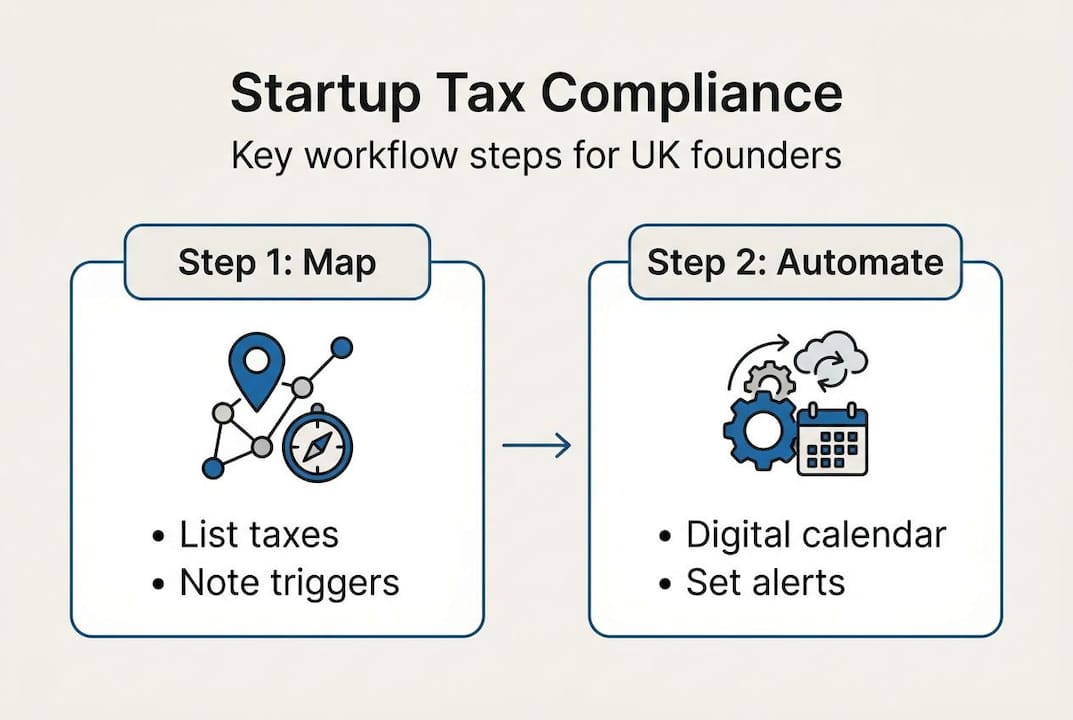
Every reliable compliance workflow starts in the same place: knowing exactly what you owe, to whom, and when. Before you choose software or set calendar reminders, you need to understand your company structure because it determines everything else.
Sole trader or limited company? The choice carries serious implications. As a sole trader, your income tax and National Insurance obligations flow through Self Assessment, and you carry personal liability. As a limited company, you gain liability protection and access to investor reliefs such as SEIS and EIS, but you take on additional obligations including Corporation Tax, PAYE if you have employees, and potentially VAT. For most founders seeking external investment, the limited company route is effectively non-negotiable.
Once you have confirmed your structure, a solid startup tax compliance overview will help you map the specific obligations that apply. These typically include:
Understanding what triggers each obligation is just as important as knowing the obligation itself. Receiving your first SEIS investment, for example, changes your share structure and triggers specific HMRC reporting steps. Crossing the VAT threshold mid-year means you must register within 30 days. As HMRC’s Tax Confident guidance confirms, mapping your company type and core obligations is the essential first step before selecting systems or scheduling deadlines.
| Obligation | Sole trader | Limited company |
|---|---|---|
| Income Tax via Self Assessment | Yes | Director only (on salary/dividends) |
| Corporation Tax | No | Yes |
| VAT | If threshold met | If threshold met |
| PAYE | If employing staff | If employing staff or paying salary |
| SEIS/EIS eligibility | No | Yes |
For solid commercial footing alongside your tax obligations, it is also worth reviewing essential contract terms to ensure your trading agreements support clean financial records.
Pro Tip: Create a shared digital calendar from day one with every key tax deadline pre-loaded. Revisit it at the start of each financial year to capture any threshold changes announced in the Autumn Budget.
With your obligations mapped, the next step is building a system that manages them without constant manual effort. HMRC’s Making Tax Digital (MTD) initiative is reshaping how businesses record and report financial data, and it is not optional. For VAT, MTD is already mandatory for all VAT-registered businesses. Income Tax MTD is being phased in from April 2026 for sole traders and landlords with income above £50,000.
Choosing the right software is your foundation. Compatible platforms include Xero, QuickBooks, FreeAgent, and Sage. Each integrates with HMRC’s systems and can submit VAT returns directly. The key is choosing a platform that fits your team’s size and complexity, not just the cheapest option. A Making Tax Digital guide for startups can help you assess which solution suits your stage of growth.
As HMRC confirms, the core compliance operating loop involves digital record-keeping paired with periodic submissions through MTD-compatible software. Here is how to build that loop from day one:
| Compliance task | Frequency | Tool or feature needed |
|---|---|---|
| Bank reconciliation | Monthly | Bank feed integration |
| VAT return preparation | Quarterly | MTD-compatible VAT module |
| PAYE payroll run | Monthly | Payroll software or add-on |
| CT600 draft preparation | Annual | Year-end accounts module |
| SEIS/EIS tracking | As needed | Share register and document storage |
For accounting tech tips tailored to scaling startups, guidance on integrating tools such as Dext or AutoEntry for receipt capture can save your team hours each month.
Pro Tip: Set automated deadline alerts inside your accounting software and your project management tool simultaneously. Two independent reminders for the same deadline dramatically reduce the risk of a missed filing.
Once your digital workflow is running, ensuring robust VAT and invoice controls becomes your next critical safeguard. VAT errors are among the most common reasons HMRC opens an enquiry into a startup’s records, and they are almost entirely preventable with the right habits.

A sound VAT control framework, as outlined in British Business Bank guidance, covers four pillars: accurate VAT accounting on both sales and purchases, regular invoice accuracy checks, structured risk management processes, and strong data infrastructure to support MTD submissions. Each pillar reinforces the others.
On the invoice side, HMRC’s invoice requirements specify that every VAT invoice must contain:
Missing invoice details can trigger HMRC reviews and funding delays.
Common pitfalls that trip up even careful founders include applying the wrong VAT rate (for example, treating a zero-rated digital service as standard-rated), omitting the tax point date on invoices raised in a different VAT period, and failing to issue VAT invoices to business customers who require them for their own reclaims. These are not obscure errors. They are routine, and they compound over time.
Reviewing your tax planning checklist quarterly can help you catch VAT classification issues before they become filing problems.
Pro Tip: Schedule a quarterly invoice audit as a standing item in your compliance calendar. Pull a random sample of 20 invoices from each quarter and check them against the required fields listed above. Catching one error before a filing saves significantly more time than correcting it after an HMRC query.
With routine tax compliance in hand, let’s address the submissions that make or break startup investment. SEIS (Seed Enterprise Investment Scheme) and EIS (Enterprise Investment Scheme) are among the most powerful tools available to UK tech founders, but they are also among the most process-sensitive. A missed step or incorrect filing can delay investor relief for months.
As Oriel IPO’s guidance makes clear, treating SEIS/EIS as a funding-critical workflow rather than a post-investment admin task is essential. Here is the core process:
For your broader Corporation Tax timeline, Taxpipe’s guidance highlights a crucial split: you must file your CT600 return within 12 months of the end of your accounting period, but payment is due within 9 months and 1 day after the period ends. Founders routinely confuse these two dates, leading to late payment interest even when the return itself is filed on time.
Missing these milestones carries real consequences:
Using a step-by-step tax planning guide helps you integrate these milestones into your broader compliance workflow from the outset.
Pro Tip: Build a shared tracker in Notion or Google Sheets that your legal and accounting teams can both access. Map every SEIS/EIS deadline, share issuance date, and HMRC correspondence onto a single timeline. Visibility across teams eliminates the most common cause of missed submissions: assumption that someone else has it covered.
Effective workflows do not just run. They adapt. When situations fall outside the standard playbook, most founders either freeze or guess. Both responses carry risk.
Your responsibility for correct filings does not transfer to your adviser when you engage one. As S&W Group’s review of HMRC’s GfC13 confirms, taxpayers must meet a best-efforts standard, which means actively ensuring filings are complete and correct rather than simply signing off on whatever an adviser produces. If you are uncertain about a specific treatment, the right move is to disclose that uncertainty to HMRC rather than file with an assumption.
Common red-flag scenarios that warrant extra scrutiny include:
Disclosure is not a weakness but a compliance safeguard.
For deeper guidance on these scenarios, corporate accounting insights tailored to tech founders can help you build internal review processes that flag edge cases before they escalate.
Having covered the mechanics, here is the perspective that most compliance guides omit entirely. The founders who scale successfully do not treat tax compliance as an annual obligation to satisfy. They treat it as a core operating system, as fundamental to their business as their product roadmap or hiring plan.
The conventional view is that compliance is a cost centre: something you minimise, outsource, and ignore until it becomes urgent. The data tells a different story. Investors conducting due diligence on a Series A round will review your tax position in detail. Clean records and a well-documented compliance history signal that your business is professionally managed. Messy records signal the opposite, and that perception can shave points off your valuation.
There is also a strategic insight that most founders miss: self-imposed compliance standards often outpace statutory minimums by a meaningful margin, and that gap creates competitive advantage. When you close your books monthly, run quarterly audits, and maintain a real-time share register, you have the financial data to make faster, better-informed decisions than competitors who only look at their numbers at year end.
Workflow discipline is as foundational to scaling as product-market fit. You can have the most compelling product in your sector, but if your SEIS certificates are late, your CT600 is filed incorrectly, or your VAT records cannot withstand a routine check, growth stalls. The importance of proactive tax planning is not abstract; it is the difference between a funding round that closes on schedule and one that drags for six months while investors wait for compliance sign-off.
Building this workflow from scratch is achievable, but maintaining it under the pressures of a scaling startup is a different challenge entirely.

At Price & Accountants, we work with UK tech and fintech founders from pre-seed through to Series A, helping them establish compliance workflows that satisfy HMRC, satisfy investors, and free up founder time for what matters. Our bookkeeping solutions keep your records audit-ready throughout the year, while our corporation tax expertise ensures your CT600 is accurate and submitted on time. If you are investing in innovation, our R&D Tax Credits service helps you reclaim capital that belongs back in your business. Get in touch to see how we can streamline your compliance and keep your funding journey on track.
The most commonly missed deadlines are Corporation Tax registration, CT600 filing, and timely VAT returns. As Taxpipe confirms, Corporation Tax registration within the required period after starting to trade is a milestone many new limited companies overlook entirely.
Businesses must keep sales, purchase, payroll, and VAT records digitally in a compatible system under Making Tax Digital rules. HMRC’s guidance confirms that MTD-compatible software must be used to store and submit these records.
Missing a deadline can delay investor reliefs and risk losing critical early-stage funding relationships. Oriel IPO’s process guide notes that incomplete or late submissions can stall relief for investors indefinitely until the compliance statement is corrected.
The company remains responsible for completeness and accuracy, even when using professional advisers. S&W Group’s analysis of HMRC’s compliance standards confirms that taxpayers must meet a best-efforts standard regardless of who prepares the return.
Required fields include a unique sequential invoice number, dates, seller and customer details, a description of supply, and the VAT rate and amount shown separately. HMRC’s invoice requirements set these out clearly and apply to all VAT-registered businesses issuing invoices to other businesses.