TL;DR:
- Overseas founders can establish a UK company remotely without residency or British citizenship requirements. They must secure a physical UK address, complete digital identity verification, and file incorporation documents through Companies House. Properly setting up and complying from the start facilitates access to UK funding schemes and ensures long-term business success.
Setting up a UK business as an overseas founder requires appointing at least one director, securing a physical UK registered office address, completing mandatory identity verification, and filing incorporation documents with Companies House. None of these steps require UK residency, a visa, or British citizenship. Registration via the UK government portal costs £50 as of April 2026, with most applications processed within 24 to 48 hours. The UK remains one of the most accessible jurisdictions in the world for foreign founders, but the compliance requirements have tightened significantly since late 2025, and getting the structure right from day one saves considerable cost and effort later.
The UK imposes no nationality or residency restrictions on company directors or shareholders. Any individual aged 16 or over, regardless of passport, can serve as a director of a UK private limited company. This makes UK business registration for foreigners genuinely straightforward on paper, though several practical requirements demand careful preparation.
The non-negotiable prerequisites are:
Most overseas founders use formation agents who bundle virtual office addresses, registered office services, and identity checks into a single package. Formation agents handle mail scanning and forwarding for affordable annual fees, reducing the risk of application rejection and saving significant administrative time.
Pro Tip: Before engaging a formation agent, confirm they are authorised to conduct Companies House identity verification checks. Not all providers have this accreditation, and using an unauthorised agent will delay your incorporation.
The private limited company (Ltd) is the correct structure for the overwhelming majority of overseas founders, particularly those building tech or fintech businesses. The reason is specific: the Ltd structure is required to access UK tax incentives such as SEIS and EIS, which are the primary early-stage fundraising tools available to UK startups. The UK venture capital market invested £9 billion in innovative companies last year, and SEIS and EIS schemes are central to how that capital reaches founders. You can read more about how these schemes work in this guide to SEIS and EIS funding.
When preparing your incorporation documents, two decisions carry long-term consequences:
On share structure, the minimum requirement is one share issued to one shareholder. In practice, founders should think carefully about the initial share split, the nominal value per share, and whether to create multiple share classes from the outset. A poorly designed share structure at formation can complicate SEIS compliance and investor negotiations later.
Pro Tip: If you plan to bring on co-founders or early employees with equity, set up your share structure and Articles before incorporation rather than amending them afterwards. Post-incorporation changes require additional filings and legal fees.

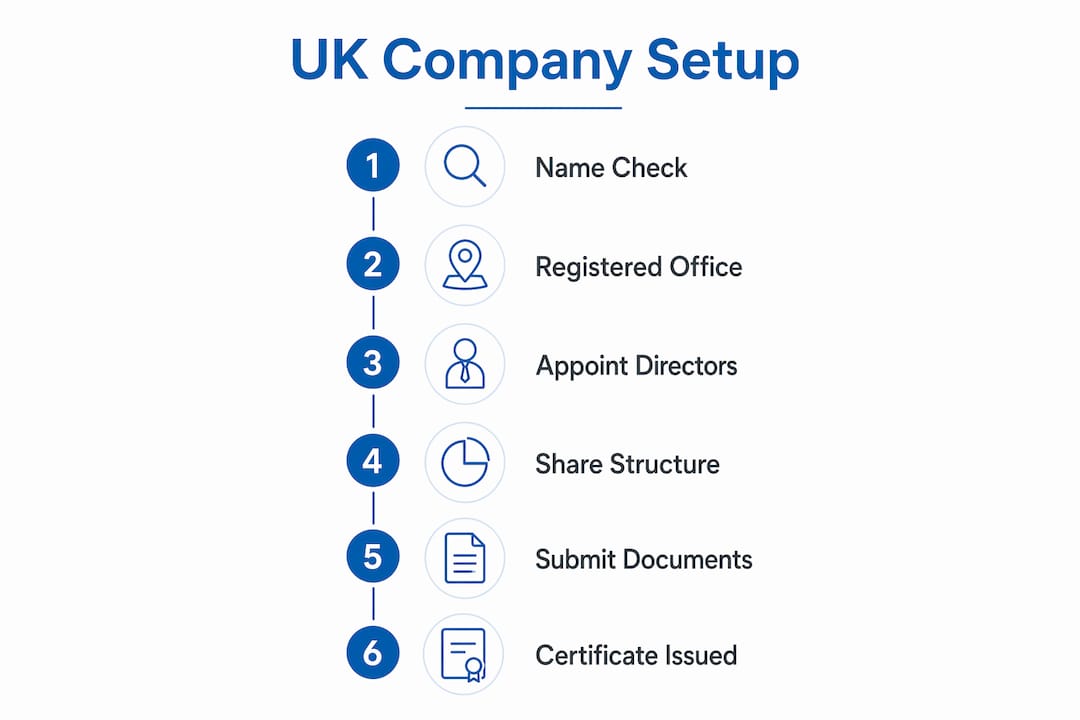
The registration process follows a clear sequence. Each step builds on the last, and skipping or rushing any stage is the most common cause of rejection or delay.
| Step | Action required | Typical timeframe |
|---|---|---|
| Name check | Companies House online checker | Immediate |
| Address setup | Virtual office or accountant | 1 to 3 days |
| Identity verification | GOV.UK One Login or authorised agent | 1 to 2 days |
| Incorporation filing | Companies House online portal | 24 to 48 hours |
| Certificate issued | Received digitally | Same day as approval |
Traditional UK banks, including Barclays, HSBC, and NatWest, often reject non-resident applicants outright or require an in-person branch visit. This is the single most frustrating post-incorporation obstacle for overseas founders. The practical solution is to use regulated fintech providers. Wise, Revolut, and Tide all offer remote business account setups completed in one to five days, providing UK sort codes and account numbers that function identically to traditional bank accounts for most business purposes. The important caveat is that some fintech providers lack Financial Services Compensation Scheme (FSCS) protection, so they are not suitable for holding large cash reserves.
Once your account is open, your compliance obligations begin immediately. The key ongoing requirements are:
Pro Tip: Set calendar reminders for every statutory deadline from the moment you receive your Certificate of Incorporation. Companies House does not send reminders by default, and late filing penalties accumulate quickly for non-resident founders who are not monitoring UK deadlines.
For founders planning to raise investment, understanding the UK tax reliefs available to startups, including R&D credits, SEIS, EIS, and EMI options, is worth doing before your first funding conversation.
Overseas founders can register a UK private limited company fully remotely, but success depends on correct address setup, identity verification, and ongoing compliance from day one.
| Point | Details |
|---|---|
| No residency required | Any individual aged 16+ can direct a UK company regardless of nationality or location. |
| Physical address is mandatory | Virtual office providers fulfil the registered office requirement from £40 per year. |
| Identity verification is now digital | All directors and PSCs must complete biometric or video verification since late 2025. |
| Ltd structure unlocks funding | Only private limited companies can access SEIS and EIS schemes for early-stage investment. |
| Compliance starts immediately | Corporation Tax registration, annual accounts, and Confirmation Statements are statutory obligations from incorporation. |
The single biggest mistake I see overseas founders make is treating company formation as a one-time administrative task rather than the foundation of a long-term business structure. They rush through the Articles of Association, pick Model Articles because it is the default, and then spend thousands of pounds restructuring everything when their first investor asks for drag-along rights or a preference share class.
The second misconception worth addressing directly: forming a UK company does not grant any immigration rights. You cannot live or work in the UK simply because you own a UK company. This surprises a significant number of founders who conflate business registration with the right to relocate. If physical presence in the UK is part of your plan, a separate visa application, typically under the Innovator Founder or Skilled Worker routes, is required.
What I consistently recommend to founders at the planning stage is to think three years ahead. If you expect to raise a seed round within 18 months, invest in bespoke Articles now. If you have co-founders, document your equity split and vesting terms before you file. If your product involves genuine research and development, structure your activities to qualify for R&D tax credits from the first financial year. These decisions cost very little at formation and save a great deal later.
The UK remains one of the most founder-friendly jurisdictions in the world for overseas entrepreneurs. The compliance framework is clear, the tax incentives are genuinely generous, and the legal infrastructure is well understood by international investors. Getting the foundations right is the only part that requires real care.
— Rahamut
Priceandaccountants works directly with international founders to handle every stage of UK company formation and post-incorporation compliance, from securing a registered office address to filing annual accounts and Corporation Tax returns. Our team specialises in SEIS and EIS scheme management, R&D tax credit claims, and cloud accounting through Xero, giving overseas founders real-time visibility of their UK finances without needing to be in the room.

If you are building a tech or fintech business and need a financial partner who understands the specific pressures of running a UK company from abroad, our specialist accounting services are designed precisely for your situation. We have supported over 20 startups through formation and growth, several now valued above £50 million. Get in touch to find out how we can take the complexity out of your UK business setup.
Yes. There are no nationality or residency requirements for UK company directors. A single non-resident individual can serve as both the sole director and sole shareholder of a UK private limited company.
No. Company formation does not confer any immigration rights. Overseas founders who wish to live or work in the UK must apply separately for the appropriate visa, such as the Innovator Founder visa.
You must use a physical UK address as your registered office. Virtual office providers and accountancy firms such as Priceandaccountants offer registered office address services, typically costing between £40 and £120 per year, which fully satisfies the Companies House requirement.
Online registration through Companies House or a formation agent typically takes 24 to 48 hours once all documents and identity verification are complete. Delays most commonly occur when identity documents require certified translation or when verification checks are incomplete.
All UK companies must register for Corporation Tax with HMRC within three months of starting to trade. VAT registration becomes mandatory once taxable turnover exceeds £90,000 in a rolling 12-month period, though voluntary early registration is available and often advantageous for B2B businesses.