

Cash runway planning means working out how many months your company can keep operating before the bank balance hits zero, then deciding what you will do while there is still time to act. The sum is simple: cash in the bank divided by monthly net burn. The planning is the hard part: forecasting burn honestly, knowing when cash will land from R&D claims or investors, and starting the next raise early enough that you never negotiate with an empty account.
This guide is written for founders of UK tech and fintech companies, from pre-seed to Series A. It covers the formula, a worked example, what investors now expect, how to build a forecast that holds up, and the UK-specific sources of cash that can add months.
TL;DR
- Runway equals cash on hand divided by monthly net burn (cash out minus cash in). Use the average of the last three to six months, then test it against your forward plan.
- Seed-stage expectations have moved: recent benchmarking puts the modern target at 24 to 30 months of cash after a seed round, not 12 to 18.
- Plan the raise to start with at least six to nine months of cash left. Fundraising takes longer than most founders budget for.
- UK levers that extend runway include R&D tax relief, SEIS/EIS advance assurance to make your round easier to close, and, in some cases, venture debt.
- Update the forecast monthly and reconcile it with actuals. A model nobody reopens is a guess.
Table of Contents
- What cash runway actually measures
- A worked example
- How much runway is enough
- Building a forecast that holds up
- UK sources of cash that extend runway
- Ways to extend runway without panic
- Our perspective: runway is a conversation with your adviser, not a spreadsheet
- How we can help
- A monthly runway routine
- FAQ
- Sources
What cash runway actually measures
Runway is the number of months of operation your current cash can fund at your current spending rate. It is a survival metric first, and a negotiating metric second: the shorter it gets, the weaker your hand with investors, suppliers and even key hires.
The formula:
Cash runway (months) = cash on hand ÷ monthly net burn
Two definitions matter here:
- Gross burn is everything you spend each month: salaries, employer’s National Insurance, pension contributions, contractors, cloud hosting, software, rent, professional fees.
- Net burn is gross burn minus the cash you actually receive from customers in that month. Runway uses net burn.
Note the word cash. Revenue you have invoiced but not collected does not count, and neither does a grant you have been promised but not received. A company with healthy invoiced sales and slow-paying customers can run out of money while the profit and loss account looks fine. If your books are not reconciled to the bank, your runway number is only as good as your last reconciliation. This is where clean bookkeeping pays for itself.
A worked example
The figures below are illustrative, not real client data.
A seed-stage SaaS company has £600,000 in the bank. Over the last three months it has spent an average of £70,000 a month in total and collected an average of £20,000 a month from customers.
| Item | Monthly figure |
|---|---|
| Gross burn (all cash out) | £70,000 |
| Cash received from customers | £20,000 |
| Net burn | £50,000 |
| Cash on hand | £600,000 |
| Runway | 12 months |
Now add the forward plan. The team intends to hire two engineers in month three at a combined cost of £14,000 a month, including employer’s National Insurance and pension. Net burn rises to £64,000 from month three. Revenue growth of £2,000 a month offsets part of that. Month by month, the real runway is closer to 10.5 months than 12, and that is the number you should be working with.
This is why a single division is never enough. The headline figure is a starting point; the forecast is the plan.
How much runway is enough
There is no universal answer, but there are useful reference points.
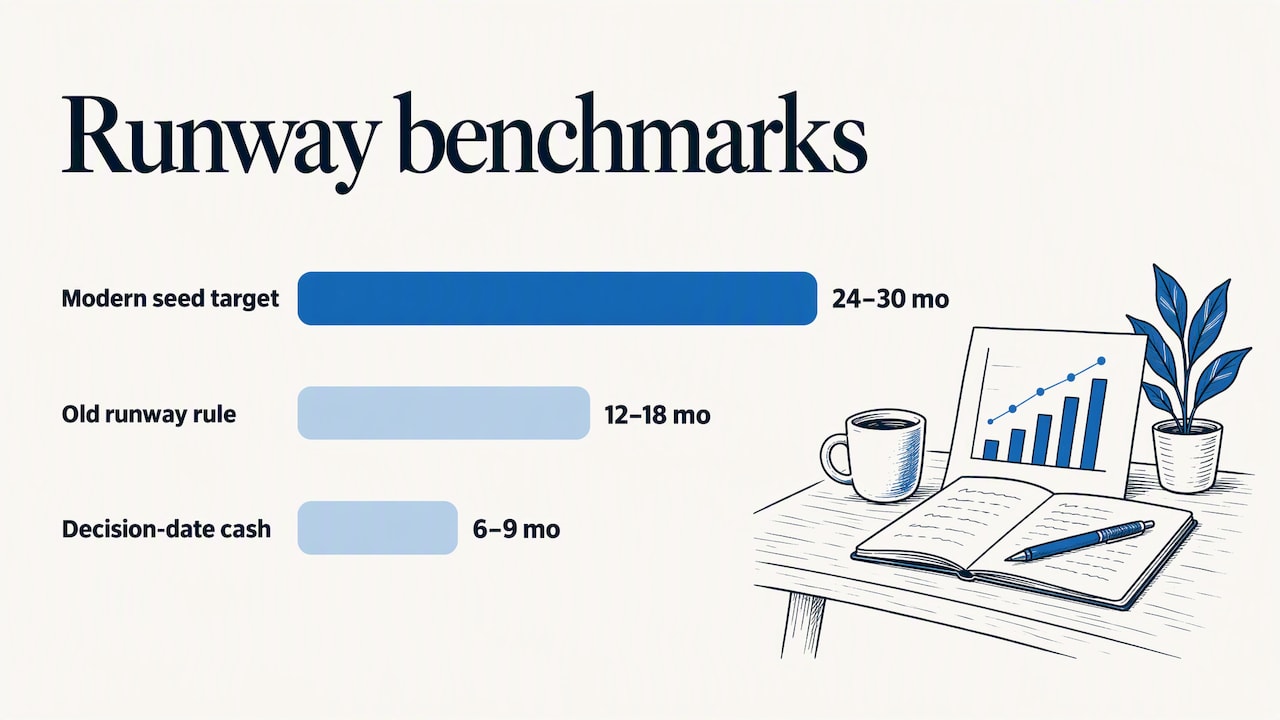
Seed-stage benchmarking published in March 2026 argues that the modern expectation is 24 to 30 months of cash after a seed round. The same source reports that the median gap between seed and Series A reached 696 days as of Q2 2025, which is why the old 12 to 18 month rule leaves founders exposed. It also gives a median monthly burn of around £20,000 at pre-seed and £50,000 to £80,000 at seed, and notes that AI-focused companies often burn considerably more because of compute costs. Treat these as benchmarks from one data set, not a rule that applies to your business.
A practical way to use them:
- Count from the end of the round, not the start. If you raise £1.2m and burn £50,000 a month, that is 24 months on paper, but only if burn stays flat.
- Set a decision date. Choose the month by which you must either have the next round in progress or have cut burn. For most founders that is when cash covers six to nine months.
- Work backwards from milestones. Investors at the next stage fund evidence: revenue, retention, a product shipped. Ask whether your runway reaches those milestones with room to spare.
Low burn is not the goal; efficient burn is
The same benchmarking source warns that the idea that low burn is always better is a trap. Investors look at burn efficiency: output relative to spend. It cites a burn multiple (net burn divided by net new annual recurring revenue) of 2.0x to 3.0x as healthy at seed, with anything above 3.5x a red flag. If you spend £50,000 a month and add £200,000 of new ARR over a year, your burn multiple is £600,000 ÷ £200,000 = 3.0x. That is the top of the healthy band, and it tells you more than the burn figure alone.
Building a forecast that holds up
A runway number is only as reliable as the forecast behind it. Here is the structure we recommend to founders.
Two horizons, two jobs
- A 13-week cash forecast, updated weekly, built from actual expected receipts and payments. ICAEW guidance for accountants recommends rolling 13-week forecasts based on actual inflows and outflows to spot shortfalls early.
- A rolling 12 to 18 month forecast, updated monthly, built from operational drivers: hiring plan, sales pipeline, pricing, and the timing of any funding.
The short view stops you missing payroll. The long view tells you when to raise.
Build it from operations, not from a growth percentage
Top-down forecasts (‘revenue grows 15% a month’) are easy to write and easy to get wrong. ICAEW’s commentary on scale-up forecasting stresses that forecasting should not be an isolated finance task: robust models draw on input from sales, HR and operations, so projections reflect shifting hiring plans and changing lead times. In practice, that means your head of sales confirms the pipeline assumptions, and whoever manages hiring confirms start dates.
What to include in the cash model
- Payroll, employer’s National Insurance and pension contributions, by start date
- Customer receipts by revenue stream, with realistic payment terms rather than invoice dates
- Cloud and software costs, which often scale with usage
- VAT, PAYE and corporation tax payments on their due dates
- Any R&D tax relief receipts, entered at the date you expect cash, not the date you file
- Investor money, split into committed and uncommitted
Run three scenarios
Build a base case, a downside (revenue 20 to 30% below plan, a key deal slipping by a quarter) and an upside. The downside is the one that sets your decision date. If it shows nine months of cash, you should be talking to investors or trimming spend now, not when the base case catches up.
UK sources of cash that extend runway
This is where UK founders have options that a generic runway guide misses.
R&D tax relief
If your team is doing qualifying software or engineering work, R&D relief can be one of the largest single additions to runway. For accounting periods beginning on or after 1 April 2024, the merged scheme replaced the old RDEC and SME schemes. According to the latest HMRC statistics, the merged R&D expenditure credit rate is 20%, and loss-making R&D-intensive SMEs can get an additional 86% deduction on qualifying costs under the enhanced R&D intensive support (ERIS). Where that creates a surrenderable loss, the payable credit is worth up to 14.5% of it, and the SME must meet a 30% R&D intensity threshold to qualify.
For planning, the key is timing. A claim is filed after the accounting period ends, and cash arrives some time after that. If you model R&D receipts, enter them conservatively and as a separate line, so you can see how much of your runway depends on them. Our guide to the 30% intensity rule explains how to test whether your company qualifies, and our comparison of RDEC and the old SME scheme covers what changed.

SEIS and EIS: making the raise easier to close
SEIS and EIS do not put money in your account directly, but they change the odds of closing a round, because UK angels value the tax reliefs they get. Advance assurance from HMRC tells investors your shares are likely to qualify before they commit. In 2025-26, HMRC approved 76% of SEIS and 72% of EIS advance assurance applications, from more than 4,000 SEIS and 3,300 EIS requests, so roughly a quarter of applications did not succeed. Getting the share structure and trade description right first time avoids a delay you cannot afford when runway is short.
Start with our guides to SEIS advance assurance, SEIS eligibility and choosing between SEIS and EIS.
Venture debt
For companies with institutional backing, debt can bridge a gap. The British Business Bank describes venture debt as a way to extend a company’s cash runway, and presents it as a non-dilutive alternative to raising another equity round early. It is not for every company: it is repaid with interest, usually suits businesses with existing investor support, and needs careful modelling against your downside scenario. Treat it as a bridge to a defined milestone, never as a substitute for a plan.
Ways to extend runway without panic
Once the forecast shows a problem, you have two groups of levers.
Spend levers
- Delay hires that do not unlock the next milestone. Every month of delay on a £7,000-a-month hire saves £7,000 of cash.
- Review software and cloud commitments. Annual prepayment discounts look cheap but pull cash forward.
- Renegotiate or restructure supplier terms before you need to.
Cash-in levers
- Move customers from monthly to annual billing where they will agree, ideally with a modest discount.
- Tighten collections: invoice on the day of delivery, chase on day one past due.
- Claim what you are owed: R&D relief, and any other reliefs your adviser confirms apply.
Change one or two of these and recalculate. The aim is to see the effect on the decision date, not just the headline figure.
Our perspective: runway is a conversation with your adviser, not a spreadsheet
We work with founders from pre-seed to Series A, and the pattern repeats. The founders who run into trouble are rarely those who never calculated runway. They are the ones whose number was out of date, built from a bank balance that had not been reconciled, or who treated an expected R&D payment or investor transfer as cash already.
Three habits separate the calm ones from the rest.
- They close the books monthly. Real-time accounting on Xero means the starting cash figure is right, and the burn figure reflects what actually happened, not what was budgeted.
- They link the funding story to the numbers. If you intend to raise on SEIS or EIS, your share structure, advance assurance and cash forecast should be planned together. A round delayed by a rejected application changes your runway in real terms.
- They treat tax relief as part of the plan, not an afterthought. For a loss-making technology company, R&D relief can change the shape of the next 12 months. It deserves a line in the forecast, owned by someone who understands the rules.
Our view is that the most useful thing an outsourced finance director does for an early-stage company is to make the runway question boring: the number is known, the decision date is set, and nobody is surprised.
— Rahamut
How we can help
If you want a second pair of eyes on your runway, we support UK tech and fintech founders with monthly accounting on Xero, R&D tax credit claims, SEIS/EIS compliance and outsourced finance director support. Our published plans start at £249 a month for Core Services and £549 a month for the Blue Plan, with the Black Plan from £1,999 a month; finance directorship services are listed on the same pricing page. You can also read about our strategic advisory and tax planning and our R&D tax credit service, or contact us to talk through your forecast.
A monthly runway routine
If you take one process from this guide, make it this one. It takes a couple of hours once the model exists.
- Close the month and reconcile the bank.
- Update actual cash, gross burn and net burn.
- Compare to forecast and note variances over 10%.
- Roll the forecast forward one month and revisit the three biggest assumptions: hiring dates, pipeline conversion, payment timing.
- Recalculate runway for base, downside and upside cases.
- Check the decision date. If it has moved closer than six to nine months, act this month.
- Share a one-page summary with your co-founders and investors.
FAQ
How do I calculate my cash runway?
Divide the cash you hold by your average monthly net burn, which is total monthly cash spending minus cash received from customers. Use three to six months of actual figures, then adjust for known changes such as planned hires or a large annual payment. Rerun it monthly.
What is a good cash runway?
For seed-stage companies, one 2026 benchmarking source suggests 24 to 30 months after the round. At any stage, the more useful test is whether your cash comfortably reaches your next funding milestone and leaves six to nine months to raise. Your sector, growth rate and investor base all change the answer.
Should R&D tax relief be included in my runway?
Only once you have a realistic view of when the cash will arrive, and ideally as a separate line so you can see your runway with and without it. Eligibility depends on your work and your accounting period, so confirm your position with an adviser before relying on it.
How often should I update my runway forecast?
Update the 13-week cash forecast weekly and the longer forecast monthly, after you close the books. Update immediately after any large event, such as a lost customer, a new hire or a funding delay.
Sources
- Startup Benchmarking at Seed Stage (2026 Data + Investor Framework), askRIA
- Planning for uncertainty: five tips for accountants, ICAEW
- Scale-up forecasting amid uncertainty, ICAEW
- R&D tax relief: the merged scheme and enhanced R&D intensive support, GOV.UK
- Research and Development Tax Credits Statistics: September 2026, GOV.UK
- Enterprise Investment Scheme and Seed Enterprise Investment Scheme: 2026, GOV.UK
- What is venture debt?, British Business Bank