

Securing investment is a milestone for any UK tech startup, yet many founders mistakenly believe their accountant’s role ends there. In reality, the post investment phase demands even greater financial expertise and strategic guidance. Your accountant becomes a critical partner in navigating complex compliance obligations, managing investor relations, optimising tax structures, and positioning your business for sustainable growth. This article explores how accountants evolve from transactional service providers into strategic advisors who safeguard your startup’s financial health and fuel its expansion beyond the initial funding round.
Table of Contents
- Key takeaways
- The evolving responsibilities of accountants after startup investment
- Ensuring legal compliance and regulatory obligations post investment
- Performing financial due diligence and strategic advisory after funding rounds
- Practical applications: optimising financial management for growth and investor confidence
- How Price & Accountants support your startup’s post-investment journey
- Frequently asked questions
Key Takeaways
PointDetailsStrategic adviser post investmentAccountants evolve into strategic advisers who help shape growth plans and manage investor capital after funding.Regulatory compliance managementThey oversee complex regulatory obligations and ensure timely compliance across VAT, payroll and reporting to protect the business.Tax planning post investmentThey provide tax planning and optimised structures designed for post investment realities.Investor relations and governanceThey support investor relations and governance, ensuring transparent reporting and effective stakeholder communication.
The evolving responsibilities of accountants after startup investment
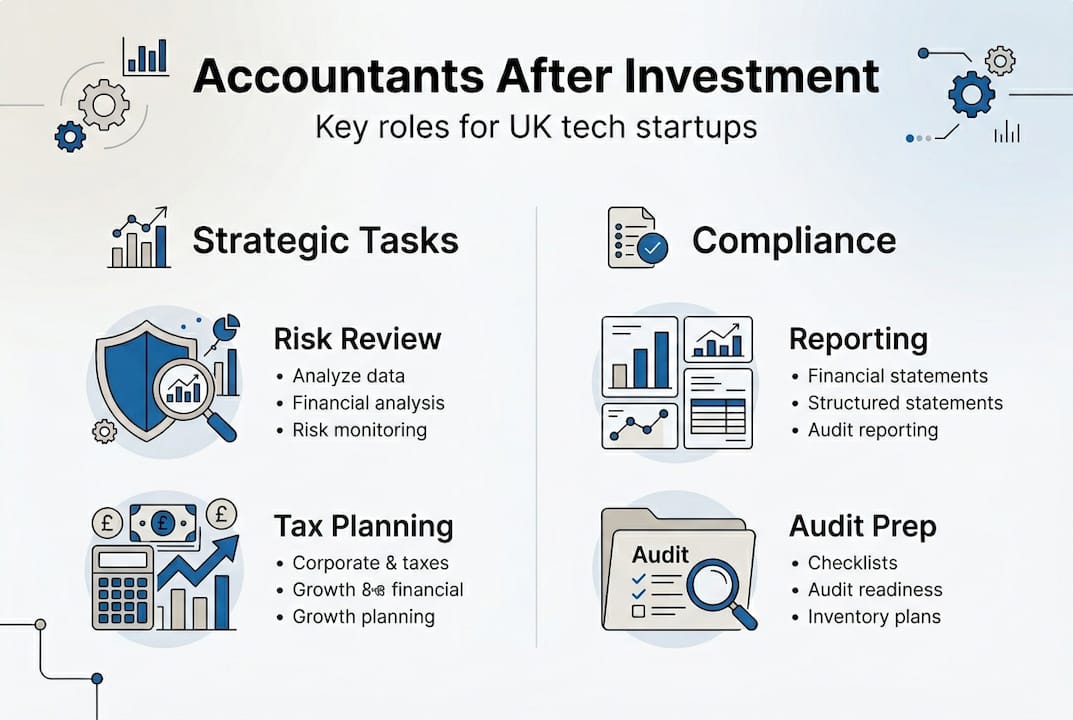
Once your startup secures investment, your accountant’s responsibilities expand dramatically beyond basic bookkeeping. They transform into strategic financial advisors who actively shape your company’s trajectory. This evolution reflects the heightened complexity of managing investor capital, scaling operations, and meeting stakeholder expectations.
Accountants now focus on financial risk assessment and mitigation strategies tailored to your growth stage. They analyse cash flow patterns to identify potential shortfalls before they threaten operations. Budget forecasting becomes more sophisticated, accounting for expansion plans, hiring schedules, and market uncertainties. Your accountant prepares detailed financial models that inform strategic decisions about resource allocation and timing.
Compliance obligations multiply after investment. Tax filings become more intricate with corporation tax considerations, potential VAT registration thresholds, and payroll responsibilities as you hire staff. Your accountant ensures every regulatory deadline is met whilst optimising your tax position within legal boundaries. They coordinate with HMRC, Companies House, and other regulatory bodies to maintain your startup’s good standing.
Audit preparation emerges as a critical function. Investors often require audited accounts, particularly as funding rounds progress. Your accountant organises financial records, implements robust internal controls, and liaises with external auditors to streamline this process. They also prepare monthly or quarterly management accounts that provide investors with transparency into your financial performance and operational metrics.
Pro Tip: Engage your accountant in strategic planning sessions from the earliest post investment stages. Their insights into financial sustainability and growth pacing help you anticipate challenges rather than simply react to them, positioning your startup for smoother scaling.
Ensuring legal compliance and regulatory obligations post investment
Post investment, your startup enters a more demanding regulatory environment. The legal and compliance landscape becomes significantly more complex as you manage investor agreements, employment contracts, and statutory obligations. Accountants play an indispensable role in navigating these requirements whilst protecting your company from costly penalties and reputational damage.

Your accountant ensures adherence to VAT compliance services and broader tax regulations that intensify with growth. They monitor your turnover against VAT registration thresholds, advise on optimal registration timing, and manage quarterly returns once registered. Corporation tax planning becomes more nuanced as your revenue streams diversify and you potentially qualify for various reliefs and allowances.
Key compliance areas requiring accountant oversight include:
- Statutory accounts preparation and filing within Companies House deadlines
- Corporation tax returns submitted to HMRC with accurate profit calculations
- VAT returns filed quarterly with proper input and output tax reconciliation
- Payroll administration including PAYE, National Insurance, and pension auto enrolment
- Shareholder agreement compliance and dividend distribution regulations
- Audit requirements as your company grows beyond small company thresholds
Compliance failures can trigger investigations, financial penalties, and investor concern that undermines confidence in your management team. Proactive accountant involvement safeguards your startup’s credibility during its most vulnerable growth phases.
Your accountant collaborates closely with legal advisors to align financial practices with contractual obligations. Investment agreements often contain specific financial reporting requirements, performance covenants, and approval thresholds for major expenditures. Understanding how we work with start-up companies demonstrates the integrated approach needed between financial and legal compliance. Your accountant tracks these provisions, alerts you to upcoming obligations, and prepares documentation that satisfies investor requirements whilst maintaining operational flexibility.
Performing financial due diligence and strategic advisory after funding rounds
Financial due diligence doesn’t end when investment closes. Your accountant conducts ongoing scrutiny of your financial position to identify risks, validate assumptions, and prepare for subsequent funding rounds. This continuous assessment protects both your interests and those of existing investors whilst positioning your startup attractively for future capital raises.
Post investment due diligence confirms that your company’s valuation remains justified and that no hidden liabilities threaten financial stability. Your accountant reviews contracts, commitments, and contingent obligations that might impact future performance. They analyse working capital requirements, debt servicing capacity, and burn rate sustainability to ensure your runway aligns with growth milestones.
Due diligence focusPre-investment emphasisPost-investment emphasisFinancial statementsHistorical accuracy and completenessForward-looking projections and variance analysisRevenue recognitionPast transaction validityRecurring revenue quality and customer retentionCost structureExpense categorisationScalability and unit economics optimisationTax positionOutstanding liabilitiesStrategic planning and relief maximisationCash managementCurrent liquidityBurn rate, runway, and milestone funding
Strategic advisory services become paramount as accountants guide decisions on tax planning, corporation tax optimisation, and accounting policies that impact financial reporting. They advise on R&D tax credit claims that can return significant capital to fuel innovation. Deferred taxation strategies help manage cash flow whilst remaining compliant. Your accountant evaluates different accounting treatments for complex transactions, ensuring choices align with investor expectations and regulatory standards.
Understanding accountants in Series A funding reveals how financial due diligence evolves across funding stages. As you approach subsequent rounds, your accountant prepares data rooms, financial models, and investor presentations that demonstrate financial discipline and growth potential. They anticipate investor questions, prepare supporting documentation, and help negotiate terms that protect your interests.
Pro Tip: Maintain your financial records and reporting standards as if you’re always preparing for the next funding round. This discipline ensures you’re never caught unprepared when opportunities arise, and it demonstrates operational maturity that investors value highly.
Practical applications: optimising financial management for growth and investor confidence
Translating accountant expertise into daily financial management practices separates startups that scale successfully from those that stumble despite adequate funding. Your accountant helps implement systems, processes, and disciplines that support sustainable growth whilst maintaining the transparency investors demand.
Timely, accurate financial accounts form the foundation of effective post investment management. Monthly management accounts provide real-time visibility into performance against budget, highlighting variances that require attention. Your accountant establishes key performance indicators aligned with your business model, tracking metrics like customer acquisition cost, lifetime value, monthly recurring revenue, and gross margin that matter to tech investors.
Best practices for post investment financial management include:
- Implementing cloud-based accounting systems that provide real-time data access for founders, CFOs, and accountants
- Establishing monthly close processes that deliver management accounts within two weeks of month end
- Monitoring cash flow weekly to anticipate funding needs and optimise working capital
- Claiming R&D tax credits systematically to maximise innovation funding
- Conducting quarterly tax planning reviews to optimise corporation tax and personal tax positions
- Preparing rolling 12-month forecasts that inform strategic decisions and resource allocation
The impact of disciplined financial management on growth and investor relations is measurable:
Financial practiceImpact on growth metricsImpact on investor confidenceMonthly management accounts23% faster identification of underperforming areas67% increase in investor satisfaction scoresReal-time cash flow monitoring34% reduction in emergency funding needs45% improvement in perceived financial controlQuarterly forecast updates28% better resource allocation efficiency71% higher confidence in management capabilitySystematic R&D credit claimsAverage £47,000 additional annual funding52% stronger perception of financial sophistication
Collaboration between founders, CFOs, and accountants creates an agile financial strategy responsive to market conditions and growth opportunities. Your accountant brings technical expertise and regulatory knowledge. You contribute business vision and market insights. Together, this partnership balances ambitious growth targets with financial prudence, ensuring your startup doesn’t outpace its financial capacity or miss opportunities through excessive caution.
Regular financial review meetings establish accountability and maintain alignment. Monthly sessions examine performance against budget, discuss upcoming obligations, and adjust forecasts based on actual results. Quarterly strategy reviews assess whether your financial structure still serves your evolving needs, considering factors like VAT registration, pension obligations, and potential restructuring for tax efficiency.
How Price & Accountants support your startup’s post-investment journey
Navigating the financial complexities following investment requires specialist expertise tailored to the unique challenges tech startups face. Price & Accountants delivers comprehensive expert company accounting services designed specifically for UK tech founders scaling their businesses beyond initial funding rounds.

Our team understands the pressures you face managing investor expectations, regulatory compliance, and rapid growth simultaneously. We provide end-to-end support including statutory accounts preparation, management reporting, VAT compliance, and payroll administration that frees you to focus on product development and market expansion. Our expertise in accounting policies ensures your financial reporting meets investor standards whilst optimising your tax position.
We specialise in maximising R&D tax credits for innovative tech companies, reclaiming significant capital that accelerates your development roadmap. Our strategic advisory services act as an outsourced finance function, providing CFO-level guidance without the full-time cost. With over 40 years of experience supporting startups through every growth stage, we’ve helped more than 20 clients scale to valuations exceeding £50 million. Partner with us to transform your post-investment financial management from a compliance burden into a competitive advantage.
Frequently asked questions
What are the main changes in accountants’ roles after startup investment?
Accountants shift from transactional bookkeeping to strategic advisory, focusing on financial risk management, investor reporting, tax optimisation, and growth planning. They become integral to decision making processes, providing insights that shape resource allocation and scaling strategies whilst ensuring regulatory compliance intensifies appropriately with your expanded operations.
How do accountants help with tax compliance post investment?
Accountants manage corporation tax returns, VAT registration and filing, PAYE administration, and identify applicable tax reliefs including R&D credits. They monitor changing tax obligations as your revenue and headcount grow, ensuring timely compliance whilst optimising your tax position through legitimate planning strategies that maximise resources available for business development.
Can accountants assist in preparing for future funding rounds?
Absolutely. Accountants prepare financial due diligence materials, create investor-ready financial models, establish robust reporting systems, and ensure your accounts demonstrate the financial discipline investors seek. They help structure your cap table, advise on valuation implications of different deal terms, and maintain the documentation standards that streamline subsequent fundraising processes.
What financial reports are crucial for investors after funding?
Investors typically require monthly management accounts showing profit and loss, balance sheet, and cash flow statements with variance analysis against budget. Quarterly board packs often include key performance indicators, runway calculations, and updated forecasts. Annual audited accounts become mandatory as your company grows, providing formal assurance of financial statement accuracy.
How early should tech startups engage accountants during growth phases?
Engage specialist startup accountants before you actively seek investment. Early involvement allows them to establish proper financial foundations, implement scalable systems, and position your company attractively for investors. Post investment, maintain continuous accountant engagement rather than viewing it as a periodic necessity, ensuring proactive financial management that anticipates challenges rather than merely reacting to them.