
TL;DR:
- Specialist accountants help tech startups unlock up to 20% of missed R&D tax credits during international expansion.
- They optimize legal structuring, manage cross-border compliance, and implement cloud systems to enable scalable growth.
- Early engagement with experts prevents operational complexity from outpacing revenue and costly regulatory issues.
Up to 20% of eligible R&D tax credits are missed by expanding tech startups without specialist accounting support. That is a significant sum left on the table at precisely the moment when capital matters most. For founders scaling across borders, the gap between compliant bookkeeping and genuine strategic advice can cost far more than a missed tax claim. This guide explains how specialist accountants act as growth partners for international expansion, covering everything from cross-border structuring and cloud system setup to investor-ready reporting and funding schemes. If you are building a tech or fintech business with global ambitions, read on.
Table of Contents
- Why accountants are essential for international expansion
- Key financial strategies accountants deliver for global operations
- Tech trends and cloud systems: How expert setup drives compliance and efficiency
- Structuring, compliance, and funding: Accountants as pivotal global advisors
- Our view: What most scaling founders underestimate in global expansion
- How Price & Accountants can support your global journey
- Frequently asked questions
Key Takeaways
PointDetailsStrategic accounting fuels growthAccountants enable tech and fintech entrepreneurs to unlock funding, scale efficiently, and avoid missed opportunities.Expert systems prevent costly mistakesHaving the right accounting setup early ensures compliance and supports complex international operations.Structure and funding advice is crucialAccountants guide you through entity setup, tax reliefs, and investment, preventing errors and delays.Cloud technology needs expert setupProper integration of cloud accounting is essential to meet both UK and global compliance standards.
Why accountants are essential for international expansion
The days of the accountant as a passive record-keeper are long gone. For tech and fintech founders scaling internationally, a good accountant is closer to a co-pilot than a compliance officer. They spot structural risks before they become expensive, identify funding opportunities before windows close, and translate complex regulatory landscapes into clear action plans.
The shift from domestic to international operations introduces a new layer of complexity almost immediately. You are suddenly dealing with multiple tax jurisdictions, cross-border payroll obligations, foreign currency exposure, and investor reporting requirements that differ by market. Without expert guidance, these pressures compound quickly.
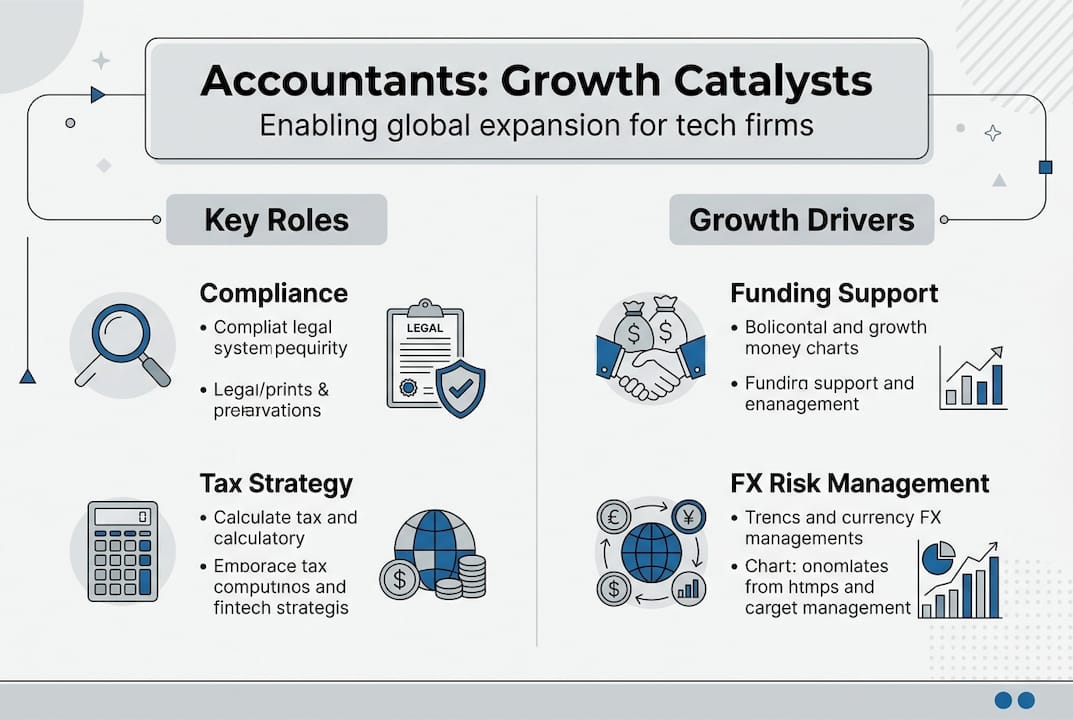
Accountants who specialise in tech growth optimise SEIS/EIS, R&D credits, and cloud integrations as a matter of course. These are not optional extras. They are the financial infrastructure that allows a startup to grow without haemorrhaging cash or falling foul of HMRC.
Here are four strategic ways a specialist accountant enables scale:
- SEIS and EIS scheme management: Structuring your share capital correctly from the outset to unlock SEIS/EIS tax benefits for early investors, which can make your startup significantly more attractive at pre-seed and seed stage.
- R&D tax credit applications: Identifying qualifying activities, preparing robust technical narratives, and submitting claims that withstand HMRC scrutiny, often recovering tens of thousands of pounds per year.
- Cloud accounting for Making Tax Digital (MTD): Ensuring your systems are fully MTD-compliant while providing real-time financial visibility across entities and currencies.
- Advanced financial modelling: Building forecasts that satisfy investor due diligence and inform strategic decisions, rather than simply reporting on what has already happened.
“Early financial controls prevent complexity emerging faster than revenue. The startups that struggle at Series A are rarely the ones with the weakest product. They are the ones whose financial infrastructure never kept pace with their ambition.”
Understanding tax consultancy explained as a discipline helps founders appreciate why generalist accountants so often miss these opportunities. Specialist knowledge is not a luxury at scale. It is a prerequisite. A solid startup tax planning guide will always begin with this premise.
Key financial strategies accountants deliver for global operations
Once you commit to international growth, your financial strategy needs to evolve just as fast as your product roadmap. The practical methods a specialist accountant implements can mean the difference between a well-managed expansion and a cash crisis that catches you off guard.
The five core strategies that matter most are:
- Cash flow forecasting: Rolling 13-week forecasts that account for seasonal revenue patterns, delayed international payments, and currency fluctuations, giving you genuine visibility rather than guesswork.
- Multi-currency management: Setting up your accounting systems to record, reconcile, and report across multiple currencies without creating a compliance nightmare at year-end.
- FX risk hedging: Using forward contracts and natural hedging to protect margins. Businesses that manage FX risk proactively typically retain 90 to 92% of revenue value compared to those that leave exposure unmanaged.
- Investor-ready reporting: Preparing management accounts and board packs that meet the expectations of institutional investors, not just the minimum statutory requirements.
- Scalable accounting systems: Selecting and configuring platforms that grow with you, rather than systems you will need to replace painfully at Series A.
FX risk approachCost exposureReporting accuracyScalabilityNo hedging (DIY)HighLowPoorBasic forward contractsMediumMediumModerateAccountant-led FX strategyLowHighStrong
The table above illustrates why leaving FX management to chance is a false economy. The cost of a single bad quarter of currency movement can wipe out months of margin. Specialist accountants build this protection into your tax planning workflow from the start.
Pro Tip: When selecting accounting software for international operations, insist on MTD compatibility and multi-entity support before committing. Migrating systems mid-growth is expensive and disruptive. The right platform, chosen with guidance from someone who understands accounting to scale, saves you that pain entirely.
Tech trends and cloud systems: How expert setup drives compliance and efficiency
Cloud accounting is now the baseline expectation for any tech or fintech business operating across borders. But selecting a platform and actually implementing it correctly are two very different things. Founders who rush this step often create problems that take months to unpick.
The comparison below shows why accountant-led implementation consistently outperforms the DIY approach:
CriteriaDIY software adoptionAccountant-led implementationData securityVariableControlled access and audit trailsMTD complianceOften incompleteFully configured from day oneScalabilityLimited by initial setupBuilt for multi-entity growthMulti-entity supportManual workaroundsIntegrated from the outset
The most common mistakes founders make when adopting cloud accounting tools include:
- Poor data migration: Importing historical data without cleansing it first, which corrupts your opening balances and creates reconciliation headaches.
- Lack of permissions control: Giving too many team members full access, which creates both security vulnerabilities and audit trail gaps.
- Ignoring MTD requirements: Setting up systems without checking whether they meet HMRC’s Making Tax Digital obligations, leading to penalties later.
- Skipping integrations: Failing to connect payroll, expenses, and banking feeds properly, which forces manual data entry and introduces errors.
- No review process: Launching without a monthly close process, so errors accumulate rather than being caught early.
The cloud accounting setup process, when led by a specialist, accounts for all of these risks before they materialise. Cloud accounting integration with platforms like Xero requires expert configuration to deliver its full compliance and efficiency benefits.

Pro Tip: Always have your accountant review your chart of accounts before you go live on any new system. A poorly structured chart of accounts is one of the most common causes of inaccurate management reporting, and fixing it retrospectively is far more costly than getting it right at the start.
Structuring, compliance, and funding: Accountants as pivotal global advisors
The structural decisions you make in the first 18 months of international expansion often determine how difficult the next five years will be. Getting the legal entity structure wrong, hiring in the wrong jurisdiction, or missing the window for SEIS/EIS funding can have consequences that are genuinely hard to reverse.
The key structuring decisions your accountant should guide you through are:
- EOR versus subsidiary: Deciding whether to use an Employer of Record service or open a local legal entity in each market, based on headcount, revenue, and regulatory exposure.
- Timing of local entity formation: Opening a local entity too early creates unnecessary compliance overhead. Too late, and you risk permanent establishment issues that trigger unexpected tax liabilities.
- HMRC advance assurance for SEIS/EIS: Applying for advance assurance before raising from investors gives both you and your investors certainty, and a specialist accountant manages this process efficiently.
- Cross-border payroll compliance: Ensuring that employees and contractors in each jurisdiction are correctly classified and taxed, avoiding the penalties that come with misclassification.
EOR solutions like Deel can save over £15,000 a year until local entity needs emerge. For an early-stage fintech with a distributed team, that saving funds a meaningful portion of your engineering capacity.
The entity setup process is rarely as straightforward as founders expect, particularly when multiple jurisdictions are involved. An accountant who maps compliance requirements across each market prevents the kind of fragmented approach that leads to gaps. Understanding common SEIS/EIS compliance mistakes before you raise is equally important. A single structural error can disqualify your investors from claiming their relief, which is a conversation no founder wants to have.
Our view: What most scaling founders underestimate in global expansion
After working with over 20 startups through their early growth stages, some now valued at well over £50 million, we have noticed a consistent pattern. Founders invest heavily in product, hiring, and go-to-market strategy. They underinvest in financial controls until something goes wrong.
The real risk of scaling internationally is not the complexity of any single jurisdiction. It is operational complexity outpacing revenue. When your financial infrastructure cannot keep up with your growth, the symptoms appear everywhere: delayed investor reporting, unexpected tax bills, payroll errors in new markets, and cash flow surprises that force reactive decisions.
Most founders assume they need an accountant when it is time to file or when a funding round is approaching. The truth is that the future challenges for tech startups are almost always rooted in decisions made much earlier, before anyone thought specialist advice was necessary.
Pro Tip: Engage a specialist accountant from your very first cross-border hire, not just when tax filings or entity structures demand it. The cost of early engagement is a fraction of the cost of untangling problems that accumulate quietly in the background.
How Price & Accountants can support your global journey
Scaling a tech or fintech business internationally requires more than good intentions. It requires the right financial infrastructure, the right compliance framework, and advisors who have done this before.

At Price & Accountants, our company accounting services are built specifically for founders navigating exactly this journey. From cloud system rollout and entity setup to R&D tax credits advice and SEIS/EIS management, we provide the specialist support that generalist accountants simply cannot match. Whether you are preparing for your first international hire or structuring ahead of a Series A, we are ready to help. Speak to an advisor today and find out how we can make your global expansion cleaner, faster, and more cost-efficient.
Frequently asked questions
What are the biggest compliance risks when expanding globally?
The main risks are mismatched entity structures, late local tax registrations, and poor record-keeping across multiple jurisdictions. Proactive accountants prevent complexity from accumulating before it becomes a regulatory problem.
How do accountants help access funding like SEIS/EIS for UK startups?
They manage legal applications, secure HMRC advance assurance, and ensure your share structure is compliant so investors can claim their relief without delay. Accountants unlock SEIS/EIS funding far more efficiently than founders attempting to navigate the process alone.
What financial systems are essential for global expansion?
Startups need integrated cloud accounting, rolling cash flow forecasting tools, and multi-currency support configured correctly from the outset. Cloud tools and financial controls are crucial from the earliest stages of scaling.
Why use Employer of Record solutions before opening a local entity?
EOR services enable compliant international hiring immediately and save over £15,000 a year until the scale of your operations justifies the overhead of a local legal entity.
Recommended
- Role of accountants for UK tech startups in 2026 - Price & Accountants
- Why accountants are crucial in exit planning for tech startups - Price & Accountants
- Accountants’ role post investment for UK tech startups - Price & Accountants
- Why startups need accountants for UK tech founders - Price & Accountants