
42% of UK SMEs outsource payroll specifically to manage compliance demands, yet many tech and fintech founders still assume keeping payroll in-house gives them more control. The reality is often the opposite. As your headcount grows and HMRC obligations multiply, an in-house payroll process can quietly become one of your biggest operational risks. This article breaks down what payroll outsourcing actually costs, what it genuinely delivers, and how to choose the right provider as you scale towards your next funding round.
Table of Contents
- What is payroll outsourcing and why are UK startups considering it?
- The true costs: What does outsourced payroll really cost UK startups?
- Benefits beyond cost savings: Why outsourcing payroll aids compliance and growth
- Risks, edge cases and how to mitigate downsides of outsourced payroll
- How to choose the right payroll provider for your startup’s growth
- Empowering your growth: Payroll and compliance solutions for UK tech startups
- Frequently asked questions
Key Takeaways
PointDetailsCompliance is criticalOutsourcing payroll helps UK tech startups stay on top of changing regulations and reduces legal risks.Predictable costsTypical outsourcing fees range £5-£12 per employee per month, offering clear budgeting compared to in-house payroll.Strategic valuePayroll outsourcing frees up leadership focus, reduces errors, and supports scalable growth during funding rounds.Risk managementCertified providers mitigate risks like data security and continuity, making outsourcing safer for fast-growing startups.
What is payroll outsourcing and why are UK startups considering it?
Payroll outsourcing means handing the administration of employee pay, tax deductions, National Insurance contributions, and pension enrolment to a specialist third-party provider. Rather than managing these processes internally, your startup pays a provider to handle them accurately and on time, every month.
For UK tech and fintech startups, the appeal is straightforward. Regulatory complexity is relentless. HMRC’s Real Time Information (RTI) reporting, auto-enrolment pension obligations, and ever-shifting tax codes create a compliance burden that grows with every new hire. 75% of UK SMEs outsource at least one business function, and 42% specifically choose payroll because of compliance-heavy activities.
A good payroll provider typically handles:
- RTI submissions to HMRC
- PAYE calculations and tax code management
- National Insurance contributions
- Statutory payments such as sick pay and maternity pay
- Auto-enrolment pension administration
- Payslip generation and employee self-service portals
- Year-end P60 and P11D reporting
For startups using cloud accounting platforms, outsourced payroll pension services integrate directly with your existing financial stack, reducing manual data entry and the errors that come with it. Pairing this with solid bookkeeping essentials gives you a clean, audit-ready financial picture at all times.
“Compliance is not optional. For a startup preparing for Series A due diligence, a single payroll error can raise red flags with investors and delay your round.”
The true costs: What does outsourced payroll really cost UK startups?
Let’s be direct about pricing. Outsourced payroll costs £4 to £25 per employee per month for UK SMEs, with the typical range sitting between £5 and £12 per employee per month (PEPM). For a 50-person tech startup, that translates to roughly £350 to £620 per month.
Here is how that breaks down across different team sizes:
Team sizeLow estimate (£5 PEPM)Mid estimate (£8 PEPM)High estimate (£12 PEPM)10 employees£50/mo£80/mo£120/mo25 employees£125/mo£200/mo£300/mo50 employees£250/mo£400/mo£600/mo100 employees£500/mo£800/mo£1,200/mo
Now compare that to in-house payroll. A part-time payroll administrator in London costs upwards of £28,000 per year in salary alone, before you factor in employer National Insurance, pension contributions, payroll software licences, and training. For most startups under 80 employees, outsourcing is simply cheaper.
Predictable costs and error reduction consistently outweigh outsourcing fees, and the time saved allows your finance and HR teams to focus on strategic priorities rather than monthly admin.

Pro Tip: When comparing providers, ask for a full breakdown of fees including setup costs, year-end reporting charges, and any fees for additional pay runs. These hidden costs can push your actual spend 20 to 30% above the headline PEPM rate.
For startups managing tight budgets, integrating outsourced payroll with your broader bookkeeping for small business processes and your tax planning workflow creates a joined-up financial operation that scales without proportional cost increases.
Benefits beyond cost savings: Why outsourcing payroll aids compliance and growth
Cost is only part of the equation. The strategic value of outsourcing payroll becomes clearest when you look at what it frees up inside your business.
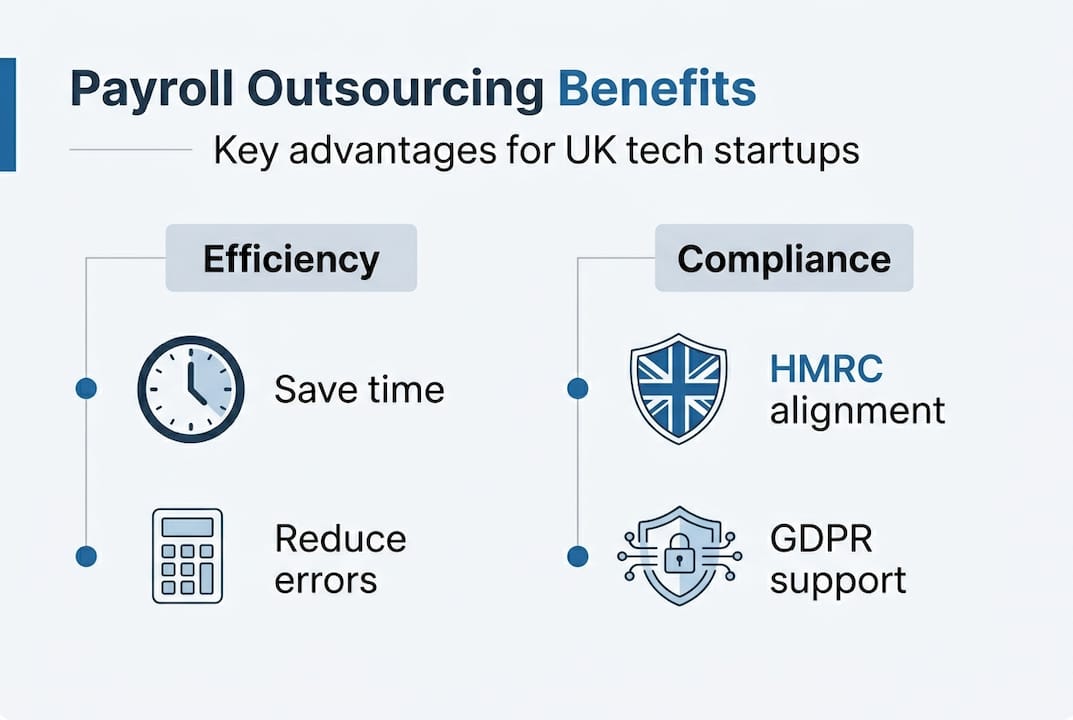
Outsourcing saves 6 to 12 hours per month for most UK SMEs, and that time compounds quickly. Your founders and finance leads can redirect that capacity towards investor relations, product development, and growth planning rather than chasing payslip queries.
Here are the key strategic advantages for startup leadership:
- HMRC compliance on autopilot. Specialist providers stay current with every legislative change, so you are never caught out by a new tax code or reporting requirement.
- GDPR-compliant data handling. Employee payroll data is sensitive. Reputable providers operate under strict data protection frameworks, reducing your legal exposure.
- Scalability without friction. Hiring 10 people in a month? Your payroll provider scales with you. No recruitment, no onboarding, no delays.
- Continuity during staff changes. If your in-house payroll person leaves, payroll still runs. Provider continuity removes a critical single point of failure.
- Investor-ready records. Clean, accurate payroll records are essential during due diligence. Outsourced providers produce audit-ready documentation as standard.
“For a startup moving from seed to Series A, the ability to demonstrate clean financial operations is as important as your revenue metrics.”
Pairing outsourced payroll with strong bookkeeping best practices and guidance from a specialist tax consultant creates a financial infrastructure that supports rather than hinders your growth ambitions.
Risks, edge cases and how to mitigate downsides of outsourced payroll
Outsourcing is not without risk. Understanding the downsides helps you choose a provider that genuinely protects your startup rather than creating new vulnerabilities.
Growth periods and staff turnover expose in-house payroll to significant continuity risks, but outsourcing introduces its own concerns: data security, reduced direct control, and dependency on a single vendor.
FactorIn-house payrollOutsourced payrollCost predictabilityVariable (salary, software, training)Fixed PEPM rateCompliance expertiseDepends on staff knowledgeSpecialist, always currentData securityInternal controls requiredProvider-managed, certifiableScalabilitySlow, requires hiringImmediateControlHighModerateContinuity riskHigh (staff dependency)Low (provider SLAs)
To mitigate the risks of outsourcing, look for providers that:
- Hold ISO 27001 certification for information security management
- Are registered with the Information Commissioner’s Office (ICO) under GDPR
- Offer contractual SLAs covering accuracy, timeliness, and data breach response
- Provide dedicated account managers rather than generic support queues
- Have a clear business continuity plan in the event of system outages
Pro Tip: Before signing any contract, request a copy of the provider’s data processing agreement (DPA). This document outlines exactly how your employee data is stored, processed, and protected. If a provider cannot produce one quickly, walk away.
For startups already managing VAT management and compliance obligations, choosing a payroll provider that integrates with your existing compliance framework reduces duplication. Working with tax filing consultants who understand your full financial picture adds another layer of protection.
How to choose the right payroll provider for your startup’s growth
Selecting a payroll provider is not a procurement exercise. It is a strategic decision that affects your compliance, your team’s experience, and your readiness for investment.
Continuity during growth and staff turnover is one of the most critical factors to evaluate. Here is a practical step-by-step approach:
- Define your requirements clearly. How many employees do you have now, and how many do you expect in 12 months? Do you need multi-currency payroll for international hires? Do you require integration with Xero or another cloud accounting platform?
- Check certifications first. ISO 27001 and ICO registration are non-negotiable for any provider handling sensitive employee data.
- Evaluate scalability track record. Ask providers for case studies from startups that scaled from 20 to 100 employees. How did they handle rapid headcount growth?
- Assess technology integration. Your payroll provider should connect seamlessly with your accounting software, HR platform, and pension provider. Manual data transfers are a red flag.
- Request client references. Speak directly to two or three existing clients in the tech or fintech sector. Ask specifically about error rates and response times.
- Negotiate SLAs upfront. Your service level agreement should specify payroll accuracy guarantees, processing deadlines, and what happens if an error occurs.
Pro Tip: Request a written continuity guarantee that outlines what happens if your account manager leaves or the provider experiences a system outage. This single document tells you more about a provider’s reliability than any sales pitch.
For startups building out their financial operations, reviewing expert bookkeeping essentials alongside your payroll setup ensures every part of your financial infrastructure is working together from day one.
Empowering your growth: Payroll and compliance solutions for UK tech startups
Getting payroll right is not just about paying your team on time. It is about building the financial credibility that investors, regulators, and your own people expect as you scale.

At Price & Accountants, we work with UK tech and fintech startups at every stage, from pre-seed to Series A and beyond. Our bookkeeping solutions keep your records clean and investor-ready, while our streamlined payroll and pension administration services ensure you stay fully compliant with HMRC and auto-enrolment obligations. For startups investing in innovation, our R&D tax credits for startups service helps you reclaim capital that can be reinvested into growth. With over 40 years of expertise and a track record of supporting startups now valued at over £50m, we are the financial growth partner your startup deserves.
Frequently asked questions
Is outsourced payroll more cost-effective than managing it in-house?
For most UK startups, yes. Outsourced payroll costs £5 to £12 per employee per month, which is typically far less than the combined cost of a payroll administrator’s salary, software, and compliance training.
How can UK startups avoid the risks of dependency when outsourcing payroll?
Choose providers with ISO 27001 and GDPR certification and insist on contractual SLAs that cover data security, accuracy guarantees, and business continuity in the event of provider disruption.
What are the main compliance benefits of outsourcing payroll?
Outsourcing ensures your startup meets HMRC and GDPR obligations consistently, reduces the risk of costly penalties, and produces audit-ready records that support investor due diligence.
How much time do startups typically save by outsourcing payroll?
Most UK startups save 6 to 12 hours per month, freeing up founders and finance leads to focus on strategic priorities rather than monthly payroll administration.
Recommended
- Expert bookkeeping essentials for UK tech startups in 2026 - Price & Accountants
- How to streamline bookkeeping in UK fintech startups: cut time 40% - Price & Accountants
- Why hire specialist tax consultant for UK tech startups - Price & Accountants
- Bookkeeping best practices for UK tech startups: 2026 guide - Price & Accountants