
Revenue lands on the profit and loss account when a performance obligation is satisfied, not when cash hits the bank. For most SaaS businesses that means access-based subscriptions get recognised ratably across the contract term, usage-based fees get recognised as customers consume them, and one-off implementation or licence fees often land at a single point in time. The three judgements that decide whether you get this right are the true contract term, how you handle variable consideration, and how you allocate price across bundled obligations.
TL;DR:
- Contract enforceability determines revenue recognition periods, with many contracts shorter than their headline terms due to notice clauses or non-cancellable conditions.
- Identifying and separating performance obligations, especially distinguishing between platform access and bundled add-ons, is crucial to avoid misstatements.
- Accurate revenue recognition requires correctly estimating variable consideration and constraining it to prevent future reversals.
- Applying a consistent stand-alone selling price method, such as market assessment or cost-plus, is essential for fair allocation across obligations.
- Maintaining thorough documentation and controls, like contract registers and reconciliation processes, helps ensure compliance and audit readiness.
Before you sign off a revenue schedule, run the contract against five questions. Skip one and you risk a restatement six months later.
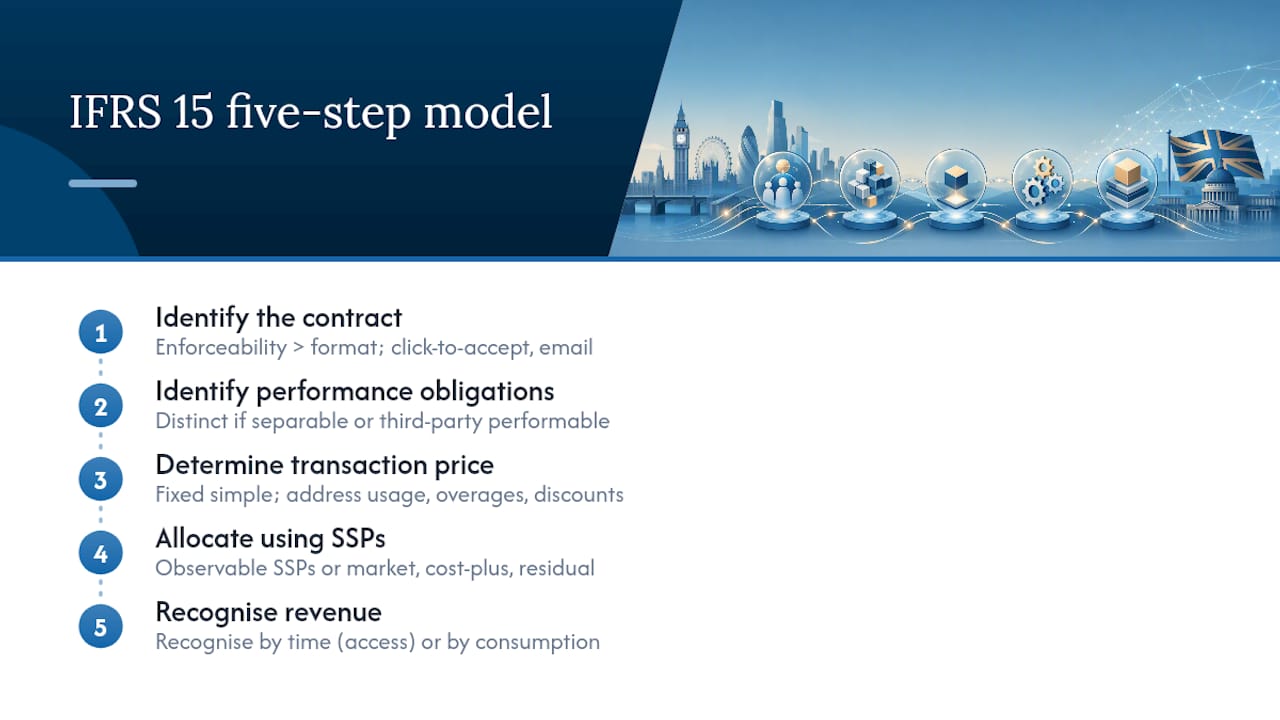
IFRS 15 sets out five steps for recognising revenue, and each one behaves differently once you apply it to a subscription business rather than a one-off sale.
Step 1: identify the contract. For SaaS, this is rarely a signed PDF. Click-to-accept terms, an online checkout flow, or an email confirming a renewal can all create an enforceable contract, provided both parties have approved it and payment terms can be identified. The test is enforceability, not paperwork format. A free trial that auto-converts to a paid plan only becomes a contract once the customer has committed, not when the trial starts.
Step 2: identify distinct performance obligations. This is where most SaaS businesses trip up. A typical contract bundles platform access, onboarding or implementation, customer support, and sometimes premium features released later. Something counts as distinct if the customer can benefit from it on its own or with resources readily available to them, and if the promise is separately identifiable from other promises in the contract. Implementation that’s highly integrated with the software and can’t function without it usually isn’t distinct. Implementation that a third party could perform equally well often is.
Step 3: determine the transaction price. Fixed subscription fees are straightforward. Complications arrive with variable elements: usage tiers, overage charges, service credits for downtime, or discounts tied to volume commitments. If a contract includes a significant financing component, such as a multi-year prepayment at a discount that effectively acts as a loan to the vendor, that also needs separating out. Most SaaS arrangements are short enough that this rarely applies, but multi-year enterprise deals with heavy upfront discounts can trigger it.
Step 4: allocate the price using stand-alone selling prices. Where you sell access, implementation, and support separately to other customers, you already have observable SSPs. Where you don’t, practical guidance points to three fallback methods: adjusted market assessment (what would a similar customer pay a similar vendor), expected cost plus a margin, or the residual approach when one element’s price is highly variable or uncertain. The IFRS 15 standard expects you to pick a method and apply it consistently, not cherry-pick per contract.
Step 5: recognise revenue as obligations are satisfied. For access-based promises, an appropriate measure of progress is usually time elapsed, because the customer receives equal benefit throughout the term, as explained in detail in streamlining SaaS operations without adding overhead. For usage-based promises, revenue tracks consumption. Getting this distinction wrong, straight-lining a consumption-based contract, is one of the more common misstatements in SaaS financial reporting, and it’s exactly the kind of error auditors flag first.
Four areas cause more restated revenue schedules than everything else combined.
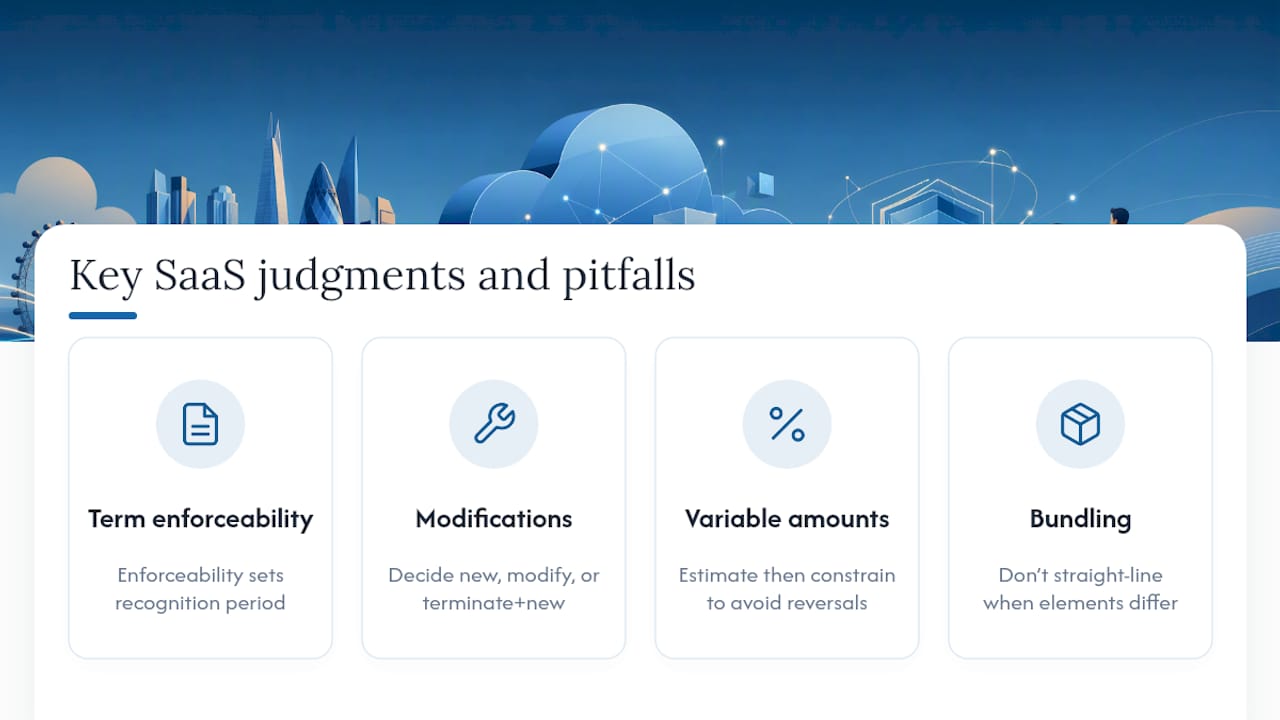
Contract term and enforceability. A three-year headline term with a 30-day termination-for-convenience clause isn’t a three-year contract for accounting purposes. Enforceability, not the label on the cover page, determines the recognition period, and this trap regularly shortens the effective term to a rolling monthly commitment. Auditors specifically test this because it changes both revenue timing and the remaining performance obligations you disclose.
Contract modifications. When a customer upgrades tiers, adds seats, or converts a legacy licence to a SaaS subscription, you need to decide whether that’s a new contract, a modification of the existing one, or a termination of the old contract combined with a new one. Licence-to-SaaS conversions are particularly messy: the cancellation credit given for the old licence can be treated either as a discount against the new arrangement or as variable consideration, depending on the substance of the deal. Document which approach you took and why, because the two treatments produce different revenue curves.
Variable consideration and the constraint principle. Usage fees, refund rights, and service-level credits all count as variable consideration. IFRS 15 requires you to estimate the amount you’re entitled to, then constrain that estimate so you only recognise amounts unlikely to reverse. Overestimate usage revenue in month one and you’ll be unwinding it in month two.
Bundling and the straight-line default. Applying one blanket recognition pattern across implementation, access, and support because it’s administratively simpler almost always misstates results when those elements have genuinely different satisfaction patterns.
Pro Tip: Build a simple decision tree for modifications before you need it: new contract, prospective modification, or cumulative catch-up. Deciding this in the heat of a renewal negotiation is how errors creep in.
A SaaS vendor signs a one-year, non-cancellable contract worth £24,000: a £4,000 upfront implementation fee, £18,000 for platform access billed monthly, and estimated API usage charges of £2,000 based on prior consumption, capped and billed as incurred.
| Component | Treatment | Recognition |
|---|---|---|
| Implementation fee | Point in time (SSP: £4,000, distinct service) | Recognised on completion |
| Platform access | Over time (ratable) | £1,500 per month |
| API usage | Over time (consumption-based) | Recognised monthly as usage occurs |
Cash of £22,000 (fixed fees, excluding usage) is received upfront and posted to deferred revenue, then released monthly: debit deferred revenue, credit revenue, £1,500 for access, plus the implementation fee once delivered. API usage is invoiced and recognised as consumed, with revenue estimated and constrained if billing lags actual usage at month end.
IFRS 15 disclosure isn’t optional paperwork. Paragraph 120 requires disclosure of the transaction price allocated to remaining performance obligations, alongside the significant judgements made about contract term, variable consideration, and SSP methodology.
Three controls keep this manageable month to month:
Because IFRS 15 is principle-based rather than rule-based, the same set of facts can support more than one defensible treatment. What auditors actually test is whether your judgement was documented at the time, not reconstructed afterwards.
Setting up a revenue recognition policy that survives audit scrutiny takes more than reading the standard once. Priceandaccountants works with SaaS founders on accounting policy setup, deferred revenue schedules, SSP estimation, and ongoing outsourced FD support as contracts scale from a handful of customers to hundreds. Our team has taken more than 20 start-ups through this exact process, several now valued well over £50 million, so the checklists in this guide come from live contract reviews, not theory. If your current schedule hasn’t been stress-tested against a termination clause or a usage spike, that’s worth fixing before your next funding round, not after.
IFRS 15 is often criticised for being vague. It isn’t vague, it’s principle-based, and that’s a different problem. The standard gives you a framework, not a lookup table, which means two SaaS companies with near-identical contracts can land on different, equally defensible treatments. That’s uncomfortable for founders who want a single correct number, but it’s also the point: the standard cares more about whether your judgement reflects economic substance than whether it matches a competitor’s spreadsheet.
Where conventional advice falls short is treating the five-step model as a one-time compliance exercise rather than an operational habit. I’ve seen finance teams build a beautiful revenue policy at Series A and never revisit it as pricing, contract terms, and bundling changed. The termination-for-convenience trap is the clearest example: nobody deliberately overstates contract term, but nobody rechecks it either once the template contract is signed off.
If you take one thing from this guide, prioritise the contract register before the SSP methodology. You can’t allocate price correctly to obligations you haven’t correctly identified, and you can’t identify obligations correctly if you’re working from a contract term that was never actually enforceable.
— Rahamut
The alternative to muddling through IFRS 15 with a generic bookkeeper is working with accountants who’ve built revenue schedules for SaaS businesses specifically, not adapted from retail or manufacturing templates. Priceandaccountants specialises in exactly the contract structures this guide covers: usage-based pricing, multi-year enterprise deals, licence-to-SaaS conversions, and the termination clauses that quietly shorten a contract term without anyone noticing until audit season.

We offer full accounting services for tech and fintech founders, including policy setup, deferred revenue schedules, and SSP documentation that holds up under audit. If you’ve read this far because your current revenue schedule feels like guesswork rather than a defensible policy, book a revenue recognition health check with our team and get a second opinion before your next set of accounts goes out the door.
For the primary text, see IFRS 15 and its full standard wording. For SaaS-specific worked guidance, see NetSuite’s revenue recognition guide and Priceandaccountants’s SaaS accounting overview.