
A board reporting pack must let directors reach a decision using only what is in the pack, with no follow-up calls or missing figures. Good packs share three traits: a one-page decision summary, one paper per substantive item, and a clear recommendation on every paper. The FRC’s guidance on the UK Corporate Governance Code and the statutory duty to retain minutes under the Companies Act 2006 both point the same way: the pack is a governance record, not a briefing document.
TL;DR:
- A board pack must include a clear, one-page decision summary, a decision-asked agenda, and a single substantive paper per item to support choices without follow-up.
- Every document should have version control, clear purpose, decision request, background, options, risk, financial impact, stakeholder effects, recommendation, and assurance to ensure independence and traceability.
- The pack should be issued in full five to seven working days before the meeting, using fixed workflow, versioning, and secure distribution to prevent late additions or leaks.
- Visual data should be concise and directly related to the decision, with consistent labelling, and charts should be paired with contextual commentary for clarity.
- Tailoring the structure to different director roles improves efficiency, emphasizing decision-related fields for chairs and risk or financial details for operational or risk-focused directors.
A board reporting pack is the set of documents circulated ahead of a board meeting so directors can prepare, question and decide. Its primary purpose is decision support, not information storage. Under Principle F of the Corporate Governance Code, the chair carries primary responsibility for the quality and flow of information to the board, while the company secretary typically facilitates that flow in practice, chasing papers, checking format and managing distribution.
The strongest packs follow what CGI and Board Intelligence call the Question-Driven Insight principle: every paper opens with the “so what” and states the decision the board is being asked to make.
Before a pack goes out, run it against a whole-pack test rather than checking each paper in isolation. A board pack checklist built around director decisions, rather than a simple table of contents, catches gaps that a contents list misses.
Papers added after the initial issue should be genuinely exceptional and flagged as late, not treated as routine.
Each substantive paper should stand on its own. A director reading only that document, with no other context, should be able to say what is being asked and why. The BoardServe checklist sets out the fields that make this possible.
These fields exist partly to protect directors, since a paper that documents options, risks and stakeholder impact gives the board a record supporting its section 172 duty to have regard to a range of interests when reaching a decision.
Pro Tip: Cap substantive papers at 6 to 8 pages and move supporting detail such as data tables, contracts or lengthy analysis into numbered appendices that the paper explicitly references.
A cover sheet lets a director grasp the ask before reading a single line of the paper itself. It should take under two minutes to read and leave the director able to state the decision, the recommendation and the main risk without opening the appendices.
| Field | Example entry |
|---|---|
| Paper title | Approval of Series A bridge facility |
| Purpose | Decision |
| Decision requested | Approve drawdown of bridge facility on stated terms |
| Recommendation | Approve |
| Key risk | Covenant tightens headroom if revenue slips below forecast |
| Financial impact | Increases monthly interest cost; no equity dilution |
| Reading time | 3 minutes (cover sheet: 1 minute) |
| Appendix reference | Appendix 2: term sheet and covenant schedule |
Substantive papers should sit within the 6 to 8 page range set out above, with appendices carrying anything a director would only consult if they had a specific question.
Issue the full pack in one go, not in instalments. Common UK practice, reflected in guidance from several governance bodies, is to circulate the complete pack five to seven clear working days before the meeting, a standard worth writing into the board’s terms of reference rather than leaving as convention.
Keep the metric set small and split across four categories: financial (revenue, cash, margin), operational (delivery, capacity, headcount), customer (retention, satisfaction, pipeline) and risk or compliance (breaches, near-misses, outstanding actions). Adding metrics because they are available, rather than because a director needs them to decide, is how packs bloat.
A short commentary template keeps writing consistent: Movement, then Why, then Impact, then Recommendation. Our guide to financial reporting best practice for SMEs covers definitions consistency in more depth.
Pro Tip: Keep a single definitions register for every metric so “gross margin” means the same thing in month one and month twelve.
Most failing packs share a small set of causes, and each has a direct fix.
Good packs stop being exceptional once the process behind them is fixed rather than improvised each cycle.
Repeating this cycle turns pack quality into a process outcome rather than a matter of individual author skill.
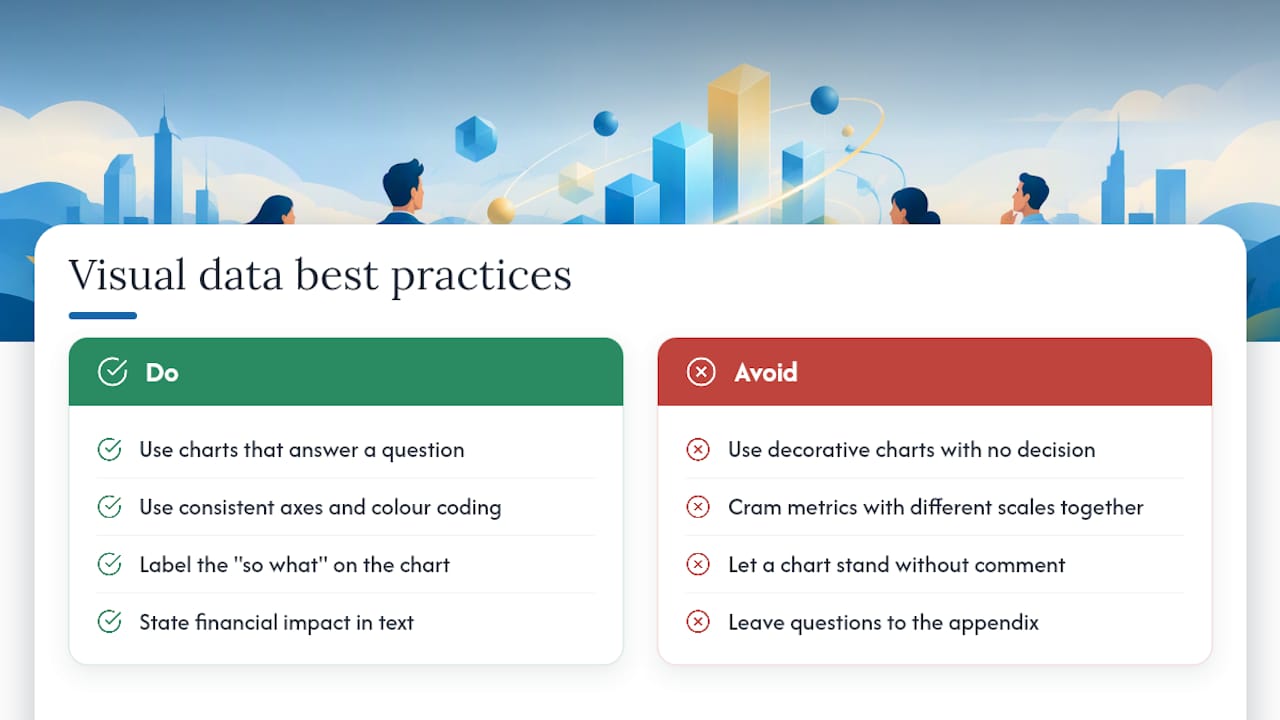
Charts and dashboards earn their place only when they answer a question faster than a sentence would. A trend line showing cash runway against forecast over six months tells a director more in one glance than a paragraph of narrative, but a decorative pie chart with no decision attached wastes a page.
Keep a few rules in mind. Use consistent axes and colour coding across the pack so a director learns to read a red flag the same way every month. Label the “so what” directly on the chart rather than leaving the director to infer it, a short caption stating the direction and cause works better than a chart title alone. Avoid cramming several metrics onto one chart when they operate on different scales, since this usually obscures rather than clarifies. Dashboards summarising operational metrics are useful for noting items, but decision papers still need their own financial impact figures stated in text, since a chart alone cannot carry a resolution.
Where a metric has moved sharply, pair the chart with the Movement, Why, Impact, Recommendation commentary structure described earlier, rather than letting the visual stand alone. A chart that raises a question without answering it forces the director back into the appendix, which defeats the purpose of a cover sheet built for a short reading time.
Not every director reads a pack the same way. A non-executive director focused on audit and risk will look first at the risk mapping and assurance fields on each paper, while an executive director closer to operations will scan the financial impact and options sections for detail the board discussion is likely to test.
The chair, who under Principle F of the Corporate Governance Code carries primary responsibility for information quality, tends to use the decision summary as the master document during the meeting itself, checking each resolution against the paper behind it. Committee chairs, where the board has an audit or remuneration committee, often need the committee’s own papers cross-referenced against the main board pack rather than duplicated in full.
This does not mean producing several versions of the same pack. It means writing papers so that the fields most relevant to each role, risk and assurance for one reader, financial impact and options for another, are easy to locate rather than buried in narrative. A well-structured paper serves every director without requiring a bespoke edit for each of them.
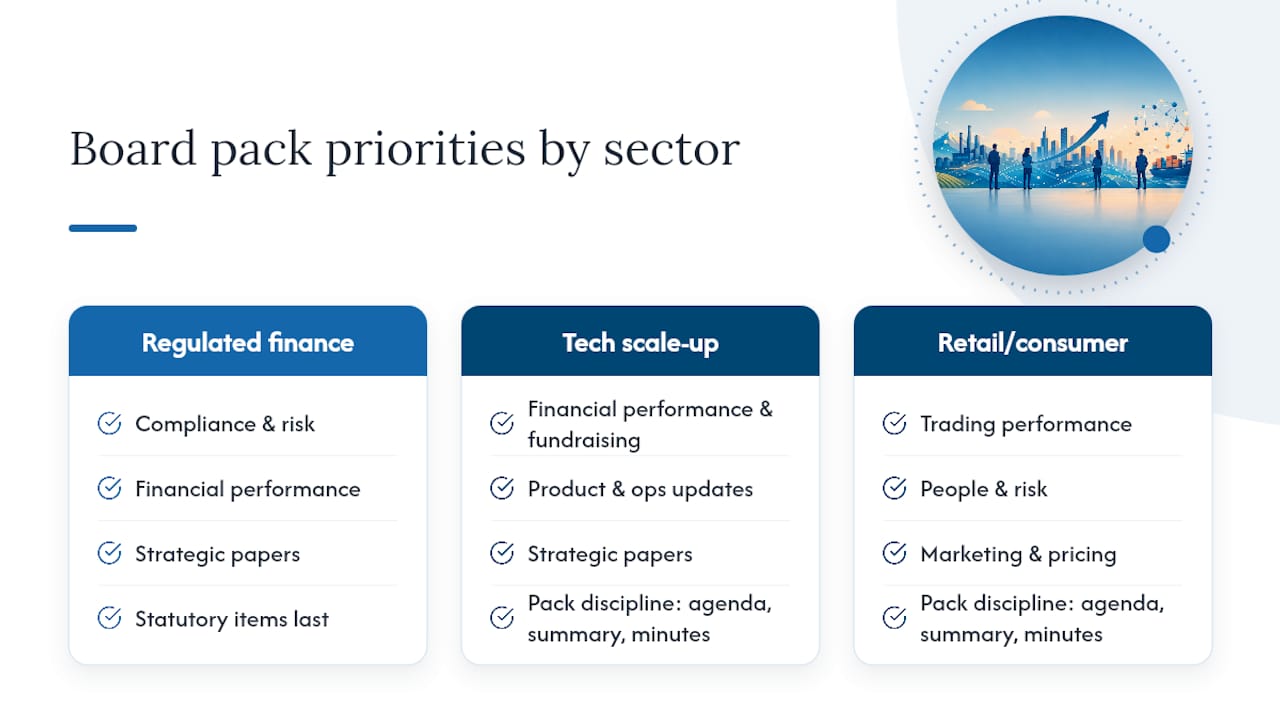
Structure varies by sector, but the underlying logic holds everywhere: decision papers up front, information papers later, statutory items last. A regulated financial services board typically places compliance and risk committee reports early in the pack, given the weight regulators place on those items, followed by financial performance and then strategic papers. A technology scale-up board more often leads with financial performance and fundraising papers, since cash runway and investor relations tend to dominate discussion, with product and operational updates following.
A retail or consumer business board commonly structures its pack around trading performance first, given how directly monthly sales data feeds into decisions on stock, pricing and marketing spend, before moving to people and risk items. What stays constant across all three is the pack-level discipline described earlier: an agenda with purpose per item, a decision summary, and previous minutes and the action log included as standing items regardless of sector.
The lesson for a company secretary moving between sectors, or supporting a business as it scales past its first board meetings, is that the fields and checklists matter more than the sector-specific running order. Adjust the sequence to match what the board spends most of its time on, but keep every paper decision-ready on its own terms.
Manually collating a pack in a shared folder or a single long document is workable at a handful of directors but breaks down as the board and the paper volume grow. Purpose-built board portal software addresses the specific failure points described above: single-issue distribution, version control, and an auditable record of who read what and when.
Most governance-focused platforms handle the same core functions: templated paper structures that enforce the mandatory fields, controlled distribution windows that prevent late additions slipping in unnoticed, and a permanent archive tying each pack to its approved minutes. Cloud accounting tools such as Xero can feed live financial data into board papers directly, cutting the lag between management accounts closing and the board seeing the numbers.
The choice of tool matters less than the discipline it enforces. A basic template used consistently, with version numbers and a fixed distribution date, will outperform an expensive platform used inconsistently. Whatever the platform, the same test applies: can a director open the pack and decide, without chasing anyone for a missing figure or an unclear ask.
Board packs routinely carry information that would cause real harm if it reached the wrong audience: unpublished financial results, personnel matters, litigation strategy and, for many scale-ups, live fundraising terms. Treat distribution as a security decision, not just a logistics one.
Restrict access to the pack platform or shared folder to sitting directors, the company secretary and named advisers, and revoke access promptly when someone leaves the board. Avoid emailing packs as unencrypted attachments where a portal or secure link is available, and never leave a prior version live once a revision has replaced it. Watermarking or tracked access logs, standard features on most governance platforms, give the secretariat a record of who accessed a paper and when, which matters if a leak needs investigating.
Confidentiality obligations do not end when the meeting closes. Directors should be reminded, as a matter of course, that pack contents remain confidential after the meeting and that papers should be destroyed or returned rather than retained informally on personal devices. The one copy that must survive is the archived version tied to the approved minutes, kept securely for the ten-year period the Companies Act requires.
Working with pre-seed to Series A companies, the same pack failures recur: no decision summary, papers written as updates rather than asks, and metrics that shift definition between months. An outsourced finance director or managed reporting support tends to fix this faster than an internal hire alone, because the template and discipline arrive already built rather than being invented from scratch under deadline pressure.
— Rahamut
Building a board-ready pack from scratch takes time most finance teams at a scale-up do not have, particularly once fundraising, R&D claims and compliance deadlines are already competing for attention. Price & Accountants supports founders and finance leads through this directly.

If your pack needs a structural rework rather than a light edit, a pack audit is a practical starting point. Visit our pricing page to see the Core Services, Blue Plan and Black Plan options, or review the full services overview to find the right level of support.
For the original wording, see the FRC’s Corporate Governance Code guidance, CGI and Board Intelligence’s reporting research, and section 248 of the Companies Act 2006 on minutes retention.
A board pack should include an agenda with a purpose per item, a decision summary listing exact resolutions, previous minutes, an action log, and one substantive paper per agenda item covering purpose, decision requested, risk and financial impact. The BoardServe checklist sets out these fields in full.
A board report, or paper, should state its purpose, the exact decision requested, background, options considered, risk mapping, financial and stakeholder impact, and a clear recommendation. Substantive papers work best kept to 6 to 8 pages, with supporting detail moved into numbered appendices.
A board pack exists to let directors reach a decision using only the documents in front of them, without needing follow-up calls or missing figures. Guidance from CGI and Board Intelligence frames this as writing papers that answer the “so what” and state the expected director action directly.
Typical board documents include the agenda, the decision summary, individual papers for each substantive item, the previous meeting’s approved minutes, and the outstanding action log. Board packs also commonly include a one-page cover sheet per paper and numbered appendices for supporting detail such as contracts or detailed financial tables.
Common practice is to issue the complete pack five to seven clear working days before the meeting, in a single distribution rather than a trickle of late additions. This standard, referenced across several governance sources, works best when written into the board’s own terms of reference.