TL;DR:
- Missing filing deadlines can result in hefty fines and hinder investor confidence.
- Choosing the appropriate accounts format impacts funding readiness and investor perceptions.
- Building investor-ready, accurate accounts early offers strategic advantages for growth and fundraising.
Missing one filing deadline can cost your startup more than a £150 fine. It can signal disorder to a prospective investor, delay an SEIS advance assurance, or trigger a penalty spiral that compounds across multiple quarters. For UK tech and fintech founders, Ltd company accounts are not a bureaucratic afterthought — they are the financial backbone that makes fundraising, R&D claims, and strategic pivots possible. Many founders treat compliance as an annual box-ticking exercise, only to find themselves scrambling when a funding opportunity appears. This guide cuts through that confusion and gives you a structured, expert-backed roadmap for managing your accounts with precision.
| Point | Details |
|---|---|
| Know your deadlines | Missing Companies House or HMRC filing dates brings swift penalties and risk. |
| Choose the right accounts | Micro- or small/full accounts can affect investor trust and eligibility for SEIS/EIS. |
| Unlock SEIS/EIS funding | Clear, prompt accounts open the door to crucial investor schemes and tax reliefs. |
| Manage with digital tools | MTD-compliant systems simplify compliance, tracking, and fast access to funding. |
| Plan for more than the minimum | Build investor-ready accounts from day one to accelerate growth and avoid fire drills. |
Every UK limited company, from a pre-seed fintech to a scaling SaaS platform, has a legal obligation to file statutory accounts. There are no exceptions for early-stage businesses. Understanding exactly what you must file, and when, is the first step towards building a financially credible organisation.
Your core filing obligations break down into two streams:
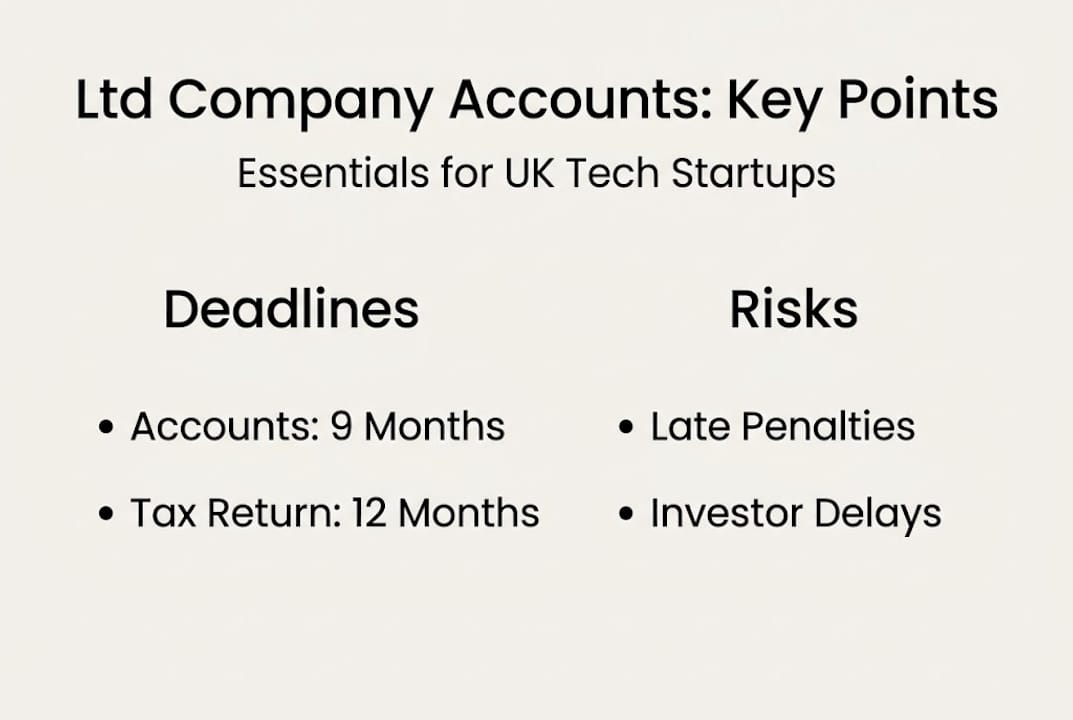
The deadlines are non-negotiable. Annual accounts must be filed within 9 months of your financial year end, or 21 months after incorporation for your very first set of accounts. Your Corporation Tax return is due 12 months after the accounting period ends. Crucially, tax is typically paid 9 months and one day after the year end, so cash flow planning matters here too.
| Filing obligation | Deadline | Penalty for lateness |
|---|---|---|
| Statutory accounts (Companies House) | 9 months after year end | From £150 rising steeply |
| First set of accounts | 21 months after incorporation | From £150 |
| Corporation Tax return (HMRC) | 12 months after year end | Fixed penalties plus surcharges |
| Corporation Tax payment | 9 months and 1 day after year end | Interest and surcharges |
Penalties for late filing escalate fast. A return filed between 1 and 3 months late attracts a £150 fine. Beyond 6 months, that rises to £750, and beyond 12 months it reaches £1,500. Repeated lateness doubles those figures. It is worth noting that Companies House and HMRC each impose their own penalties independently, meaning a single disorganised year can generate fines from two separate authorities simultaneously.
For compliance essentials that go beyond the basics, building systematic digital processes from the outset protects you considerably.
Pro Tip: From April 2026, Making Tax Digital (MTD) requirements expand significantly. Adopting MTD-compliant software now, such as Xero or FreeAgent, keeps your records current and makes submissions far less stressful. The accounting tips for scaling startups you build into your process early will compound over time.
Once deadlines and obligations are clear, your next decision is how transparent you want to be — and why it matters far more than most founders realise.
UK Ltd companies can file under three main formats, each with different disclosure requirements and strategic implications:
| Format | Eligibility | Investor readiness | Level of detail |
|---|---|---|---|
| Micro-entity accounts | Turnover under £632k, balance sheet under £316k | Low | Minimal |
| Small company accounts | Turnover under £10.2m, balance sheet under £5.1m | Medium | Moderate |
| Full (large company) accounts | Above small company thresholds | High | Full disclosure |
Micro-entity accounts are attractive because they require very little public disclosure. No profit and loss account needs to be filed at Companies House. For founders who value privacy in the early days, this is appealing. The trade-off is significant though: investors, particularly venture capital firms and angel networks, find micro-entity accounts frustrating because they reveal almost nothing about commercial performance.

Most startups qualify as micro-entities initially, but opting for small or full accounts builds investment readiness considerably. For SEIS and EIS applications, HMRC and sophisticated investors expect to see clear financial statements that demonstrate eligibility and sound governance.
The key triggers for upgrading your accounts format include:
Pro Tip: The moment you start talking to investors seriously, switch to small company accounts or above. Do not wait until you are raising. Producing investor-grade financials from startup bookkeeping essentials onwards signals professionalism and saves considerable time during due diligence.
Format choice feeds directly into the next critical area — enabling SEIS and EIS-fuelled growth.
The Seed Enterprise Investment Scheme (SEIS) and Enterprise Investment Scheme (EIS) are among the most powerful funding tools available to UK tech startups. The numbers speak for themselves: in 2023 to 2024, 2,290 companies raised £242m through SEIS and 3,780 companies raised £1,575m through EIS. That is well over £1.8bn flowing into startups via these schemes in a single year.
To qualify, you need to meet strict eligibility criteria. SEIS covers companies under 3 years old with gross assets below £350,000 and fewer than 25 employees. EIS applies to companies up to 7 years old (or 10 years for knowledge-intensive companies) with assets under £16m. Both schemes require a qualifying trade, which excludes financial activities, property development, and several other sectors.
The SEIS/EIS process follows a clear sequence:
“Advance assurance from HMRC de-risks SEIS and EIS fundraising substantially — investors can commit knowing the tax relief is confirmed in principle.”
Pro Tip: Meticulously organised accounts shave weeks off HMRC’s review process and build immediate credibility with investors. Founders who work with accountants on fundraising consistently secure advance assurance faster than those who approach it without specialist support.
Solidifying your funding potential means keeping your day-to-day finances watertight and future-ready.
The best bookkeeping strategies are not complex — but they do require consistency. For tech and fintech Ltds, the following monthly and quarterly routines are non-negotiable:
Monthly tasks:
Quarterly tasks:
From April 2026, MTD-compliant software is no longer optional for most businesses within its scope. Platforms such as Xero and FreeAgent integrate directly with HMRC’s systems, automate VAT submissions, and provide real-time dashboards that give you genuine visibility over your financial position. HMRC paid £7.6bn in R&D tax relief in 2023 to 2024, and founders who keep clean, detailed records of qualifying activity claim a far greater proportion of what they are entitled to.
Revenue recognition under FRS 102 is another area that catches tech founders off guard. Subscription revenue, deferred income, and milestone-based contracts all have specific rules about when revenue can be recognised. Getting this wrong distorts your accounts and can affect your SEIS/EIS eligibility calculations.
Pro Tip: Building robust digital records from the outset means faster R&D claims and no scrambling when investors request due diligence materials. The role of accountants for startups extends well beyond filing — a good adviser builds these systems with you.
The founders we see succeed fastest are rarely those who ask “what is the minimum we need to file?” They are the ones who ask “what do our accounts need to show for our next funding conversation?”
There is a pervasive assumption in the startup world that compliance is a cost centre — something to be minimised and delegated. We think that view is fundamentally mistaken. Accounts that are accurate, current, and formatted for investor scrutiny are a strategic asset. They let you move quickly when a partnership opportunity or bridge round appears unexpectedly. They shorten due diligence. They reduce the friction of HMRC reviews.
In our experience, the startups that build investor-grade reporting from day one — not from Series A — consistently set the pace in their market. They do not scramble when opportunity arrives. They are ready. Understanding why accountants matter at the earliest stage is often what separates founders who raise confidently from those who lose weeks preparing retrospectively.
Pro Tip: Treat your accounts as a live document, not a year-end chore. Build reporting habits now that you would be comfortable sharing with a Series A investor tomorrow.
If you would rather focus on building your product than worrying about statutory deadlines and investor-ready financials, this is where Price & Accountants makes a tangible difference.

We specialise in Ltd company accounting services tailored specifically for tech and fintech founders — from first-year accounts and SEIS/EIS advance assurance to ongoing management accounts and R&D tax credits advice. If you are unsure where your obligations sit right now, our understanding Ltd accounts resource is a clear starting point. With over 40 years of expertise and a track record of supporting startups now valued at over £50m, we act as your financial growth partner from pre-seed onwards. Get in touch today to see how we can remove the complexity and keep you focused on growth.
All UK Ltd companies must file statutory accounts annually with Companies House, regardless of size or trading status. These accounts summarise the company’s financial position and trading activity for the period.
Both schemes require clear, timely accounts to demonstrate eligibility, issue investor certificates, and satisfy HMRC’s compliance process. SEIS and EIS funding depends on accounts that are accurate and investor-ready from the outset.
Adopt MTD-compliant platforms such as Xero or FreeAgent to meet HMRC’s digital tax rules from April 2026 and maintain real-time visibility over your finances.
Late filing penalties start at £150 and escalate rapidly beyond 3, 6, and 12 months. Use digital accounting systems to track deadlines proactively and never rely on memory alone.