
TL;DR:
- Switching to Xero helps UK tech and fintech SMEs save time and increase expense claims with automation. It provides real-time financial visibility, streamlines compliance, and enhances decision-making through seamless integrations and expert support. Proper configuration and professional guidance maximize Xero’s benefits for sustainable business growth.
UK tech and fintech SMEs that switch to Xero report saving 6 to 8 hours monthly on admin tasks alone, while capturing £3,200 to £5,800 more in legitimate expenses every year. If your business is still juggling spreadsheets, chasing receipts, or waiting until month-end to understand your cash position, you are not just wasting time — you are making decisions in the dark. This article walks you through exactly how Xero reshapes financial control, automates compliance, and gives growing tech businesses the kind of real-time visibility that used to require a full-time finance team.
Table of Contents
- Why Xero is purpose-built for UK small business challenges
- Core features that drive efficiency and compliance
- How Xero boosts financial visibility and smarter decision-making
- Integrations, app ecosystem and partnership with your accountant
- Pricing, ROI, and how to get started with Xero in 2026
- Why cloud accounting success still depends on human expertise
- Unlock your business’s financial potential with expert support
- Frequently asked questions
Key Takeaways
PointDetailsReal-time financial controlXero provides UK SMEs with instant visibility into business finances through automated bank feeds and dashboards.Seamless app integrationsOver 1,000 app integrations let businesses automate admin and expand Xero’s capabilities for growth.Significant time and cost savingsMost UK SMEs save 6-8 hours monthly on admin and claim thousands more in expenses annually using Xero.Paired human expertiseCombining Xero technology with accountant insight ensures compliance and strategic decision-making.Flexible, scalable pricingXero’s pricing and unlimited users allow easy scaling for startups and growing tech businesses.
Why Xero is purpose-built for UK small business challenges
Manual bookkeeping and spreadsheet-based accounts carry hidden costs that most founders only notice when something goes wrong. A missed VAT deadline, an unreconciled payment, or a cash flow crisis that could have been spotted three weeks earlier — these are the symptoms of outdated financial infrastructure. For a fast-growing tech or fintech business, that kind of lag is genuinely dangerous.
The cloud accounting benefits of a platform like Xero go well beyond convenience. Xero provides cloud-based accounting for UK small businesses, enabling real-time access to finances via automated bank feeds, invoicing, expense tracking, and full Making Tax Digital (MTD) compliance. Every transaction is visible the moment it lands, not when your bookkeeper gets around to entering it.
A few practical advantages stand out for the tech and fintech sector specifically:
- Unlimited users on all plans, meaning your team, your accountant, and your investors can all access the same live data without paying per seat
- Bank feed automation that pulls transactions directly from your business account, eliminating manual data entry
- MTD-ready VAT submissions built natively into the platform, keeping you compliant without extra software
- Integration with fintech tools including payment processors, payroll systems, and AI-powered receipt capture
The contrast with traditional bookkeeping is stark. Finance automation for SMEs research consistently shows that manual processes carry error rates several times higher than automated equivalents, and the time cost compounds every month.
Here is a direct comparison across the leading platforms:
FeatureXeroQuickBooksSageUK MTD complianceYes, nativeYesYesUnlimited usersYes, all plansNo, per seatNo, per seatApp marketplace1,000+ integrations750+ integrations200+ integrationsBank feedsYes, open bankingYesYesStarting price (monthly)£7£10£14Best fitUK tech/fintech SMEsFreelancers, sole tradersEstablished mid-market firmsPayroll add-onFrom £16/moBuilt-in (some plans)Strong native payroll
“Xero has become the dominant cloud accounting choice for UK SMEs precisely because it was built for collaboration, compliance, and connectivity — not just ledger entries.” — A reflection shared consistently among UK-based accountants working in the tech sector.
For a growing fintech or SaaS business, Xero’s collaborative architecture is not a minor feature — it is the foundation of how modern financial operations work.
Core features that drive efficiency and compliance
With this backdrop, let’s get clear on the specific tools Xero provides to make finance easier and safer for your business. The platform is not simply a digital version of a spreadsheet. It is an interconnected system where each feature reinforces the others.
Here are the core tools and how they work together:
- Automated bank feeds pull transactions from your business accounts daily, often in real time, removing the single most time-consuming task in traditional bookkeeping
- Bank reconciliation matches imported transactions against invoices and bills automatically, flagging exceptions rather than requiring you to check every line
- Automated invoicing lets you create recurring invoices, schedule reminders, and accept online payments, all from the same screen
- Batch payments allow you to pay multiple suppliers in a single action via open banking, saving hours at the end of each payment run
- Expense tracking captures receipts via mobile, categorises them, and feeds them directly into your accounts without manual re-entry
- MTD VAT submissions file your returns directly to HMRC from within Xero, with a full audit trail retained automatically
Xero integrates with over 1,000 apps, including AI tools for bill processing and receipt capture such as Hubdoc and Dext, as well as batch payment tools via open banking. These integrations are where the real time savings compound. Dext, for example, reads a photograph of a receipt and codes it to the correct account before your bookkeeper even sees it. Hubdoc pulls bank statements and bills from supplier portals automatically.
The table below illustrates how key integrations affect admin time for a typical tech SME:
IntegrationFunctionEstimated monthly time savingDext or HubdocReceipt capture and bill extraction3 to 4 hoursStripe or GoCardlessPayment reconciliation2 to 3 hoursGusto or KeyPayPayroll sync1 to 2 hoursFathom or SpotlightReporting and forecasting1 to 2 hoursXero ExpensesMileage and staff expense claims1 to 2 hours
Xero enables financial visibility through real-time dashboards, cash flow forecasting, and reports that support informed decisions and ongoing compliance. The AI-powered bookkeeping tools that plug into Xero are becoming central to how well-run tech businesses operate, and the benefits are measurable from the first month.

Pro Tip: Connect Dext or Hubdoc to Xero before you begin. Capturing receipts at source — rather than chasing them at month-end — is the single biggest lever for improving your expense claim accuracy and saving your accountant’s time.
The streamline fintech bookkeeping process becomes far more manageable once these integrations are live. What used to require a bookkeeper working three days a month can often be reduced to a few hours of review.
How Xero boosts financial visibility and smarter decision-making
After reviewing Xero’s key features, let’s see how those translate into real business intelligence for your company’s growth trajectory. This is the part that matters most for founders and directors who need to make fast, confident decisions.
Real-time dashboards in Xero show you, at any moment, your current cash position, outstanding invoices, upcoming bills, and recent bank transactions. There is no waiting for month-end reports. There is no asking your accountant what the numbers look like. The data is live, and it is yours.
Here are actionable ways you can use Xero’s financial visibility to drive better decisions:
- Track your key performance indicators (KPIs) such as monthly recurring revenue, debtor days, and gross margin directly from your dashboard
- Run cash flow forecasts to model when invoices will be paid and when large outgoings are due, giving you a clear picture of your cash runway
- Scenario plan for growth by adjusting forecast assumptions — for example, what happens to your cash position if a major client pays 30 days late
- Monitor expenses by category to spot where costs are creeping up before they become a problem
- Review aged debtors weekly to chase outstanding invoices before they become bad debts
The UK small business bookkeeping discipline shifts fundamentally when you move from monthly spreadsheets to a live system. Decisions that used to take days of preparation now take minutes. For a fintech business managing investor reporting or preparing for a funding round, that speed is genuinely competitive.
Xero’s financial visibility features support compliance alongside strategic decision-making. HMRC enquiries, investor due diligence, and R&D tax credit claims all benefit from clean, well-organised financial records kept in real time rather than reconstructed at year-end.
Pro Tip: Use Xero’s custom tracking categories to tag revenue and costs by product line, project, or geography. This makes it far easier to see which parts of your business are actually profitable, not just which ones are generating revenue.
Good bookkeeping tips for tech firms consistently emphasise the value of building financial habits early. Xero makes this easier because the system actively prompts you — reconciliation reminders, overdue invoice alerts, and upcoming tax deadlines are surfaced automatically.
For businesses thinking about streamlining company accounts, the shift from reactive to proactive financial management is the most significant outcome of adopting Xero correctly.
Integrations, app ecosystem and partnership with your accountant
While real-time financial clarity is vital, successful tech businesses also need seamless operations and professional oversight. Let’s see how Xero makes this possible through its open ecosystem and collaboration model.
Xero’s app marketplace is one of its most underrated advantages. With over 1,000 integrations, including AI-driven tools for bill processing, receipt capture through Hubdoc and Dext, and payments via open banking, the platform connects to nearly every tool a modern tech business already uses. The integrations that matter most for UK tech and fintech start-ups include:
- Hubdoc and Dext for automated receipt capture, bill extraction, and document storage
- Stripe and GoCardless for real-time payment reconciliation
- KeyPay, Gusto, or Xero Payroll for payroll processing and pension auto-enrolment
- Fathom or Spotlight Reporting for investor-grade financial reporting and KPI dashboards
- Shopify, WooCommerce, or Paddle for e-commerce and SaaS revenue reconciliation
- Xero Tax for preparing and filing corporation tax returns directly
However, the ecosystem alone does not guarantee good outcomes. Xero pairs best with experienced accountants precisely because the platform amplifies expertise — it does not replace it. An accountant who knows Xero deeply can configure your chart of accounts correctly, set up tracking categories that match your reporting needs, and catch errors before they compound.
“Technology without judgement is just noise. The businesses that get the most from Xero are the ones that treat it as infrastructure, not as a substitute for professional advice.”
A good Xero bookkeeper working within your Xero subscription can maintain clean records monthly without the overhead of a full-time finance hire. And a Xero advisor adds a further layer — interpreting the data, flagging risks, and ensuring that your automation is set up in a way that actually holds up under scrutiny.
The unlimited user model means your accountant can work inside your live data without needing to export anything. That reduces errors, saves time, and makes year-end accounts a much lighter exercise than it is for businesses using disconnected systems.
Pricing, ROI, and how to get started with Xero in 2026
With a clear understanding of Xero’s technology and integrations, it is time to look at practical numbers and action steps. The cost question is usually the first one founders ask, and the answer is more straightforward than many expect.
Xero pricing starts at £7 per month and rises to £65 per month for the most advanced plan, with payroll available as an add-on from £16 per month. Unlimited users are included on every plan. The main difference between tiers is the number of invoices and bills you can process, plus access to more advanced features like multi-currency and project tracking.
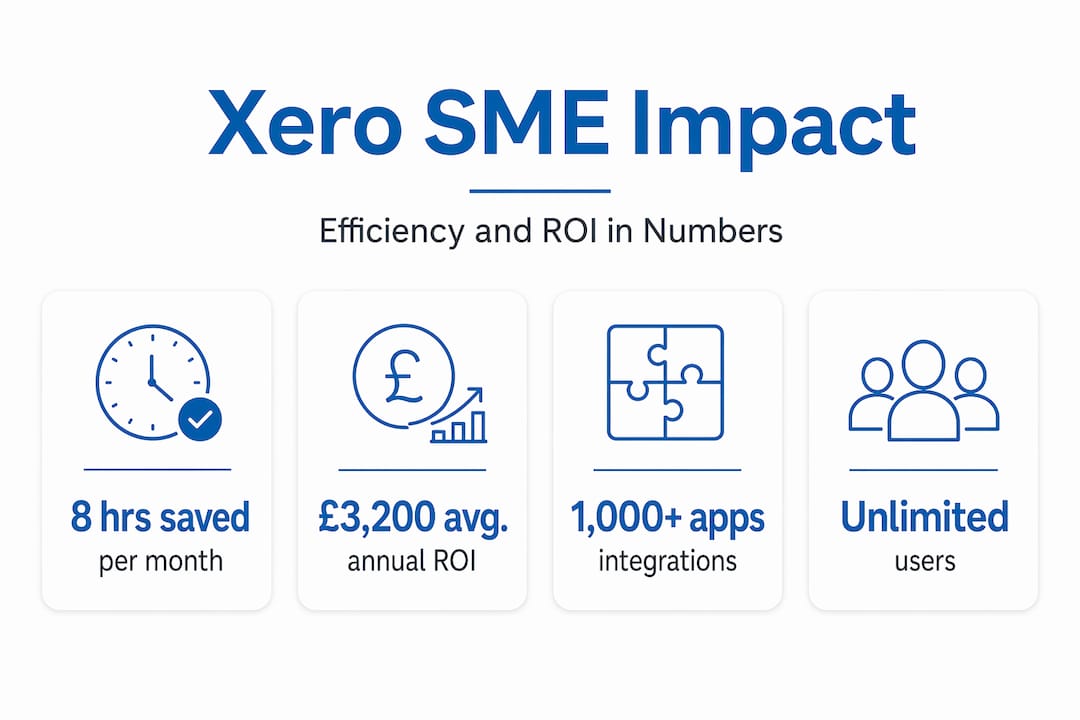
The return on that investment is well-documented. UK SMEs save 6 to 8 hours monthly on admin tasks and claim £3,200 to £5,800 more in allowable expenses each year when using Xero with the right add-ons. ROI in year one is estimated at ten times the cost of the subscription. For a business paying £29 per month for Xero, the annual subscription cost is £348 — a fraction of what most firms recover in additional expense claims alone.
Research consistently shows that automation reduces errors in financial processes, which carries its own ROI in reduced accountant correction time and lower risk of HMRC penalties.
Here is a simple four-step plan to get started:
- Assess your needs — list your current pain points: late invoicing, messy receipts, manual VAT, unclear cash flow. Match them to Xero’s feature set to identify which plan tier fits
- Start a free trial — Xero offers a 30-day free trial. Use it to connect your bank feed, import historical transactions, and test reconciliation before committing
- Connect your bank feeds and key integrations — prioritise receipt capture (Dext or Hubdoc) and payment tools (Stripe, GoCardless) in the first week
- Invite your accountant — add them as an adviser in Xero immediately. They can configure your accounts correctly from the start, which prevents months of cleaning up later
Pro Tip: During your free trial, run one full month of real transactions through Xero. Do not use dummy data. Seeing your actual business in the system makes it far easier to evaluate whether the setup is right before you commit.
Why cloud accounting success still depends on human expertise
Here is something that rarely gets said plainly: Xero is an exceptional tool, but it does not make judgement calls. It processes what you give it. If your chart of accounts is set up incorrectly, Xero will organise your wrong data very efficiently. If your expense categories are too broad, your reports will look clean but tell you nothing useful.
In our experience working with UK tech and fintech businesses from pre-seed through to Series A, the businesses that extract the most value from Xero are the ones that treat it as a system to be configured and maintained — not a set-and-forget solution. The companies that struggle are typically those that expected automation to solve problems that were actually structural or strategic.
The overlooked risk of over-automation is real. When bank feeds reconcile transactions automatically, it is tempting to assume everything is correct. But automated matching makes assumptions. A payment to a cloud provider might be coded to software costs one month and infrastructure the next, quietly distorting your margins over time. Only a trained eye reviewing the data regularly catches these patterns.
Pairing expert Xero advice with the platform itself is where the genuine compounding happens. An adviser who understands both the software and your sector can configure reporting that supports R&D tax credit claims, investor pack preparation, and HMRC enquiries simultaneously. Technology multiplies good judgement. It does not replace it.
Unlock your business’s financial potential with expert support
Getting Xero set up correctly from the start makes everything downstream easier — but knowing how to configure it for a tech or fintech business specifically is a different skill to general bookkeeping.

At Price & Accountants, we work exclusively with UK tech and fintech businesses, and Xero is central to how we deliver real-time financial visibility for every client. Whether you need bookkeeping services to keep your records clean month to month, accounting services to prepare investor-ready financials, or specialist R&D tax credits advice to reclaim capital on your innovation spend, we bring over 40 years of expertise to every engagement. We do not just file returns — we act as your financial growth partner from day one.
Frequently asked questions
Is Xero compliant with UK Making Tax Digital (MTD) rules for 2026?
Yes, Xero is fully MTD-compliant and supports digital VAT submissions directly from its platform, including real-time bank feeds that satisfy HMRC’s digital record-keeping requirements.
Which UK banks does Xero connect with for real-time feeds?
Xero connects with most major UK banks, auto-importing transactions via secure bank feeds so your accounts are always up to date without manual data entry.
Can I run payroll for my staff through Xero?
Yes, Xero offers payroll from £16 per month, covering PAYE, pension auto-enrolment, and payslips, making it a practical all-in-one platform for growing teams.
How does Xero compare to QuickBooks and Sage for a growing tech startup?
Xero stands out for unlimited users and a vast app ecosystem for UK SMBs, whilst QuickBooks may offer a cheaper entry point and Sage excels in payroll for larger firms, making Xero the top-rated choice for most UK tech businesses.
Does Xero automate expense claims and receipt capture?
Yes, Xero integrates with AI receipt capture tools like Hubdoc and Dext, automating the extraction and coding of expenses so your claims are accurate and your records are always audit-ready.