
TL;DR:
- Specialist startup accountants are essential for managing R&D credits, EIS/SEIS compliance, and investor-ready reports.
- Choosing experienced firms improves fundraising success and helps avoid costly non-compliance issues.
- Ongoing strategic support from the right accountant shapes investor perception and facilitates scale.
Scaling a tech startup from pre-seed through to Series A is one of the most financially complex journeys a founder can undertake. Every funding round brings tighter scrutiny, more sophisticated investors, and compliance obligations that multiply faster than your headcount. A specialist accountant for startups becomes essential at this stage, covering R&D tax credits, SEIS/EIS compliance, and investor-ready financials. Choosing the wrong accountant at this stage is not just inconvenient. It can cost you investor trust, delay your raise, and leave significant tax relief unclaimed. This guide walks you through exactly what to look for, what to ask, and what to avoid.
| Point | Details |
|---|---|
| Niche expertise is critical | Choose accountants with deep experience in R&D tax relief, SEIS/EIS, and investor reporting for tech startups. |
| Proper vetting prevents risk | Test for fundraising track record and compliance knowledge to avoid costly mistakes and ensure future funding success. |
| Best value through partnership | Work closely with your accountant for strategic financial narratives and to maximise claims and savings at every stage. |
| Modern tools boost efficiency | Adopt MTD-compliant, AI-powered software with your accountant to save costs and avoid errors. |
Most founders discover the limitations of a generalist accountant at the worst possible moment: during investor due diligence. A standard high-street firm might handle your VAT returns perfectly well and still have no idea how to structure an SEIS advance assurance application or document qualifying R&D expenditure for HMRC. These are not minor oversights. They are deal-breaking gaps.
The reason why tech startups need accountants with specific sector experience comes down to the specialist reliefs and compliance frameworks involved. SEIS (Seed Enterprise Investment Scheme) and EIS (Enterprise Investment Scheme) allow early-stage investors significant income tax and capital gains reliefs, but only if your share structure, company age, and trading activity meet strict HMRC criteria. Get that wrong and you could invalidate investor relief retroactively, which is a catastrophic outcome for your next round.
R&D tax credits add another layer of complexity. Claiming them requires clear technical narratives, precise cost allocation, and project-level documentation. Niche tech specialists outperform generalists for R&D and SEIS work, though they may lack the global scale of a Big 4 firm. For most startups scaling to Series A, that trade-off is entirely worthwhile.
Here is a direct comparison to make this concrete:
| Criteria | Tech specialist accountant | Generalist accountant |
|---|---|---|
| R&D tax credit claims | Deep expertise, narrative support | Limited or no experience |
| SEIS/EIS compliance | Advance assurance, ongoing monitoring | Often outsourced or missed |
| Investor-ready reporting | Board packs, SaaS metrics, cap tables | Basic statutory accounts |
| MTD compliance | Cloud-native, automated | Variable |
| Fundraising due diligence | Proactive, experienced | Reactive, unfamiliar |
Common problems founders encounter with generalist firms include missed R&D claim windows, poorly documented expenditure that HMRC queries, and financials that simply do not speak the language investors expect. Following startup bookkeeping best practices from day one creates the foundation that specialist accountants build upon.
The right accountant does not just keep you compliant. They keep you fundable.
DIY accounting at seed stage might feel cost-effective. By Series A, it almost always creates expensive remedial work and erodes investor confidence at precisely the moment you need it most.
With the need for a specialist firmly established, let us detail exactly what you should require when hiring. There is a meaningful difference between an accountant who has worked with one or two startups and one who has guided fifteen companies through successful funding rounds. The checklist below separates the two.
Core capabilities to require:
Bookkeeping best practices confirm that monthly bank reconciliations, VAT and PAYE checks, 13-week cash forecasts, and MTD-compliant software are non-negotiable for any startup preparing for institutional investment.
Questions to ask during selection:
| Question | What a strong answer looks like |
|---|---|
| How many R&D claims have you submitted? | Specific numbers, success rate, average claim value |
| Can you share a case study of a Series A client? | Named or anonymised, with tangible outcomes |
| How do you handle HMRC enquiries? | Proactive pre-notification, dedicated adviser contact |
| What software do you use? | Xero, cloud-native, automated reconciliation |
| Do you offer fractional CFO support? | Board-level strategic input beyond compliance |
Verifying credibility matters enormously. Ask for references from investors, not just founders. VCs and angels interact with portfolio company accountants regularly and will give you an honest picture of how well a firm communicates under pressure.
Pro Tip: Check whether the firm has worked with your type of investor. A firm experienced with angel syndicates may not have the same fluency with institutional VC expectations around financial controls and board reporting.
Look at expert bookkeeping essentials and accounting tips for scaling startups as benchmarks for what a competent specialist should already know and be doing for clients at your stage.
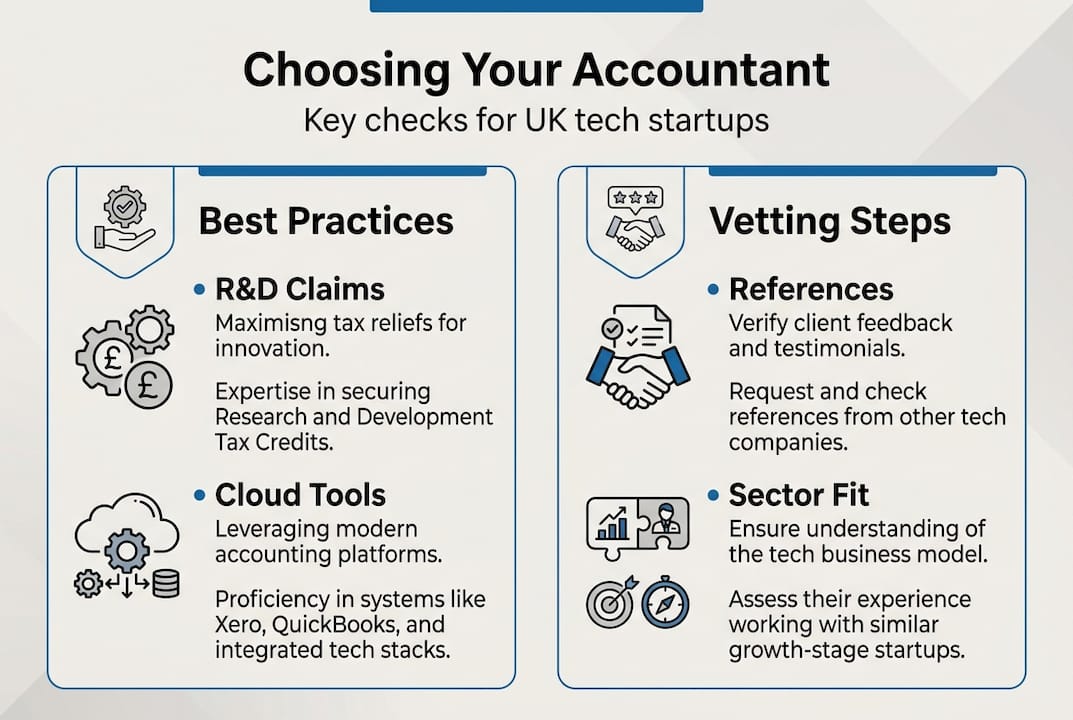
Once you know what skills your accountant must have, it is time to find and vet your options. The best candidates rarely appear through a generic Google search. They come through warm referrals.
Where to find specialist accountants:
Recommended specialist firms in the UK include Accountancy Cloud, which has supported over 150 startups and helped raise more than £500m, alongside Onside, Valentis, and Thrive, all of which focus on the pre-seed to Series A journey.
Once you have a shortlist, the vetting process should be structured, not just instinctive.
A good accountant will ask you as many questions as you ask them. If they only pitch, walk away.
During your conversations, press for specifics on startup accounting due diligence: how many R&D claims have been successfully defended under HMRC enquiry? What is their process when a client is approaching a funding round? How do they work with a startup’s legal team during a share issuance?

Red flags to watch for include generic proposals that do not reference your specific sector or funding stage, no evidence of working with SaaS or deep tech companies, and an inability to explain SEIS advance assurance in plain language. Also ask about their capacity. A firm that adds 30 new startup clients a year without growing its team will eventually deprioritise smaller accounts.
Pro Tip: Ask to speak with a client they have supported through a completed funding round. That conversation will reveal more about working style, responsiveness, and genuine expertise than any pitch deck.
Understanding accountants’ role after raising funds is equally important. The work does not stop at close. Investor reporting, cap table management, and compliance obligations intensify post-investment.
Now that you know how to choose and hire the right specialist, avoid the biggest pitfalls and ensure you get full value out of your partnership.
Clean, well-maintained books cut audit time by 40% and significantly boost investor confidence, while non-compliance penalties average around £5,000 per incident. That is not a number to test.
The most common mistakes tech founders make with their accountants:
The post-2024 R&D merged scheme has raised the bar further. Stricter HMRC scrutiny now requires pre-notification of claims and strong technical narratives. An accountant who was competent at R&D claims in 2023 may not be fully across the new requirements in 2026 unless they have actively updated their practice.
Review your startup tax planning checklist quarterly with your accountant, not annually. This catches planning opportunities before they close and keeps your R&D tax relief claims fully documented in real time.
Pro Tip: Use cloud accounting software with your accountant’s direct access enabled. Real-time visibility means they catch anomalies, flag compliance risks, and prepare investor reporting far faster than a firm working from monthly exports.
AI-powered bookkeeping tools are also reducing error rates and cost significantly. A specialist firm that integrates these into their workflow passes those efficiency gains to you in the form of faster turnaround and sharper insight. Look at HMRC R&D guidance for the latest documentation standards your accountant must meet.
Most founders think of their accountant as a compliance function. File the returns, handle the VAT, stay out of trouble. We think that framing costs startups real money and real opportunities.
The role of accountants for UK startups at Series A stage is fundamentally about narrative, not just numbers. Investors are buying a story about future growth, and your financials either support that story or undermine it. A specialist accountant shapes how your unit economics, burn rate, and runway are presented so they resonate with the way VCs think, not just how HMRC requires them to be filed.
We have seen startups with genuinely strong fundamentals stumble in due diligence simply because their books were disorganised or their R&D claims were underdocumented. Conversely, founders who treat their accountant as a strategic partner, briefing them months before a round, involving them in investor conversations, and leaning on their experience of what institutional investors expect, raise faster and on better terms. That is not a coincidence. The right financial partner spots blockers before investors do, and gives you the time to fix them.
If the complexity of R&D claims, SEIS/EIS compliance, and investor-ready reporting feels like a lot to manage alongside actually building your product, that is because it is.

At Price & Accountants, we work exclusively with tech founders at every stage from pre-seed through to Series A and beyond. Our team manages startup R&D tax credit services, SEIS/EIS structuring, MTD-compliant bookkeeping, and strategic finance director support, all under one roof. We have helped over 20 startups complete their funding journeys, with several now valued above £50m. Whether you need end-to-end company accounting services or dedicated bookkeeping for tech startups, we are ready to support your next stage of growth. Book a free consultation today.
Look for specialists with hands-on experience in SEIS/EIS, R&D tax credits, and investor reporting, who use MTD-compliant cloud software. Strong candidates offer services including R&D claims with up to 86% relief, SEIS/EIS setup, cash flow forecasting, and fractional CFO support.
Yes, investor-ready financials, properly structured SEIS/EIS compliance, and clean books are all essential to a smooth fundraising process. Clean books cut audit time by 40% and measurably improve investor confidence during due diligence.
Loss-making SMEs can receive up to 18.6% cash back on qualifying R&D expenditure, with average claims ranging from £54,000 to £161,000 depending on the scale and nature of the qualifying work.
The most damaging errors include incomplete R&D documentation, missing SEIS/EIS filing windows, and poor treatment of multi-currency accounts and equity compensation. Poor documentation leads directly to R&D claim rejections and heightened compliance risk.
Not necessarily, provided your accountant has a verified track record supporting tech startups through each funding stage. Recommended specialist firms such as Accountancy Cloud, Onside, and Thrive are structured to support founders from pre-seed through to Series A and beyond.