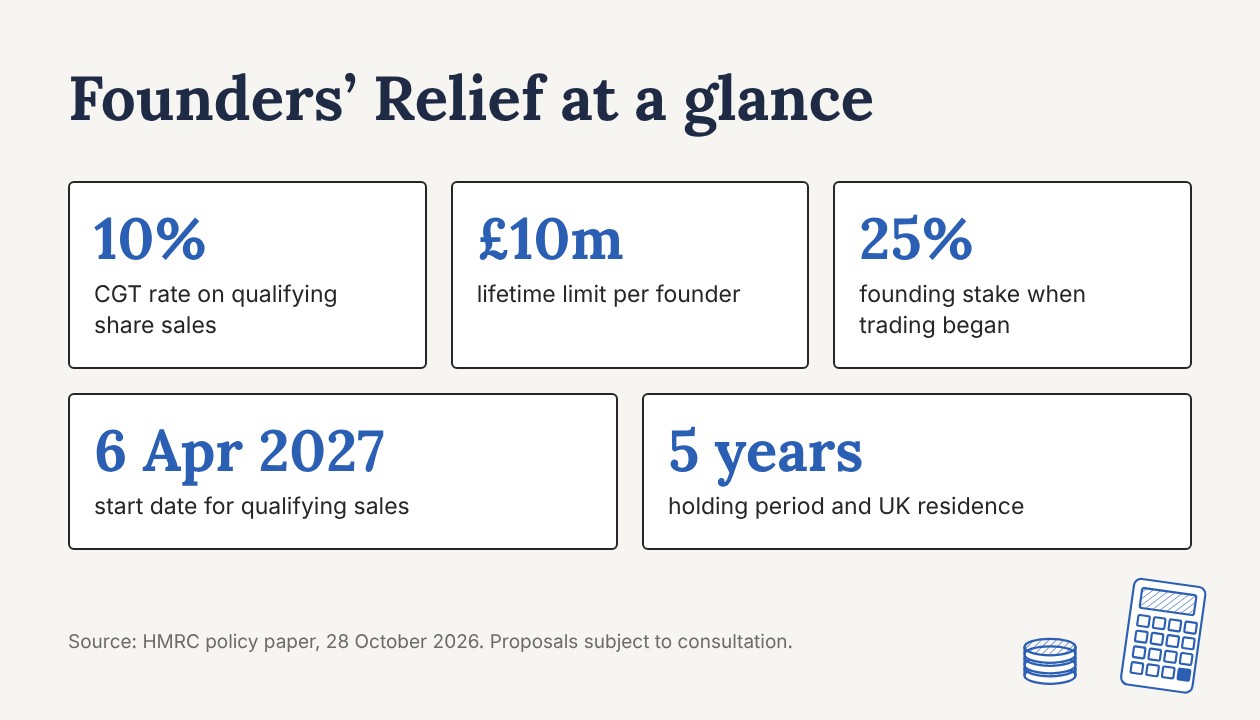
Founders' Relief is the biggest new tax break for UK business founders in years. Announced at the Autumn Budget 2026 on 28 October 2026, it cuts the rate of Capital Gains Tax (CGT) to 10% on up to £10 million of lifetime gains for eligible founders and early investors who sell shares in high-growth UK trading companies. It applies to qualifying disposals on or after 6 April 2027.
For comparison, gains on shares that don't qualify for any relief are taxed at 18% or 24%. On a £10 million gain, a 10% rate instead of 24% saves up to £1.4 million in tax.
But the relief is deliberately narrow. HMRC estimates only around 600 people a year will qualify, and the same Budget halves the Business Asset Disposal Relief (BADR) lifetime limit to £500,000 from the same date. Several of the Founders' Relief tests look back to the day your company started trading, so if you are founding a business now, or are a few years in, this is the time to understand them.
In this guide we explain who qualifies, how Founders' Relief compares with BADR, a fully worked example, whether to sell before or after 6 April 2027, and the steps founders should take now. For every other measure in the Budget, read our Autumn Budget 2026 summary.
Founders' Relief at a glance
What is Founders' Relief?
Founders' Relief is a proposed Capital Gains Tax relief that gives a 10% CGT rate on gains from selling shares in a qualifying company, up to a £10 million lifetime limit per person. The limit applies per individual, so several co-founders of the same company can each claim it if they each qualify.
The government says the relief is designed to reward people who start, or invest early in, UK companies that grow fast, create jobs and innovate. That is why, unlike BADR, it comes with company size and growth tests as well as tests for the individual.
The rules are still a proposal. They are set out in an HMRC policy paper and a technical consultation, both published on 28 October 2026, and will be legislated through amendments to the Finance Bill 2026-27.
Who qualifies for Founders' Relief?
You must pass two sets of tests: one about you, and one about the company.
Conditions for the individual
- A 25% founding stake. You must have held at least 25% of the company's ordinary share capital, with matching voting rights and rights to profits and assets on a winding up. This is measured when the company's trade, or preparation for that trade, began. It is not measured at the point of sale.
- Five years of ownership. You must have held the shares or securities for at least five years before you sell (the policy paper refers to five tax years).
- Five years of UK residence. You must have been UK resident under the Statutory Residence Test for at least five continuous tax years before the disposal.
- Individuals only. Companies, trusts and other entities cannot claim.
Once you qualify, the relief can apply to all the shares you sell, not only your original founding shares. The 25% test can also be met through the holding company of a trading group. Unlike BADR, there is no stated requirement to work for the company as an employee or officer.
Conditions for the company
- Within UK Corporation Tax. The company must be UK resident for Corporation Tax, or trade in the UK through a permanent establishment, with a substantial UK presence for the five accounting periods before the disposal.
- A trading company. It must be a trading company, or the holding company of a trading group, without substantial non-trading or excluded activities.
- Same trade throughout. It must still carry on the new trade it was set up for, with no major change in the nature of that trade.
- Scale at exit. In the accounting period before the disposal, it must have turnover of at least £10 million and at least 15 qualifying full-time employees. A qualifying employee works at least 35 hours a week and is paid at least the National Minimum Wage. Directors, contractors and agency workers do not count.
- Not an excluded trade. Trades excluded from the Enterprise Investment Scheme (EIS), such as dealing in land, financial services and property development, do not qualify.
- Listed or unlisted. Both can qualify.
The growth and innovation tests: meet at least 2 of 3
The company must also pass at least two of these three tests.
A company that innovates but doesn't claim R&D tax relief can still qualify by passing both growth tests. But if it relies on the innovation test, the R&D claim must stand up: under the proposals, if HMRC later finds a problem with the company's R&D claim, the founder could lose Founders' Relief and have to pay the extra tax with interest.
Founders' Relief vs Business Asset Disposal Relief
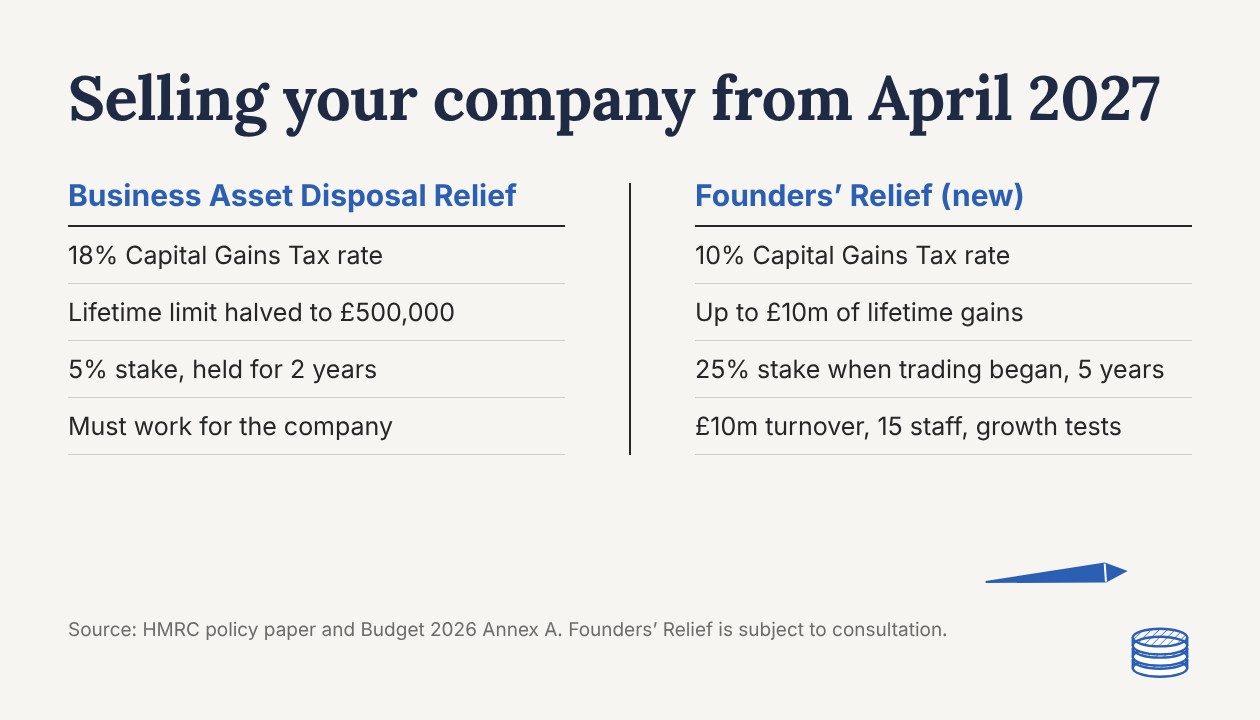
Founders' Relief sits above Business Asset Disposal Relief (BADR, formerly Entrepreneurs' Relief) as a far more generous but far harder-to-reach relief. BADR is aimed at a wide range of business owners. Founders' Relief is aimed at the founders of high-growth companies. And from 6 April 2027, BADR itself becomes much less valuable.
The two reliefs share one limit
Your £10 million Founders' Relief limit is reduced by any BADR or Investors' Relief you claim from 6 April 2027. For example, if you claim £500,000 of BADR on the sale of another business in 2028, your remaining Founders' Relief limit falls to £9.5 million. Founders' Relief does not add £10 million on top of your BADR allowance. Based on the consultation wording, claims made before 6 April 2027 do not reduce the limit.
Worked example: selling a qualifying company
Priya founded a UK software company in 2018 and held 40% of the shares when it started trading. By 2027 the company has turnover of £30 million and 120 full-time staff, and has grown both turnover and headcount by more than 25% a year. In June 2027 she sells her shares and makes a gain of £12 million. She is an additional rate taxpayer and has made no earlier BADR claims.
Founders' Relief saves Priya £1,400,000. Claiming BADR instead would save her only £30,000, because from 6 April 2027 BADR is capped at £500,000 of gains taxed at 18% rather than 24%.
Illustration only. It assumes the proposed rules are enacted as drafted, and uses the 24% CGT rate and £3,000 annual exempt amount confirmed for 2027-28. New to CGT? Start with our Capital Gains Tax guide.
Should you sell before or after 6 April 2027?
Because Founders' Relief starts on the same day the BADR limit halves, 6 April 2027 is now a key date for anyone planning an exit. The right answer depends on whether you expect to qualify.
- You expect to qualify for Founders' Relief: a sale on or after 6 April 2027 could cut your rate to 10% on up to £10 million of gains. Waiting may be worth far more than BADR, but only if the final rules match the proposals and you still meet every test at the date of sale.
- You won't qualify: a sale completed before 6 April 2027 can still use BADR on up to £1 million of gains. After that date the limit falls to £500,000, which could cost you up to £30,000 in extra tax. Special rules apply to contracts signed before 6 April 2027 that complete afterwards.
- You're not sure: get the numbers modelled now. A few months either side of 6 April 2027 could change your tax bill by six or seven figures.
Our Autumn Budget 2026 summary covers the BADR cut and the other changes that affect business owners from April 2027.
Key dates
7 things founders should do now
The rules may change after the consultation. But because several tests look back to the day trading began, early decisions matter.
- Design your cap table with the 25% test in mind. If you are starting a company with co-founders, each founder who wants to qualify needs at least 25% when trading or preparation for trading begins. That means no more than four qualifying founders. Our cap table management and new business setup services can help you get this right from day one.
- Hold founder shares personally. Only individuals can claim, so think carefully before holding founder shares through a company or trust.
- Protect the original trade. A major change in the nature of the trade could disqualify the company, so take advice before a pivot.
- Track your growth metrics. Keep clean records of turnover and qualifying full-time employees for every accounting period. The tests look back up to 10 years, longer than normal record-keeping rules require.
- Claim R&D relief where you are eligible, and get it right. The innovation test needs R&D relief to have actually been claimed, not just spent. Our R&D tax relief team can make sure your claims are robust.
- Plan the timing of any exit. Compare a sale before 6 April 2027 using BADR with a later sale using Founders' Relief, and weigh this against commercial factors and the risk that the final rules differ.
- Watch your residence. Moving abroad before a sale could break the five-year UK residence condition.
Want your say? You can respond to the consultation by emailing EnterpriseTax@hmtreasury.gov.uk before 11:59pm on 30 November 2026.
How do you claim Founders' Relief?
You will claim Founders' Relief through your Self Assessment tax return for the tax year of the sale. HMRC is considering a standard supplementary form setting out which accounting periods you rely on for each test. Because founders may not have the company's records, the government's preferred approach is a new statutory right to request the information you need from the company. HMRC is also considering targeted anti-avoidance rules, for example for company restructurings designed to bring assets into the relief.
Founders' Relief FAQs
What is Founders' Relief?
Founders' Relief is a proposed Capital Gains Tax relief announced at the Autumn Budget 2026. It gives a 10% CGT rate on up to £10 million of lifetime gains when eligible founders and early investors sell shares in high-growth UK trading companies.
When does Founders' Relief start?
It applies to qualifying disposals made on or after 6 April 2027. Sales before that date cannot use it.
What is the Founders' Relief CGT rate?
10%, compared with 18% for gains qualifying for BADR and 18% or 24% for gains with no relief.
Can I claim Founders' Relief and Business Asset Disposal Relief?
You can use both over your lifetime, but they share one limit. Any BADR or Investors' Relief claims made from 6 April 2027 reduce your £10 million Founders' Relief limit.
Do I need to own 25% of the company when I sell?
No. The 25% test is measured when the trade, or preparation for it, began. The consultation does not say your stake must still be 25% at the point of sale.
Can early investors claim Founders' Relief?
The government describes the relief as being for founders and early investors. However, the only stake test is the same 25% holding at the start of trading, so most later-round investors will not qualify.
Do I have to work for the company?
The proposals do not include an employment or officeholder condition, unlike BADR. Only the shareholding, holding period and UK residence tests apply to you as an individual.
Does my company have to be unlisted?
No. Listed and unlisted companies can both qualify.
My company doesn't claim R&D tax relief. Can I still qualify?
Yes, if the company passes both the turnover growth and headcount growth tests.
How many people will benefit?
HMRC estimates around 600 individuals a year, linked to around 400 businesses. The government expects the relief to cost around £260 million in 2027-28.
How Price & Accountants can help
Founders' Relief could save qualifying founders up to £1.4 million, but only if the groundwork is in place years before a sale. Our London team works with startups and scaling companies and can help you:
- check whether you and your company are on track to qualify
- structure founder shareholdings at incorporation
- keep turnover, headcount and R&D records ready for a claim
- model the timing of an exit and compare Founders' Relief with BADR
- prepare your Self Assessment claim
Thinking about an exit, or starting a new company? Book a free consultation with Price & Accountants today.
Recommended reading
- Autumn Budget 2026: What It Means for UK Businesses, Landlords and Individuals
- What Is Capital Gains Tax? UK Guide for 2026
- EMI share schemes for startups
- The Ultimate Tax Savings Guide 2026/27
This article reflects the proposals published on 28 October 2026. The rules are subject to consultation and may change before they become law. It is general information, not tax advice.
Sources: HMRC, Capital Gains Tax: introduction of a new Founders' Relief (policy paper, 28 October 2026); HM Treasury, Founders' Relief: technical consultation (28 October 2026); HM Treasury, Budget 2026: Annex A, rates and allowances; GOV.UK, Business Asset Disposal Relief; GOV.UK, Capital Gains Tax rates; HMRC, HS275 Business Asset Disposal Relief.