
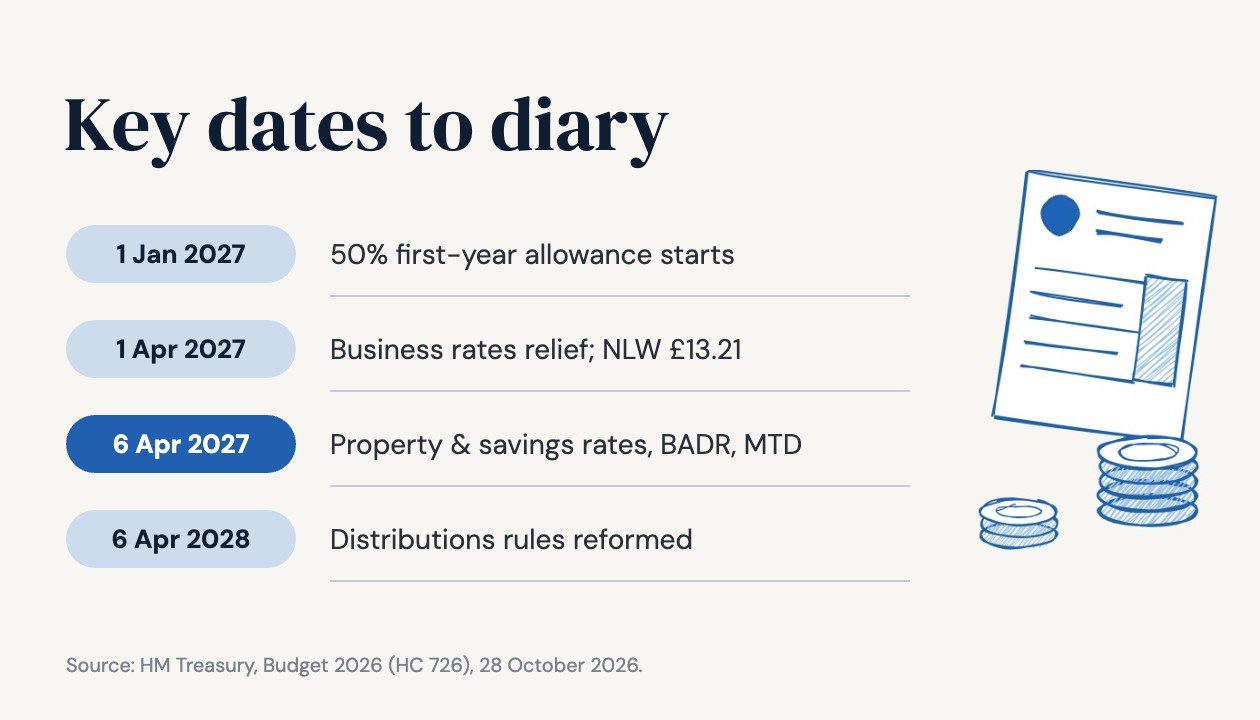
The Autumn Budget 2026 did not raise income tax, National Insurance or VAT. But if you are a landlord, a saver, a company director or a business owner thinking about selling, it is one of the most important Budgets in years. Most of the changes start on 6 April 2027, which gives you just over five months to act.
We have read the full Budget report, line by line, so you don't have to. Two days ago we published our Autumn Budget 2026 predictions; now the measures are confirmed. Here is our plain-English Autumn Budget 2026 summary: what changed, who wins, who loses, and the exact steps we recommend before April 2027.
Autumn Budget 2026: the key points in 60 seconds
Published on 28 October 2026 under the title "Breathing space for today, fresh hope for the future", the Budget protects headline tax rates and instead raises money from investment income, property income and business exits. Here is what you need to know:
- Landlords: tax on property income rises by a further 2 percentage points to 24%, 44% and 49% from 6 April 2027.
- Savers: tax on savings income rises to the same 24%, 44% and 49% rates from 6 April 2027.
- Selling a business: the Business Asset Disposal Relief (BADR) lifetime limit is halved from £1 million to £500,000 from 6 April 2027.
- Founders: a brand-new Founders' Relief offers a 10% Capital Gains Tax rate on up to £10 million of lifetime gains.
- Capital allowances: the main rate writing-down allowance falls to 12% from April 2027, while the first-year allowance rises to 50% from 1 January 2027.
- Side-hustlers: the Trading Allowance triples from £1,000 to £3,000 from 6 April 2027.
- High street: bigger business rates relief for pubs, music venues and small retail, hospitality and leisure (RHL) premises from 1 April 2027.
- Employers: the National Living Wage rises 3.9% to £13.21 an hour from 1 April 2027.
- Making Tax Digital: a penalty easement for April 2027 joiners, with roll-out deferred for some groups.
The economic backdrop: the Office for Budget Responsibility (OBR) forecasts GDP growth of 1.2% in 2026 and 1.0% in 2027. CPI inflation was 3.5% in September 2026 and is expected to peak at 3.8% in early 2027, before returning to 2% by late 2028. Borrowing is forecast at 4.2% of GDP in 2026-27, falling to 1.8% by 2030-31.
Short on time? Scroll down to our 7-point action plan, or book a free Budget review and we will tell you exactly how the Autumn Budget 2026 affects you.
Budget 2026 for landlords: property income tax rises again
Individual buy-to-let landlords are among the clearest losers from the Autumn Budget 2026.

New property income tax rates from 6 April 2027 (England, Wales and Northern Ireland):
- Basic rate: 24%
- Higher rate: 44%
- Additional rate: 49%
What this means in real money: a higher-rate landlord with £20,000 of taxable rental profit will pay £8,800 a year at 44%, compared with £8,000 at today's 40% rate. That is £800 more every year, before any rent increase.
HMRC is also watching more closely. The government will consult on third-party reporting of property income, and a landlord registration fee for the private rented sector was confirmed. Undeclared rental income will become much easier for HMRC to spot.
Stamp Duty Land Tax (SDLT): SDLT is removed on rent paid under assured tenancies in England, effective from 1 May 2026, following the Renters' Rights Act 2025. SDLT group relief rules are tightened for transactions from 29 October 2026.
First-time buyers: a new Your First Home equity loan scheme will support around 70,000 first-time buyers from April 2027.
Our view: the gap between owning property personally and owning it through a limited company has widened again. If you hold buy-to-let property in your own name, now is the time to model whether incorporation, or restructuring your finance, makes sense before April 2027. Remember to factor in the Capital Gains Tax and SDLT costs of transferring property (our Capital Gains Tax guide explains how CGT works). Our tax team can run the numbers for you.
Selling your business? BADR is halved and Founders' Relief arrives
This is where the Autumn Budget 2026 raises most of its money from business owners and investors.

Business Asset Disposal Relief cut to £500,000
The lifetime limit for Business Asset Disposal Relief falls from £1 million to £500,000 from 6 April 2027. Gains above £500,000 will be taxed at full Capital Gains Tax rates. If you are planning to sell, merge or wind up your company in the next few years, the timing of your exit could now be worth tens of thousands of pounds.
Example: a founder selling a company for a £1 million gain could lose BADR on £500,000 of that gain. At current rates (18% with BADR versus 24% without) that is roughly £30,000 of extra tax if the sale completes after 5 April 2027.
New Founders' Relief: 10% CGT on up to £10 million
From 6 April 2027, qualifying founders of high-growth, innovative companies can pay a reduced 10% CGT rate on up to £10 million of lifetime gains. This is a big incentive for start-up and scale-up founders. The detailed qualifying conditions will be crucial, so do not assume you qualify until the legislation is published. Speak to us before you restructure anything.
Distributions shake-up for owner-managed companies
The rules on company distributions to individual shareholders will be modernised from 6 April 2028. The Treasury expects this to raise around £800 million a year, so it will affect how directors take profits out of their companies (see our guide to director salary vs dividends for 2026/27). Protections for genuine ownership changes, including family succession, are promised, with draft legislation to follow. Headline dividend tax rates were not changed at this Budget.
Savings income tax and ISAs: what changes for savers
On top of the rise announced in Budget 2025, tax on savings income goes up by a further 2 percentage points from 6 April 2027:
- Basic rate: 24%
- Higher rate: 44%
- Additional rate: 49%
The Personal Savings Allowance and starting rate for savings are unchanged, and the Treasury says 84% of income taxpayers will be unaffected.
Good news on ISAs: the planned cut to the cash ISA limit is reversed, so it stays at £20,000. A new First Time Buyer ISA will replace the Lifetime ISA for new savers from 6 April 2029. The Lifetime ISA withdrawal charge falls from 25% to 20% for first-time buyers purchasing above the £450,000 price cap from 29 October 2026.
Autumn Budget 2026 for limited companies: corporation tax and capital allowances
The main rate of corporation tax stays capped at 25% and full expensing remains. The Budget instead reshapes capital allowances and adds targeted support for small and growing companies.
Capital allowances: writing-down allowance cut to 12%
The main rate writing-down allowance falls from 14% to 12% from April 2027. At the same time, the main rate first-year allowance rises from 40% to 50% from 1 January 2027. Companies buying plant and machinery outside full expensing get more relief upfront, but less on the remaining pool each year. Timing your equipment purchases has never mattered more.
Business rates relief in England from 1 April 2027
- Relief for pubs, social clubs and live music venues rises by 20 percentage points to 35%.
- Small Business Rate Relief thresholds for RHL properties rise from £12,000 to £18,000 (100% relief) and from £15,000 to £21,000 (tapered relief), taking around 70,000 more businesses out of rates altogether.
- Other RHL businesses get a two-year real-terms bills freeze.
- Reliefs are removed for vape shops and adult gaming centres.
Share schemes, R&D and energy costs
- CSOP becomes EMI2: the individual option limit doubles from £60,000 to £120,000, the exercise period extends from 10 to 15 years, and its interaction with EMI limits is removed from 6 April 2027.
- R&D tax relief: the Claim Notification Form is scrapped from 1 April 2027.
- Energy: the British Industrial Competitiveness Scheme gives over 10,000 energy-intensive firms a 20–25% electricity discount from April 2027, with a backdated payment for 2026-27.
Other business tax changes to note
- The Bank Corporation Tax Surcharge rises from 3% to 6% for 15 months from 1 January 2027.
- The foreign permanent establishment exemption becomes mandatory for accounting periods starting on or after 1 January 2027.
- Stamp Duty and SDRT on shares will be replaced by a new Securities Transfer Tax from late 2027.
- A Call for Evidence on corporation tax administration was announced.
Income tax, National Insurance and employers
There is no increase to the headline rates of income tax, employee National Insurance or employer National Insurance, so salaries are taxed as before. The changes sit around the edges:
- Trading Allowance: tripled from £1,000 to £3,000 for side-income and micro sole traders, from 6 April 2027.
- Approved mileage rates: the tax-free car and van rate rises to up to 55p for the first 10,000 business miles; the higher-mileage rate rises to up to 35p (from 6 April 2027).
- Pension Tax Allowance: no income tax for pensioners whose total income is at or below the full new State Pension, tapered above that, from 6 April 2027 to 5 April 2030.
- National Living Wage: up 3.9% to £13.21 an hour; the 18–20 rate rises 3.9% to £11.27, from 1 April 2027.
- Payrolling benefits in kind: mandatory payrolling of company cars, vans, fuel and medical benefits is delayed to 6 April 2027, with other benefits following from 6 April 2028.
- Parental Allowance: a new allowance for fathers, partners and adopters, including the self-employed, from April 2029.
Our view: the higher Trading Allowance is great news for freelancers and side-hustlers earning under £3,000 a year, who may no longer need to register or report that income. Employers should budget now for the 3.9% wage-floor increase and use the payrolling delay to get their benefits-in-kind data in order.
VAT, Making Tax Digital and HMRC compliance
VAT changes
The standard rate of VAT stays at 20%. The key changes are:
- VAT on domestic electricity is cut from 5% to 0% from 1 October 2026 to 1 July 2027.
- Online marketplaces must account for VAT on sales by UK businesses above £90,000 a year per platform from 1 October 2027.
- The reverse charge on services supplied from overseas to VAT-registered UK businesses is restricted from 1 April 2027.
- Private hire operators with fare turnover over £50 million become liable for VAT on full fares from 2 January 2028.
- Land sold to registered social housing providers is zero-rated from 1 April 2027.
- A roadmap for mandatory VAT e-invoicing from April 2029 will be published.
Making Tax Digital for Income Tax: April 2027
Sole traders and landlords joining Making Tax Digital for Income Tax in April 2027 will not get penalty points for late submission of their first four quarterly updates in 2027-28. Roll-out to several other taxpayer groups is deferred until further notice. From April 2029, Self Assessment Payments on Account will move to smaller, more frequent instalments.
Our view: the penalty easement is a cushion, not a reason to wait. If you are in MTD from April 2027, choose your software and digitise your records now. See our Making Tax Digital for Income Tax guide to get ready.
HMRC compliance crackdown
HMRC gets 670 extra compliance officers on top of the 5,500 already committed by 2029-30, plus a new power to recover lower-value tax debts directly from people who can pay but repeatedly do not. Measures to close the tax gap are now expected to raise over £12 billion a year by 2029-30. Accurate, up-to-date records are your best protection.
Pensions, motoring and household support
- Pensions: the two-year rule for taxing pension and lump-sum death benefits is removed from 28 October 2026. The State Pension triple lock will be adjusted from the next Parliament.
- Fuel duty: the temporary 5p cut is extended to 1 July 2027.
- Company cars: benefit-in-kind rates are now set through to 2030-31. The mileage-based Electric Vehicle Excise Duty (eVED) for electric and plug-in hybrid cars still starts in April 2028.
- Household energy: households in council tax bands A–D in England receive a £100 Household Energy Payment from January 2027, and gas standing charges are due to be abolished, aimed at the end of 2027.
- Student loans: interest on Plan 2 and Plan 3 loans is capped at 6% from 1 September 2026 to 31 August 2027.
Winners and losers of the Autumn Budget 2026
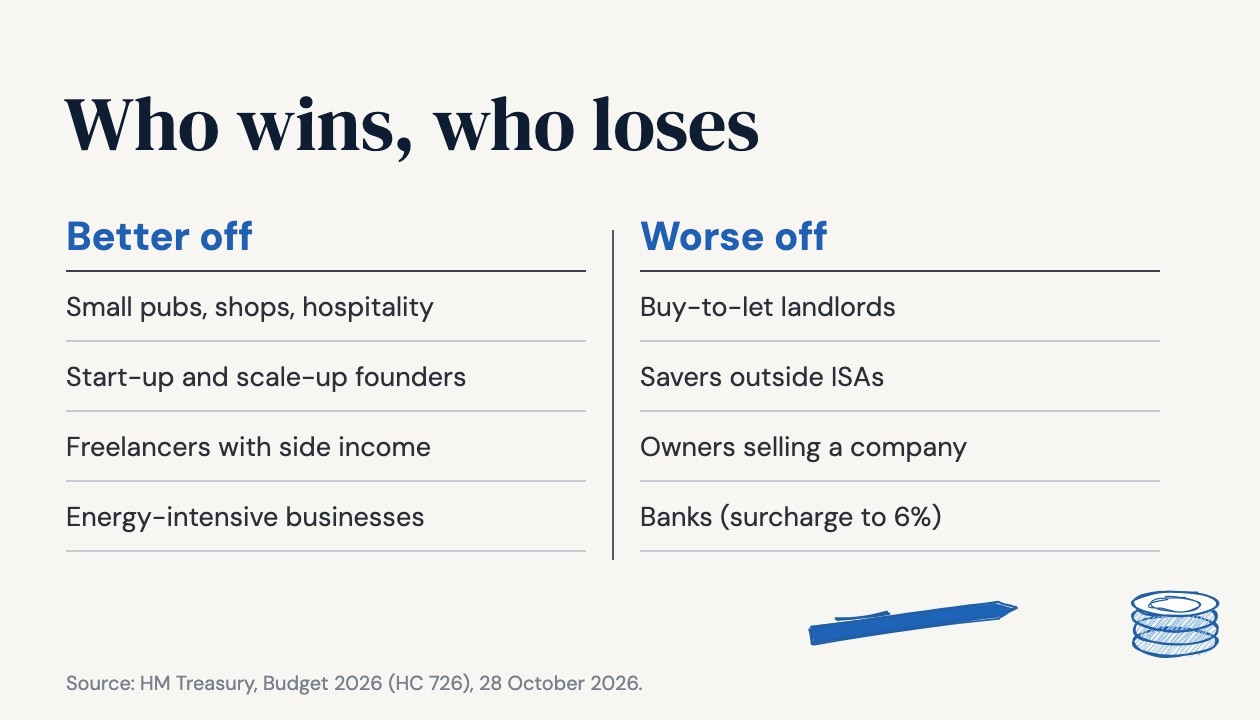
The Budget avoids headline tax rises but shifts the burden onto unearned income and business exits. Here is how it lands:
Better off
- Small pubs, shops and hospitality: higher business rates relief and SBRR thresholds from April 2027.
- Start-up and scale-up founders: 10% Founders' Relief, larger EMI2/CSOP limits and more British Business Bank finance.
- Freelancers with small side-income: Trading Allowance up to £3,000.
Worse off
- Individual buy-to-let landlords: property income tax up to 24%/44%/49%, plus more HMRC reporting.
- Savers outside ISAs: savings income tax up to 24%/44%/49%.
- Owners planning to sell a company: BADR lifetime limit halved to £500,000.
Watch closely
- Owner-managed company directors: distributions rules reformed from April 2028.
- Capital-intensive companies: a mixed picture, with a 50% first-year allowance but a writing-down allowance cut to 12%.
Your Autumn Budget 2026 action plan: 7 things to do before April 2027
- Selling a business? Model whether completing a disposal before 6 April 2027 secures BADR on up to £1 million of gains.
- Landlords: review your ownership structure and mortgage interest position, and test whether incorporation is worthwhile before property income rates rise.
- Savers: use your full £20,000 ISA allowance and make the most of spouse or partner allowances for cash held outside wrappers.
- Directors: review your salary and dividend mix for 2026-27 and 2027-28 ahead of the distributions reform.
- Equipment purchases: time spending on plant and machinery to make the most of the 50% first-year allowance from 1 January 2027.
- MTD for Income Tax: get compliant software and digital records in place well before your start date.
- Employers: budget for the £13.21 National Living Wage and prepare for payrolling benefits in kind.
Want a head start? Our free Ultimate Tax Savings Guide 2026/27 covers the reliefs and allowances you can still use this tax year.
Every situation is different, and much of the detail will only be confirmed in the Finance Bill 2026-27. This article is general information, not personal tax advice. We will update it as the legislation is published.
Autumn Budget 2026 FAQs
Did the Autumn Budget 2026 increase income tax?
No. The headline rates of income tax, National Insurance and VAT are unchanged. However, tax rates on property income and savings income rise by 2 percentage points from 6 April 2027.
What are the new property income tax rates from April 2027?
24% at the basic rate, 44% at the higher rate and 49% at the additional rate, in England, Wales and Northern Ireland.
What has changed for Business Asset Disposal Relief?
The BADR lifetime limit falls from £1 million to £500,000 from 6 April 2027.
What is Founders' Relief?
A new Capital Gains Tax relief from 6 April 2027 giving qualifying founders of high-growth, innovative companies a 10% rate on up to £10 million of lifetime gains.
Has corporation tax gone up in the Autumn Budget 2026?
No. The main rate stays capped at 25%. The main rate writing-down allowance falls to 12% from April 2027, and the first-year allowance rises to 50% from 1 January 2027.
What is the National Living Wage from April 2027?
£13.21 an hour from 1 April 2027, a 3.9% increase.
Is Making Tax Digital for Income Tax still going ahead in April 2027?
Yes, for those already in scope. April 2027 joiners will not receive penalty points for late submission of their first four quarterly updates, and roll-out to some other groups is deferred.
When do most Autumn Budget 2026 changes take effect?
Most changes start on 6 April 2027 (the start of the 2027-28 tax year) or 1 April 2027 for business rates and the National Living Wage. That gives you around five months to plan.
Get your free Autumn Budget 2026 review
Price & Accountants is a London-based cloud accounting and tax advisory firm working with limited companies, founders, landlords and individuals across the UK. Our accountants in London will show you exactly how the Autumn Budget 2026 affects you, and what to do before April 2027 to protect your income, profits and exit plans.
Book your free Budget review →
Recommended reading
- Autumn Budget 2026 Predictions: Tax Changes to Expect
- Optimal Director Salary 2026/27: What to Pay Yourself
- What Is Capital Gains Tax? UK Guide for 2026
- The Ultimate Tax Savings Guide 2026/27
Sources: HM Treasury, Budget 2026 (HC 726), 28 October 2026 — Executive summary, Chapters 1–4 and Chapter 6 (Policy Decisions, Table 6.1).