
The Autumn Budget 2026 will be delivered on Wednesday 28 October, and it is Chancellor John Healey's first. With the rates of income tax, employee National Insurance and VAT ruled out, our Autumn Budget 2026 predictions point to targeted revenue-raisers on assets, property, specific sectors and tax compliance, rather than headline rate rises.
This guide is for UK limited company directors, owner-managers, founders and investors. It brings together pre-Budget commentary from Grant Thornton, BDO, the House of Commons Library, the Institute for Fiscal Studies (IFS) and others, and sets out the tax changes to watch and what to do before and after 28 October.
Please note: everything in this article is prediction based on published commentary as at 26 October 2026. Nothing has been announced yet. We will publish our analysis of the confirmed measures after the Budget.
TL;DR
- The Autumn Budget 2026 is on Wednesday 28 October 2026. It is the first Budget of the Burnham government and would be Labour's third tax-raising Budget in a row.
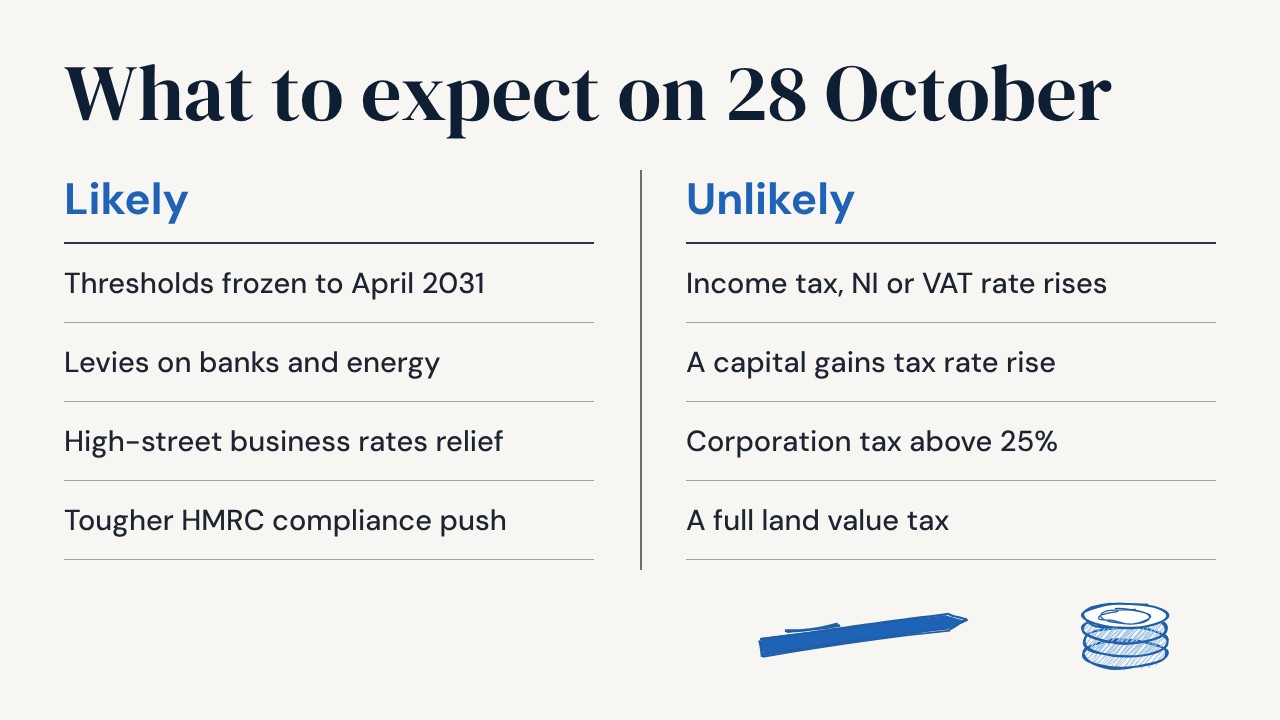
- Income tax, employee National Insurance and VAT rates are protected by the manifesto, but thresholds stay frozen to April 2031, so fiscal drag continues.
- A capital gains tax rate rise looks unlikely after press reports ruled it out, but a new relief for founders who reinvest in UK businesses is possible.
- Corporation tax should stay at 25%. Expect sector levies on banks and energy, business rates relief for the high street and a stronger HMRC push on the tax gap.
- Prepare rather than rush: review planned disposals, your salary and dividend mix, director's loan balances and succession plans, then act on the confirmed detail.
Table of Contents
- When is the Autumn Budget 2026?
- The fiscal backdrop: why tax rises are still likely
- Income tax and National Insurance predictions
- Property, savings and dividend tax predictions
- Capital gains tax, inheritance tax and pension predictions
- Business tax predictions: corporation tax, VAT and business rates
- What to do before and after 28 October
- Our perspective
- FAQ
- Get Budget-ready with Price & Accountants
When is the Autumn Budget 2026?
The Autumn Budget 2026 takes place on Wednesday 28 October 2026. It is the first Budget of the Burnham government and comes just over three months into its term, according to Grant Thornton's Autumn Budget 2026 predictions. It would also be Labour's third tax-raising Budget in a row, following a £41.5bn package in 2024 and £26bn in November 2025, as BDO's Budget predictions point out.
BDO expects "a raft of tax changes aimed at raising revenue" to fund defence and council budgets, yet unusually little has leaked. The Prime Minister has said the earlier date was chosen to shorten the period of uncertainty, and Grant Thornton suggests this could be one of the least predictable fiscal events in years.
The fiscal backdrop: why tax rises are still likely
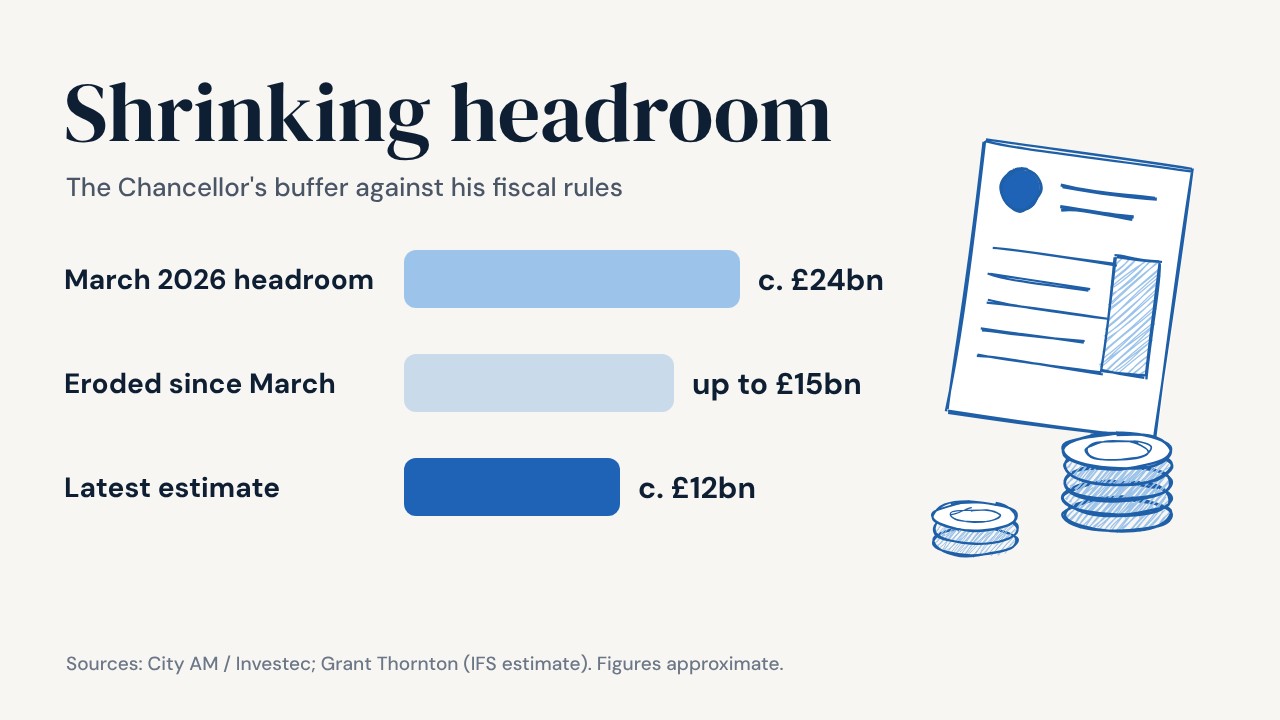
The Chancellor's buffer against his fiscal rules has shrunk since March, and he has committed to rebuilding it. That is the main reason most commentators expect some tax rises alongside spending restraint.
Pressures continue to build. Rising gilt yields, the conflict in the Middle East, higher defence commitments and cost-of-living support have all eaten into the buffer. The IFS estimates that keeping departmental budgets flat in real terms could need a £12bn top-up by the end of the decade, plus £3bn for capital, while lifting defence spending to 3% of GDP would cost £11bn in 2030–31, as reported by ITV News. IFS Director Helen Miller warned that without spending totals the Chancellor is "willing to live within", his plan would "not be credible".
The Chancellor's options are narrow. The government has kept Labour's 2024 manifesto pledge not to raise the basic, higher or additional rates of income tax, National Insurance or VAT, according to the House of Commons Library Budget briefing. Those three taxes account for almost 60% of total receipts. Investec's economists expect "a broadly neutral package" of targeted spending funded by modest tax increases, with larger decisions deferred to 2027 (City AM).
Income tax and National Insurance predictions
Our prediction: no change to income tax rates; thresholds stay frozen to April 2031; a targeted measure for state pensioners.
The manifesto pledge covers rates, not thresholds. Income tax thresholds are already frozen until April 2031, so fiscal drag will keep pulling more people into higher bands as earnings rise. Unfreezing them would be expensive: the IFS estimates that restoring inflation-linked uprating from April 2027 would cost around £8.4bn a year. BDO notes that a £500 rise in the personal allowance, floated by the Prime Minister, would cost about £5bn a year and "seems to have been sidelined".
One smaller change is expected. The government is due to set out how pensioners whose only income is the basic or new state pension will be kept out of income tax from 2027/28.
On National Insurance, employee rates are protected. BDO lists two possibilities:
- a lower employee rate for people working past state pension age
- ending the NIC differential for the self-employed
Investec also suggests NIC on earnings above retirement age, alongside relief to encourage hiring young people. However, BDO reports that an expansion of the NIC exemption for young workers is unlikely before the Milburn review of youth unemployment reports later in the year.
Property, savings and dividend tax predictions
Our prediction: incremental property measures rather than a land value tax; the "mansion tax" threshold stays at £2m; dividend tax rules may be tidied rather than raised.
The Prime Minister has long argued that the UK taxes work more heavily than wealth, which points to assets and land as likely targets. This would continue the direction set under Rachel Reeves, whose new tax rates on property, savings and dividend income took effect from April 2026.
- Land value tax. The Prime Minister has long supported one, but he has indicated that this Budget will not abolish stamp duty or council tax. A full land value tax therefore looks unlikely this year.
- High Value Council Tax Surcharge. The surcharge is due from April 2028 at a £2m threshold. Reports that it could fall to £1.5m have reportedly been ruled out.
- Holiday lets. BDO reports a rumour that holiday lets could be reclassified as second homes, making them liable to council tax instead of benefiting from small business rates relief.
- Offshore-held commercial property. BDO expects a review of commercial property held in offshore companies to avoid stamp duty land tax.
- Dividends and distributions. No dividend tax rate change is widely predicted. However, a consultation on the corporate distributions framework could affect how share buybacks, exits and demergers are taxed, and BDO suspects it could raise revenue.
- ISAs and EIS. BDO flags a possible review of ISA subscription caps and Enterprise Investment Scheme relief limits.
If you pay yourself through dividends, our guide to dividend tax rates for 2026/27 sets out where things stand today.
Capital gains tax, inheritance tax and pension predictions
Our prediction: no CGT rate rise, but possibly a new relief for founders who reinvest in UK businesses; no major IHT overhaul this year; pensions largely left alone.
Will capital gains tax go up in the Autumn Budget 2026?
Capital gains tax has been the most debated tax in the run-up. The main rate rose from 20% to 24% in October 2024, and some Labour figures want it aligned with income tax. However, the Financial Times reported on 13 October that equalisation had been ruled out, and The Times reported on 19 October that any CGT increase had been ruled out. Neither has been officially confirmed.
The evidence supports caution. Modelling, including HMRC's, suggests a simple rise above 24% could reduce revenue, because owners would hold on to assets rather than sell. Instead, both Grant Thornton and BDO highlight a possible new relief for entrepreneurs who reinvest sale proceeds in a new UK business. Investec adds that ending the CGT uplift on death remains a possibility.
Inheritance tax
The April 2026 changes to agricultural and business property relief remain politically sensitive. The Prime Minister has reportedly said he is willing to "look again" at agricultural property relief, though it is unclear whether any change would extend to business property relief. BDO suggests this may not be the year for further IHT change, with unused pensions coming into IHT from April 2027 already. It notes that a flat 10% tax on assets at death, to fund a national care service, has been mooted, but Baroness Casey's social care commission does not report until 2027.
Pensions
Major pension reform is an "outside chance", according to BDO, after the salary sacrifice cap due from 2029 caused "lots of political heat". Tax-free cash will "no doubt continue to be discussed", and a small charge on pension fund management fees is described as a simple option.
Business tax predictions: corporation tax, VAT and business rates
Our prediction: corporation tax stays at 25%; sector levies on banks and energy; business rates relief for the high street; and a stronger push on the tax gap.
Labour's manifesto caps the main corporation tax rate at 25% for this Parliament and protects full expensing and the annual investment allowance. The Chancellor has reportedly told the Financial Times he will keep to these pledges, so the changes are more likely to fall elsewhere.
For smaller companies, the compliance agenda probably matters most. Bishop Fleming expects the government to raise revenue "through stronger compliance, better tax collection and targeted reforms" rather than headline rate rises, with closer scrutiny of R&D claims and loss relief. Directors with loans from their companies should watch the participator loans consultation closely, and our guide to tax on director's loans explains the current rules.
What to do before and after 28 October
The sensible approach is to prepare, not to rush. Budget changes can take effect immediately, but acting on rumour carries its own risks. We suggest:
- Review planned disposals. If you are thinking about selling a business, shares or property, model the outcome under current CGT rates and under the scenarios above.
- Check your extraction strategy. Directors should review their salary, dividend and pension mix for 2026/27, and any outstanding director's loan account balances.
- Revisit succession and estate plans. Owners of family businesses and farmland should confirm how the April 2026 relief changes, and the April 2027 pension changes, affect them.
- Get your records in order. With HMRC focused on the tax gap, accurate and timely filings are your best protection, particularly for R&D claims, employment status and VAT.
- Wait for the detail. The Budget documents and the OBR's forecasts will be published on the day, and the small print often matters more than the speech.
Our perspective
For the directors and founders we work with, the Autumn Budget 2026 looks less like a single shock and more like a steady squeeze. Frozen thresholds, a tighter grip on compliance and closer scrutiny of how profits leave a company will cost owner-managed businesses more over time than any one headline rate change.
That is why we would not rush to sell assets or pull dividends forward on the strength of a rumour. The better move is to know your numbers now, so that when the measures are confirmed you can act within days rather than weeks.
FAQ
When is the Autumn Budget 2026?
The Autumn Budget 2026 will be delivered on Wednesday 28 October 2026. It is Chancellor John Healey's first Budget and the first of the Burnham government.
Will income tax go up in the Autumn Budget 2026?
Income tax rates are not expected to rise, because the government has kept its manifesto pledge on the basic, higher and additional rates. Thresholds are frozen until April 2031, however, so more people will pay higher rates as their earnings rise.
Will capital gains tax rise in the Autumn Budget 2026?
Press reports in October suggested a CGT rise has been ruled out, but this has not been officially confirmed. A new relief for founders who reinvest sale proceeds in a UK business is one possibility commentators have highlighted.
Will corporation tax change in the Autumn Budget 2026?
The main rate is expected to stay at 25%, with full expensing and the annual investment allowance protected. Sector-specific measures, such as on banks and energy, are more likely.
Should I sell assets or take dividends before the Budget?
Not on rumour alone. Model your options under current rules and the likely scenarios, then decide once the measures are confirmed. Changes can take effect immediately, so speak to an adviser before you act.
Get Budget-ready with Price & Accountants
Price & Accountants will publish a summary of the confirmed measures straight after the Budget. Whatever the Chancellor announces on 28 October, the businesses that come out ahead will be the ones that planned for it, so contact Price & Accountants today to book your pre-Budget review and make sure the Autumn Budget 2026 works for you, not against you.
This article is for general information only and does not constitute tax or financial advice. Predictions are based on the published sources listed below as at 26 October 2026.
Sources
- Grant Thornton: Autumn Budget 2026 predictions: the tax changes to watch
- BDO: Budget predictions: Autumn Budget 2026
- BDO: Autumn Budget 2026 FAQs
- Bishop Fleming: Autumn Budget 2026 predictions: our pre-Budget view
- House of Commons Library: Autumn Budget 2026: background briefing (CBP-12245)
- ITV News: Budget will be "work of fiction" if Healey can't fill £35billion hole, warns IFS
- City AM (Investec): Healey's first Budget calls for restraint
Recommended
- Director Salary vs Dividends UK 2026/27
- Optimal Director Salary 2026/27: What to Pay Yourself
- What Is Capital Gains Tax? UK Guide for 2026
- Director Pension Contributions in the UK
- The Ultimate Tax Savings Guide 2026/27