

A scenario planning model is a spreadsheet-led set of linked cashflow forecasts, usually a 13-week direct forecast paired with an 18-month indirect forecast, built as base, downside and extension cases so you can make investor-ready runway and fundraising decisions immediately. If you’re a founder or finance director staring at a blank tab right now, the fastest path forward is this: build both time horizons in parallel rather than picking one.
Run your 13-week direct forecast for near-term liquidity in Xero or a linked spreadsheet, and your 18-month indirect model for capital allocation and fundraising timing. Then create three scenarios, base, downside and an extension case, each with a named decision trigger.
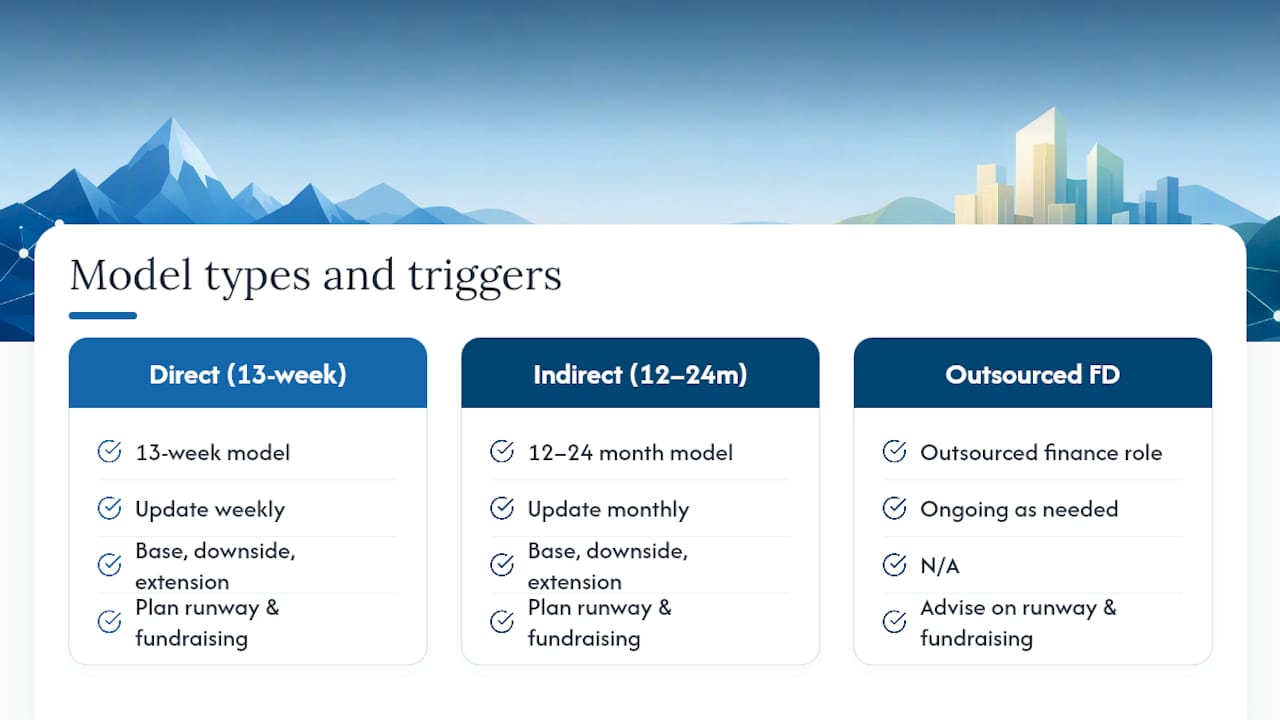
- Direct forecast: weekly cash in/out for the next 13 weeks, reconciled to your bank balance.
- Indirect forecast: monthly P&L-driven runway projection for 12 to 24 months.
- Three scenarios minimum, each tied to a specific action if triggered.
Pro Tip: Build the model in whatever tool your finance team already lives in, Microsoft Excel or Google Sheets, and pull actuals straight from Xero each week rather than retyping figures from memory.
Need a second pair of eyes on the structure before you present it to investors? A fractional finance director review can catch the gaps a first-time builder misses.
Key Takeaways
Credible scenario planning models pair a 13-week direct forecast with an 18-month indirect forecast, use three named scenarios with decision triggers, and calculate runway dynamically rather than from a static burn figure.
PointDetailsRun two forecasts in parallelBuild a 13-week direct forecast for liquidity alongside an 18-month indirect forecast for capital allocation.Watch payroll closelyPayroll often makes up 50 to 55% of monthly cash outflow, so hiring assumptions deserve the most scrutiny.Build three scenarios with triggersBase, downside and extension cases each need a named decision trigger and pre-agreed action.Validate before presentingReconcile opening cash to your bank, check AR timing, and flag any significant gap between forward and trailing runway.Get a professional reviewPriceandaccountants offers fractional FD support to build, review or sign off scenario models before fundraising conversations.
Table of Contents
- What should every startup scenario planning model include?
- How do you build a three-scenario cashflow model?
- How do you run sensitivity analysis on a runway model?
- What should you show investors from your scenario models?
- What are the most common scenario model mistakes?
- When should you bring in an outsourced finance director?
- What actually matters when you build these models
- Get your scenario model built or reviewed properly
- Frequently asked questions
- Sources
What should every startup scenario planning model include?
Every credible model needs the same skeleton, whatever industry you’re in. Miss one of these and your board pack starts looking amateur fast.
Input tabs should cover: opening cash position, revenue by stream and billing cadence, an accounts receivable collection schedule, committed financing (grants, loans, agreed investment tranches), fixed and variable costs, a headcount and hire-date schedule, and capex or debt service commitments.
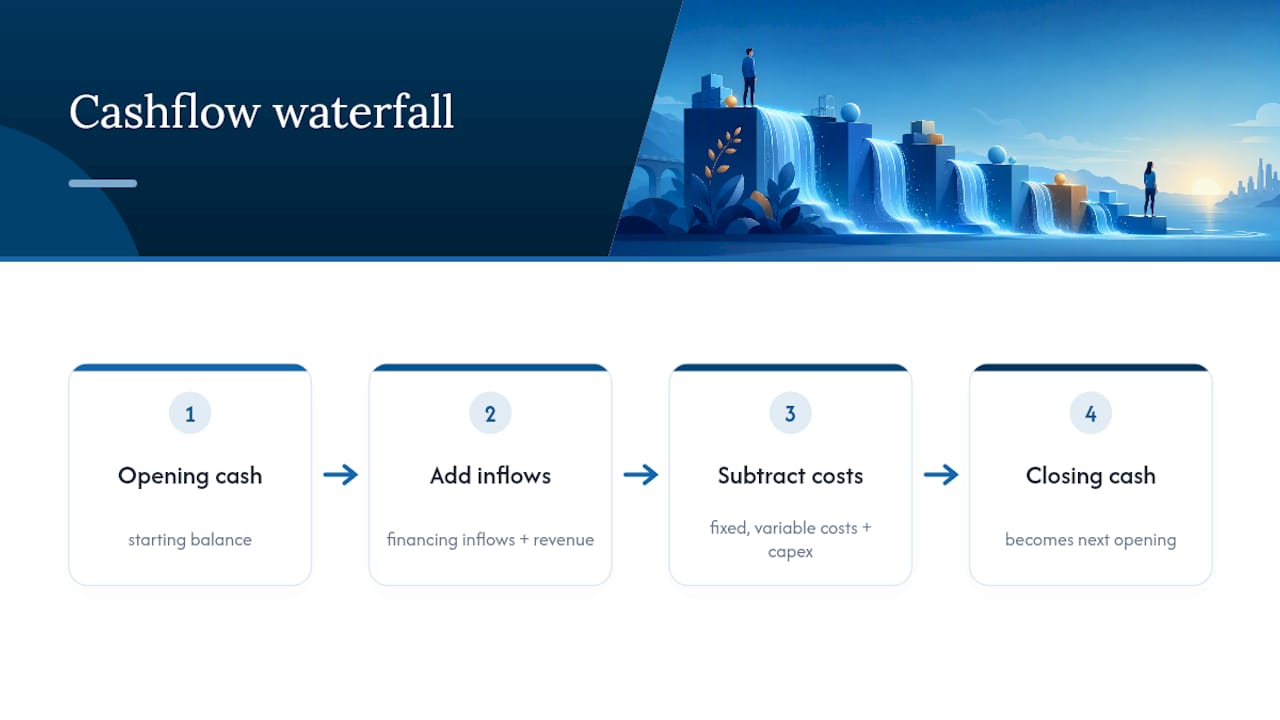
Structural separation matters more than most founders realise. Keep your direct (weekly, 13-week) and indirect (monthly, 12 to 24 month) tabs distinct but mechanically linked through a single cashflow waterfall: opening cash plus financing inflows plus revenue, minus fixed costs, minus variable costs, minus capex, equals closing cash. That closing figure becomes next period’s opening cash, automatically, with no manual re-entry.
Outputs to surface on every tab: weekly and monthly ending cash, net and gross burn, dynamic runway, projected breakeven month, and the date your fundraising trigger fires.
Payroll typically eats 50 to 55% of monthly cash outflow at growth-stage SaaS companies, which means your headcount and hire-date assumptions deserve more scrutiny than almost anything else in the model.
Add a governance layer too: an assumptions table naming an owner, a date and a rationale for each figure, plus version control so nobody’s working from last month’s numbers.
Pro Tip: If you can’t name who owns each assumption, the model isn’t ready for a board meeting yet.
How do you build a three-scenario cashflow model?
Building this from scratch takes a focused afternoon, not a week, if you follow the sequence in order rather than jumping straight to formulas.
- Reconcile opening cash to your actual bank balance and Xero ledger before touching a single formula. Set your model start date and define trailing burn as a 3-month trailing net burn average, this becomes your sense-check later.
- Build separate input tabs for financing, revenue by stream with timing, receivables, fixed costs, variable costs, and headcount with hire dates and fully loaded cost per role.
- Construct the 13-week direct sheet with weekly receipts and payments. Link every committed outflow, payroll, rent, software subscriptions, to its exact payment date rather than a rough monthly average.
- Build the 12 to 24 month indirect sheet by linking your P&L, balance sheet movements and cashflow adjustments so runway recalculates dynamically as inputs change, not as a static number you update by hand.
- Create three scenario columns or a switcher, base, downside and extension, and document the assumptions behind each. Attach a decision trigger to every scenario, not just the downside.
- Set up your working tools: named ranges, a scenario dropdown, SUMIFS formulas keyed to date, and a one-page reconciliation dashboard that flags when a tab has drifted out of sync.
CentSight recommends building bottom-up for the near term and top-down for longer horizons, then reconciling the two where they overlap. The gap between them is often where your weakest assumptions hide.
Pro Tip: Export transaction-level data from Xero directly into your model each Monday morning; manual re-keying is where most scenario models quietly go wrong.
How do you run sensitivity analysis on a runway model?
Sensitivity testing is where a scenario model earns its keep. Start with one-way tests: change a single variable, collections timing, the timing of one large deal, churn rate, or a hiring delay, and watch what happens to your cash trough.
Then move to two-way sensitivity matrices for combined shocks.
- Weight your scenarios probabilistically, say 60% base, 25% downside, 15% extension, to communicate an expected outcome without softening your triggers.
- Build an extension-case playbook inside the model itself, naming specific levers: a hiring freeze, vendor renegotiation, receivables acceleration, and quantify the months of runway each one buys.
- Chart the cash trough across all three scenarios side by side, plus a scenario tracker showing which case the business is actually tracking toward this month.
Pro Tip: Name your levers specifically. “Cut costs” tells an investor nothing; “delay two senior hires by one quarter, saving £140,000” tells them you’ve actually done the work.
What should you show investors from your scenario models?
Investors don’t want your full workbook. They want five things, clearly labelled, on one slide each.
- Current cash position and net/gross burn, stated plainly with the calculation method named.
- Runway under base, downside and extension cases, shown side by side rather than buried in separate documents.
- The forecast cash trough and the date it occurs.
- A fundraising trigger point and a use-of-funds breakdown for the raise itself.
- Identified extension levers with the specific months of runway each one adds.
Report runway using a forward-looking method validated against your 3-month trailing net burn average, and state that methodology on the slide. Investors who see runway numbers without a stated method tend to discount them on the spot; naming your approach is what makes the figure defensible under questioning.
A forward-looking, model-driven runway figure, cross-checked against trailing actuals, is what separates a credible fundraising deck from a guess dressed up in a spreadsheet.
Keep the assumptions table and a single-sheet dashboard in the main deck, and push the full month-by-month cash waterfall into an appendix for anyone who wants to dig deeper.
What are the most common scenario model mistakes?
Most modelling errors are boring and repeatable, which is good news because they’re easy to check for.
- Confusing revenue with cash. An invoice raised is not cash collected; your receivables schedule needs to reflect actual collection behaviour, not invoice dates.
- Using a static net burn figure to calculate runway instead of a dynamic, forward-looking projection.
- Over-optimistic sales timing, assuming deals close on the date they’re forecast rather than the date they historically actually close.
- Forgetting annual bills, insurance renewals, annual software licences, and other infrequent liabilities that blow a hole in a single month’s cash position.
Validate the model by reconciling opening cash to your bank statement, confirming your AR collection profile against historical patterns, checking payroll and tax payment timing, and running a couple of dummy scenarios to confirm formulas actually flex correctly.
Keep a dated version history with named assumption owners and change notes, and build in a sign-off step before any model goes into a board pack. Watch for unlinked sheets, hidden manual overrides, and scenario outputs that quietly contradict your dashboard summary, these are the errors that surface in the worst possible meeting.
When should you bring in an outsourced finance director?
Three signals usually mean it’s time: your base-case runway drops below 12 to 18 months, you’re heading into a fundraise, or you keep spotting forecasting errors with no one clearly owning the assumptions.
An outsourced FD typically builds and signs off the model, designs the scenario switcher and extension-case playbook, prepares investor-ready outputs, and runs the fundraising trigger calculation properly. The service breakdown usually includes monthly rolling 13-week updates, a monthly indirect reforecast for the board, ad-hoc stress tests when a big decision looms, and support negotiating with vendors or investors.
- Runway below 12 to 18 months with no clear plan.
- Fundraising preparation underway or imminent.
- Recurring forecast errors or no named assumption owner.
- Complex financing instruments, convertible notes, SAFEs, that need proper modelling.
Pro Tip: One founder we’ve seen work through this used extension levers modelled by an outsourced FD, freezing two hires and renegotiating a vendor contract, to gain three extra months of runway and walk into their next investor conversation from a position of strength rather than panic.
Facilities and office costs often get modelled as an afterthought too; if headcount growth is a scenario driver, planning office expansion alongside hiring triggers avoids a nasty capex surprise mid-scenario.
What actually matters when you build these models
Build the model you’ll actually update every week, not the one that looks most impressive the day you finish it. A beautifully formatted forecast that sits untouched for two months is worse than a rough one that’s current.
Prioritise visibility over elegance, decision triggers over vanity metrics, and named assumption owners over anonymous formulas nobody can defend in a meeting. Investors consistently respond better to a credible, specific extension case than to a dramatic worst-case scenario nobody quite believes.
Get your scenario model built or reviewed properly
Most founders lose weeks wrestling with formulas instead of running the business, and a scenario model built in isolation often misses the assumptions an investor will challenge first. Priceandaccountants builds the 13-week direct and 18-month indirect models together, runs the sensitivity tests, and hands you investor-ready outputs, not just a spreadsheet with formulas you don’t fully trust.

A typical engagement runs four to six weeks for a full build and handover, followed by either a monthly update retainer or ongoing fractional FD support for reporting and fundraising cycles. This also matters more than founders expect: R&D tax credits often represent a meaningful, non-dilutive cash inflow that belongs in your financing assumptions, and Priceandaccountants’ R&D tax service can identify whether your work qualifies before you finalise the model.
If your current model hasn’t been stress-tested by anyone outside your own head, request a model health-check through Priceandaccountants and get a second opinion before your next board meeting or fundraise.
Frequently asked questions
What is a scenario planning model in startup finance?It’s a spreadsheet-based set of linked cashflow forecasts, typically direct 13-week and indirect 12 to 24 month models, built with base, downside and extension cases so founders can plan runway and fundraising decisions with confidence.
How often should I update my scenario model?Weekly for the 13-week direct forecast, and monthly for the indirect reforecast. Treat forecasts as living documents, not a one-off exercise you complete before a fundraise.
What tools do founders typically use to build these models?Most build in Microsoft Excel or Google Sheets, pulling actuals from Xero. Some growth-stage companies later adopt dedicated forecasting software, though spreadsheets remain the standard starting point for pre-seed to Series A companies.
How is startup runway actually calculated?The most defensible method uses a forward-looking, model-driven burn projection, cross-checked against a 3-month trailing net burn average, rather than a single static snapshot.
When should I hire an outsourced finance director instead of building the model myself?When base-case runway drops below 12 to 18 months, you’re preparing to fundraise, or forecasting errors keep recurring with no clear assumption owner.
This article is general information, not a substitute for advice from a qualified financial advisor. Consult a qualified financial professional about your own circumstances before acting on anything here.
Sources
- Cash flow forecasting for startups: a CFO-level guide to runway, burn, and decision timing
- Cash Flow Forecasting for Startups: The 2026 Guide | CentSight
- How to Calculate Startup Runway (With Excel Template) | KDesk Accounting
- Cash Flow Forecasting: A 2026 Founder’s Guide to Runway
Recommended
- Financial runway for founders: how to calculate and act - Price & Accountants
- Startup investment tips for UK founders: 2026 guide - Price & Accountants
- Strategic financial planning that unlocks UK tech growth - Price & Accountants
- Strategic financial planning that unlocks UK tech growth - Price & Accountants