

An HMRC R&D enquiry means HMRC has asked for further evidence to check whether your claim meets the qualifying rules. Specialist enquiry defence manages that response, deals with HMRC directly and cuts the risk of a penalty or clawback.
Act now if your claim is high-value, technically complex, backed by thin or generic evidence, or if it was prepared by a third-party adviser you have not vetted. The first move is simple: preserve every relevant document and timesheet, then get a specialist to review the enquiry letter before you reply.
Key Takeaways
Specialist enquiry defence works because it replaces reactive, piecemeal answers to HMRC with a coordinated technical and financial response prepared before the deadline bites.
PointDetailsPreserve evidence immediatelyFreeze project files and stop retrospective timesheet edits the moment a letter arrives.Expect a documented evidence requestHMRC typically wants technical narratives, payroll records, timesheets and subcontractor invoices.Contemporaneous beats retrospectiveRecords created at the time of the work carry far more weight than reports written after the fact.Early advice shortens enquiriesSpecialist review before you respond can reduce both the enquiry’s length and any penalty exposure.Get expert enquiry defencePriceandaccountants reviews existing claims and HMRC correspondence, including claims prepared by other advisers.
Table of Contents
- What triggers an HMRC R&D enquiry and how claims get selected
- What evidence will HMRC ask for?
- How does professional enquiry defence actually work?
- What should you do in the first 72 hours?
- How do you choose the right enquiry defence adviser?
- Expert view from Price & Accountants
- A brief note on staying calm under enquiry
- How Price & Accountants can help with your enquiry
- Frequently asked questions
- Sources
What triggers an HMRC R&D enquiry and how claims get selected
HMRC says its goal is to help businesses “get tax right first time” while acting on non-compliance where it finds it. In practice, claims get flagged through internal risk models, benchmarking against similar businesses, patterns linked to certain advisers, or simply because a claim looks unusually large or oddly worded.
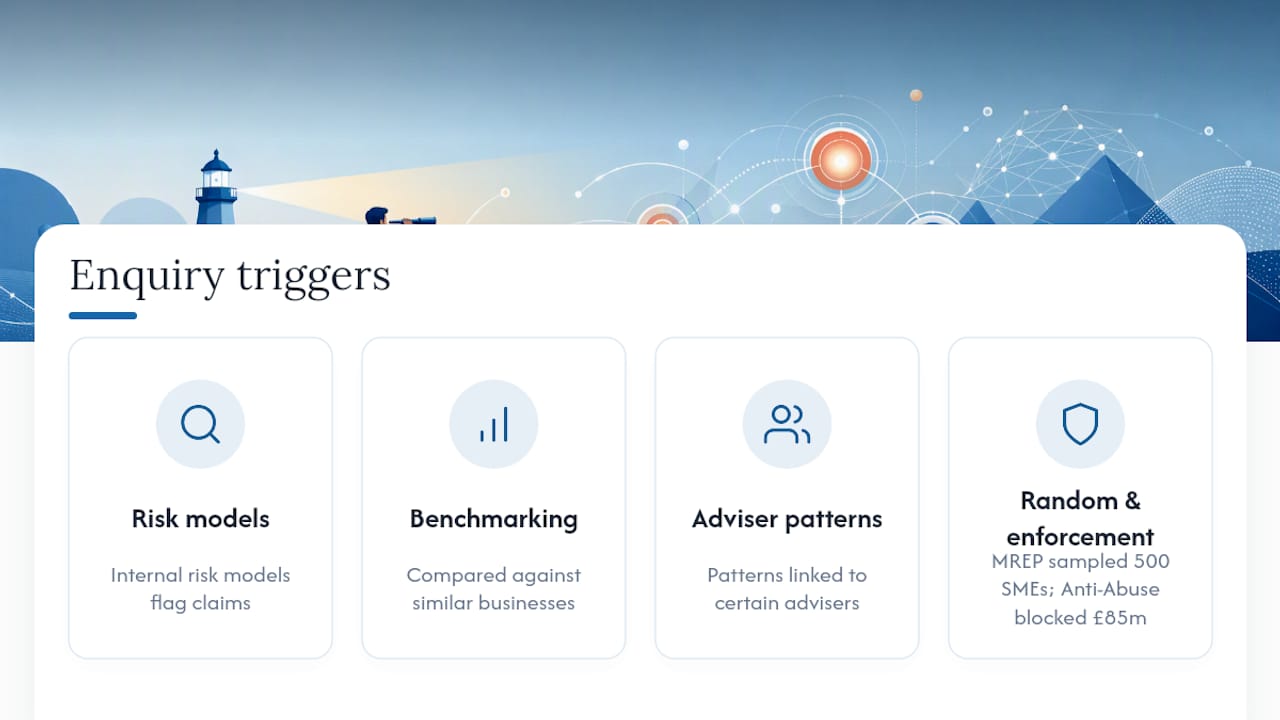
Then there’s the mandatory random enquiry programme (MREP), which pulled 500 SME claims from the 2020 to 2021 tax year for full audit, purely to measure how much non-compliance exists across the whole system. Add the dedicated R&D Anti-Abuse Unit, and HMRC has blocked £85 million in fraudulent claims. None of that means your claim is automatically suspect. It does mean scrutiny has tightened across the board, and even a well-run SME claim can land in the sample.
What evidence will HMRC ask for?
HMRC’s internal guidance sets out what officers should request, and it is more specific than most businesses expect. The HMRC manual on examining a claim asks officers to keep requests proportionate, but they will push further if something does not add up.
Expect to be asked for:
- Technical project narratives written in plain English, addressing the scientific or technological advance sought and the specific uncertainty that made the outcome unpredictable at the outset.
- Payroll records and timesheets showing which staff worked on qualifying activity, and for how long, apportioned sensibly against other duties.
- Subcontractor invoices and contracts, with a clear method for allocating those costs to the R&D project rather than general business overheads.
- Contemporaneous records covering project meetings, technical decisions and cost tracking, created at the time rather than reconstructed after the enquiry letter lands.
Generic technical reports written by an adviser with no company-specific detail are the single weakest form of evidence HMRC sees, alongside timesheets built retrospectively from memory. HMRC officers may also request a meeting with your engineers or technical lead directly, expecting a response within a set window, usually a matter of weeks.
Pro Tip: Keep a running project log while the work happens, not after the claim is filed. A single paragraph per month describing what was tried, what failed, and why, is worth more to HMRC than a polished report written six months later.
How does professional enquiry defence actually work?
Bringing in a specialist follows a fairly consistent sequence, whichever firm you use.
- Scoping the risk. The adviser reads the enquiry letter alongside your original claim and evidence, then identifies which specific points HMRC is likely to push on.
- Building the response. This means drafting or rewriting the technical narrative in HMRC’s own terms, pulling together contemporaneous documents, and reconciling staff costs and subcontractor invoices against the claim figures.
- Handling HMRC directly. Your adviser becomes the point of contact, arranging any meetings and translating technical detail into language an HMRC officer without an engineering background can follow.
- Resolving the enquiry. Outcomes range from HMRC accepting the claim as filed, to a negotiated adjustment, to an internal review or tribunal appeal if you genuinely disagree with HMRC’s conclusion. A good adviser tells you upfront which outcome is realistic and roughly how long it will take, typically two to six months for routine enquiries, longer for complex or high-value cases.
What should you do in the first 72 hours?
- Preserve everything immediately. Snapshot your project management system, freeze relevant folders, and stop anyone editing timesheets retroactively, even with good intentions.
- Read the letter properly and note the deadline. HMRC’s requests carry a response date; if you need more time, ask for an extension in writing rather than letting the date pass.
- Run an internal fact-find. Sit down with the technical lead and finance team and document, in writing, who worked on what and when, while memories are still fresh.
- Get a specialist review before you reply. Early advice from someone who has handled HMRC enquiries before tends to shorten the process and reduce penalty exposure, because the first response often sets the tone for everything that follows.
Pro Tip: Never let the finance team respond to a technical query alone, and never let engineers respond to a cost query alone. Enquiry letters usually blend both, and answers that only cover half the question invite a second, more detailed letter.
How do you choose the right enquiry defence adviser?
Look for HMRC-facing experience specifically, not just general R&D claim preparation; the two skills overlap less than most people assume. Over 90% of R&D claims are filed through an agent, and claims above £500,000 handled by specialist agents show lower non-compliance rates, so credentials matter.
Before engaging anyone, ask:
- Who will personally lead the case, and have they defended a claim in your sector before?
- Can they describe (without breaching confidentiality) how a similar enquiry was resolved?
- What’s the fee structure, fixed fee, hourly, or contingent, and what’s the realistic timescale?
- Do they hold professional indemnity insurance?
Walk away from anyone promising a guaranteed outcome, refusing to name a comparable case, or suggesting anything other than full cooperation with HMRC.
Expert view from Price & Accountants
A clear technical narrative fails most often when it describes what the product does rather than what was uncertain about building it. Rahamut’s advice to clients drafting these narratives: name the specific technical question you couldn’t answer from existing knowledge, not just the eventual solution.
Price & Accountants has supported UK tech and fintech businesses through R&D claims and HMRC scrutiny for over 40 years of combined accounting practice, with direct experience preparing the technical and financial evidence HMRC now expects as standard.
A brief note on staying calm under enquiry
Most enquiries we see stem from weak evidence, not wrongdoing, and they resolve once someone puts the missing detail in front of HMRC clearly. That’s genuinely reassuring if you’re staring at a letter right now.
Bring your technical team and your accountant into the same conversation early. The businesses that struggle are the ones where finance and engineering answer separately, weeks apart, instead of together, once.
How Price & Accountants can help with your enquiry
If an HMRC letter has landed on your desk, or you want a claim reviewed before it ever gets that far, Priceandaccountants runs an initial review covering your technical narrative, staff cost workings and subcontractor evidence against exactly what HMRC’s manuals ask for.

That review flags the gaps before HMRC does, and it applies just as well if your original claim was prepared by another adviser, we can step in mid-enquiry without starting from scratch. Fees depend on claim complexity and how far the enquiry has already progressed, and we’ll always tell you honestly if a case looks straightforward enough to handle without full representation. Visit our R&D tax credit services page to see what’s included, or get in touch to arrange a review of your enquiry letter this week.
Frequently asked questions
What is an HMRC R&D enquiry?It’s a formal request from HMRC for further evidence and explanation about an R&D tax credit claim you’ve already submitted, ranging from a single follow-up letter to a full audit of your technical and financial records.
How long does an R&D enquiry defence process typically take?Routine enquiries with clear, well-organised evidence often resolve in two to six months; complex or high-value cases can take considerably longer.
Can I handle an HMRC R&D enquiry myself without an adviser?You can, but claims backed by specialist agents show lower non-compliance rates, particularly above £500,000, and the technical and cost evidence HMRC expects is easy to under-prepare without experience of past enquiries.
Does an enquiry always mean HMRC suspects fraud?No. Most enquiries arise from unclear evidence or an underdeveloped technical narrative rather than any suggestion of deliberate wrongdoing.
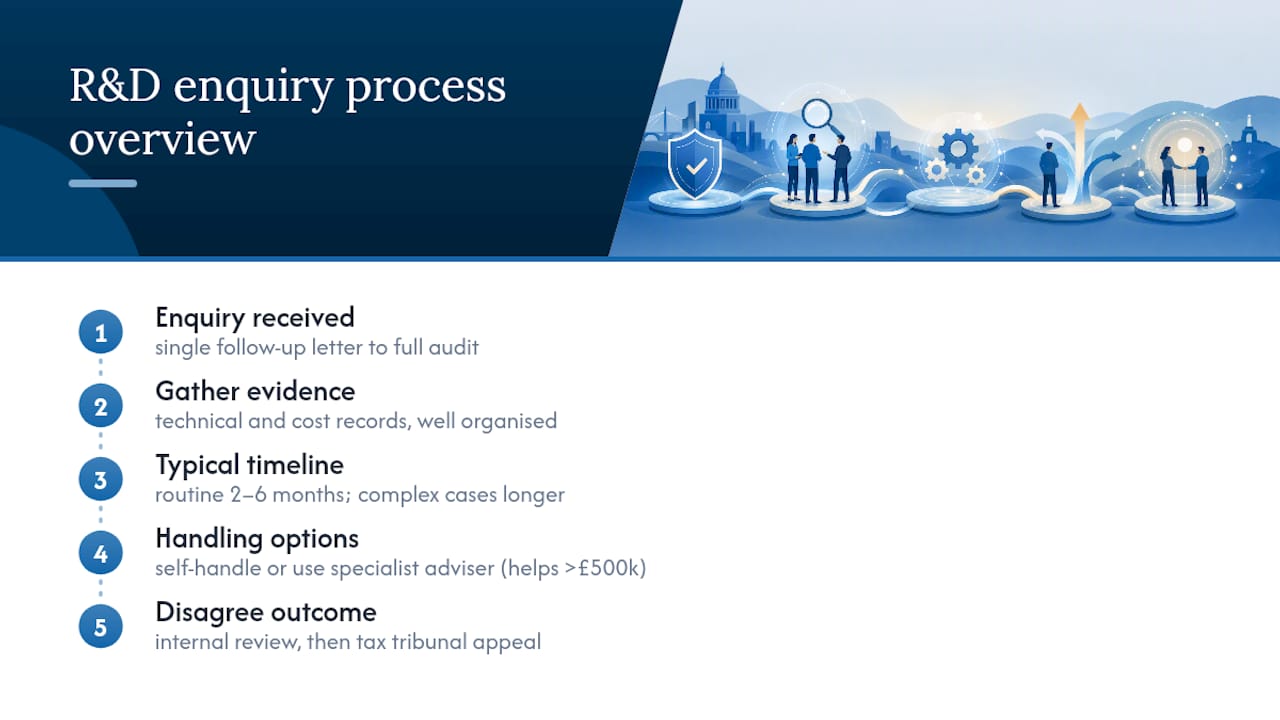
What happens if I disagree with HMRC’s enquiry conclusion?You can request an internal review or, if that doesn’t resolve matters, appeal to the tax tribunal; a specialist adviser can explain which route suits your specific case and the likely timeline involved.
Sources
- HMRC’s approach to Research and Development tax reliefs
- R&D Tax Credit Investigations FAQ | HMRC Enquiries 2025
Recommended
- Why Report R&D to HMRC? Avoid 100% Claim Rejection in 2026 - Price & Accountants
- Getting the R&D claim process right first time - Price & Accountants
- R&D subcontractor costs: a practical guide for UK businesses - Price & Accountants
- UK R&D Claims 2026: 27% Credit Boost for Tech Startups - Price & Accountants