
TL;DR:
- Price & Accountants is a London-based Xero-native firm offering hands-on R&D tax credit, SEIS/EIS, and outsourced FD services for UK tech startups. It stands out as the best alternative to Gravita for seed-to-Series-A founders needing integrated accounting, tax credits, and strategic financial advice. Choosing the right provider depends on Xero expertise, R&D experience, transparency, and alignment with funding growth stages.
For UK tech startups and small businesses, Price & Accountants is the strongest alternative to Gravita: a London-based, Xero-native firm with hands-on R&D tax credit and SEIS/EIS experience, plus outsourced FD capability that most generalist practices simply do not offer.
Before diving in, a quick note on search noise. Searching for “gravita.com alternatives” returns a genuinely mixed bag. Some aggregators list software tools such as Sage or FreeAgent alongside accounting firms, while other directories conflate Gravita the UK accountancy practice with Gravita Infotech (an IT vendor) and even Gravita Protocol (a DeFi project). This article is specifically about alternatives to Gravita the UK accounting and advisory firm, not software substitutes.
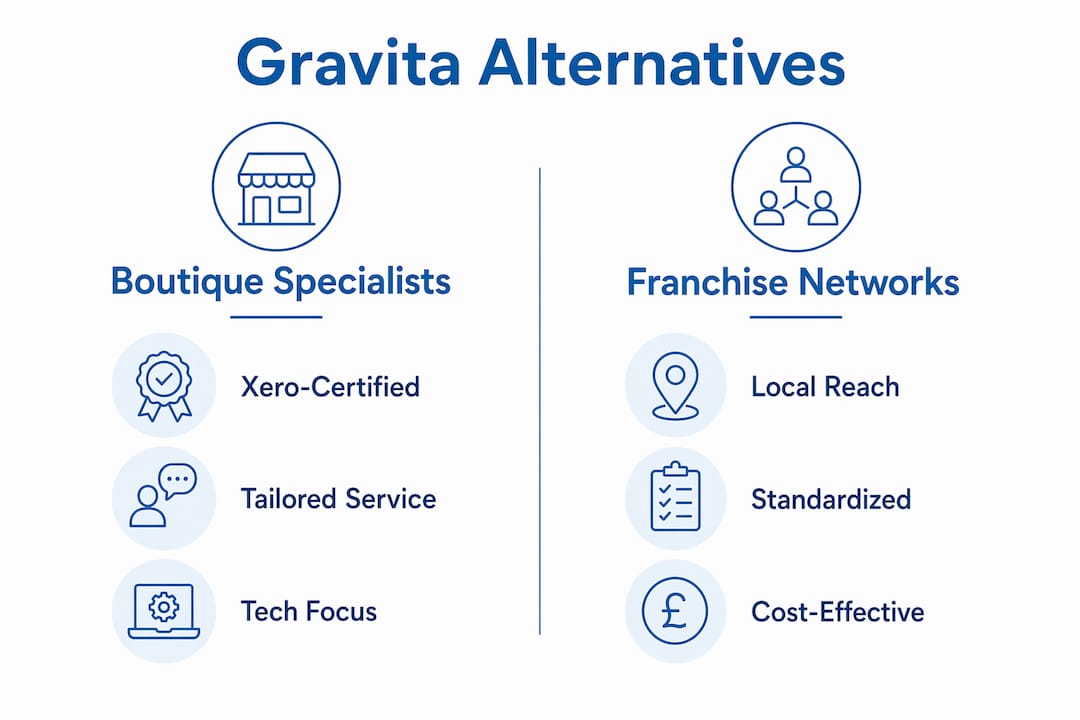
Here is the shortlist by category:
The table below maps four provider categories across the dimensions that matter most when switching. Pricing bands reflect typical UK SME monthly retainers ranging from low to high tiers, covering budgets from modest to premium levels.
| Category | Ideal client | Core services | Xero/cloud | Pricing band | Onboarding model | Trust signals |
|---|---|---|---|---|---|---|
| Cloud-first boutique (e.g. Price & Accountants) | Tech/fintech startups, pre-seed to Series A, overseas founders | Bookkeeping, year-end, payroll, R&D, SEIS/EIS, outsourced FD | Xero-native; full integrations | Mid–High | Dedicated contact; structured migration | Xero partner, ACCA/ACA, startup case studies |
| National franchise network (e.g. TaxAssist) | Established micro and small businesses, sole traders | Bookkeeping, year-end, VAT, payroll, personal tax | Varies by branch; cloud adoption inconsistent | Low–Mid | Local branch; variable SLAs | Franchise brand, local reviews |
| Mid-tier advisory firm (e.g. Mazars) | Scaling SMEs, listed companies, PE-backed businesses | Audit, tax, advisory, corporate finance | Cloud-capable; not always Xero-first | High | Structured onboarding; relationship manager | Big-brand recognition, regulated audit |
| Tech payroll/compliance specialist (e.g. Crunch, SJD) | Contractors, IR35 workers, early-stage founders | Payroll, year-end, VAT, basic bookkeeping | Cloud-based platforms; Xero or proprietary | Low–Mid | Self-serve or semi-managed | Fixed-fee transparency, online reviews |
Service flags to check against your needs:
Rather than listing every firm by name, the profiles below use category labels so you can apply the criteria to any provider you shortlist. Gravita itself positions as an accounting and advisory practice serving SMEs and listed clients across accountancy, audit, tax, and advisory. The alternatives below cover the same ground with different strengths.
What they do: End-to-end accounting and tax for tech companies, built around Xero from day one. The best ones combine monthly bookkeeping, year-end accounts, VAT returns, payroll, R&D tax credit claims, SEIS/EIS compliance, and outsourced FD services under one roof.

Ideal client: A seed-to-Series-A founder who needs investor-ready management accounts, wants to claim R&D relief, and does not yet need a full-time finance director.
Services checklist:
Typical pricing: Mid-to-high band. Expect a monthly retainer covering core compliance, with R&D claims and FD advisory priced separately or bundled at higher tiers.
Pros:
Cons:
Trust signals to verify: Xero partner status (check the Xero partner directory), ACCA or ACA credentials for lead advisers, published startup case studies with named outcomes, and independent reviews on Google or Trustpilot.
What they do: Locally operated branches under a national brand, offering standard compliance services: bookkeeping, year-end accounts, VAT, payroll, and personal tax returns.
Ideal client: An established micro-business or sole trader who values face-to-face contact and wants a recognisable brand behind their accountant.
Services checklist:
Typical pricing: Low-to-mid band. Fixed-fee packages are common, which is good for budget certainty.
Pros:
Cons:
What they do: Full-service accounting, audit, tax, and corporate finance for larger or more complex businesses. Firms in this category often have sector desks and can handle statutory audit.
Ideal client: A PE-backed or scaling SME that needs audit alongside advisory, or a business approaching an exit or acquisition.
Typical pricing: High band. Hourly or project-based fees are common alongside retainers.
Pros:
Cons:
Trust signals to verify: Regulatory registration with the FRC or ICAEW, published sector credentials, and named partner contacts.
What they do: Fixed-fee packages covering payroll, year-end accounts, VAT, and basic bookkeeping, often delivered through a proprietary portal or Xero.
Ideal client: Contractors, IR35-affected workers, and very early-stage founders who want low-cost compliance without advisory depth.
Typical pricing: Low-to-mid band. Transparent fixed fees are the main selling point.
Pros:
Cons:
Pro Tip: Ask any provider whether their Xero certification covers the full advisory tier, not just the basic partner badge. There are three Xero partner tiers (Silver, Gold, Platinum), and the higher tiers indicate both volume and quality of Xero work.
The primary deciding factors are Xero and cloud fluency, R&D and seed-stage tax expertise, access to FD-level counsel, and pricing transparency. Get those four right and the rest follows.
Weight the criteria that matter most to your business. For a tech startup, a sensible pass/fail structure looks like this:
| Criterion | Weight | Pass threshold |
|---|---|---|
| Xero-certified adviser on account | Critical | Must pass |
| R&D claim experience (last 12 months) | Critical | Must pass |
| SEIS/EIS administration capability | High | Strongly preferred |
| Outsourced FD / strategic advisory | High | Preferred |
| Pricing transparency (written quote) | Medium | Must pass |
| Startup case studies available | Medium | Preferred |
| Named contact and SLA commitment | Medium | Must pass |
Any provider that fails a “must pass” criterion should be removed from your shortlist, regardless of price.
Pro Tip: When comparing a lower monthly retainer against a higher one, ask each provider to quote the same scope in writing, including ad-hoc rates for R&D claims, SEIS/EIS filings, and management accounts. A £150/month retainer that charges £2,000 per R&D claim separately often costs more annually than a £450/month all-inclusive package.
Switching accountants is less painful than most founders expect, but it does take planning. The typical timeline from signing an engagement letter to receiving your first clean management accounts can vary, generally taking several weeks depending on the state of your existing records.
A Xero migration and clean-up usually takes 2–6 weeks. First management accounts follow 4–8 weeks after that, once payroll and bank feeds are reconciled. The total timeline is longer if prior bookkeeping is incomplete or if HMRC authorisations are delayed.
| Item | Typical range | Notes |
|---|---|---|
| One-off onboarding / Xero migration | Mid-to-high band | Depends on volume of historic transactions |
| Monthly retainer (bookkeeping + year-end + VAT) | Low-to-mid band | Varies by turnover and complexity |
| R&D claim preparation | £1,500–£5,000 per claim | Often a percentage of the claim value |
| Historic bookkeeping catch-up | — | Depends on how far back and how messy |
| SEIS/EIS compliance and filings | — | Per round or per filing |
These are indicative ranges for UK SMEs; your actual costs will depend on turnover, payroll headcount, and the complexity of prior records.
Prepare the following before your first meeting with a new provider:
Most providers require 30 days’ written notice. Some ask for the full notice period before releasing working papers, so factor that into your timeline. Your statutory accounts and tax returns belong to you; a professional firm cannot withhold them, though they may charge for preparation of a handover pack if that was not included in your original agreement.
For a UK tech or fintech startup, the right accountant is not just a compliance function. It is the firm that helps you claim R&D relief before your runway runs out, structures your SEIS round correctly so early investors get their tax relief, and produces the management accounts your Series A investors will scrutinise.
Price & Accountants matches that brief directly:
The honest answer is that Price & Accountants is built for founders who are building something. If that is not your situation, one of the other categories above will serve you better.
Price & Accountants is the most direct alternative to Gravita for UK tech startups that need Xero-native bookkeeping, R&D tax credits, SEIS/EIS support, and outsourced FD capability under one roof.
| Point | Details |
|---|---|
| Verify Xero credentials first | Check the Xero partner directory for tier and certification before shortlisting any firm. |
| R&D claims need specialist depth | A compliant claim requires technical project summaries, timesheets, and payroll records — not all firms can deliver this. |
| Switching takes 6–14 weeks | Budget for a Xero migration (2–6 weeks) plus first management accounts (4–8 weeks further). |
| Compare total cost, not just retainer | Ad-hoc fees for R&D claims and SEIS/EIS filings can double the apparent monthly cost. |
| Price & Accountants for tech founders | Combines Xero fluency, R&D and SEIS/EIS expertise, and outsourced FD services for pre-seed to Series A startups. |
The conventional wisdom in accountancy procurement is to find a firm with a good reputation and competitive fees, then let them get on with it. That logic works fine for a stable business with predictable compliance needs. For a tech startup, it is the wrong frame entirely.
The firms that genuinely move the needle for founders are the ones that treat R&D claims as a revenue event, not an admin task. A well-prepared R&D claim can return tens of thousands of pounds to a pre-revenue startup’s bank account. That is not a compliance function. It is a funding mechanism. The same logic applies to SEIS and EIS: getting the share structure wrong at the seed round does not just cost tax relief, it can unwind investor agreements entirely.
What I find underappreciated in the “just find a good accountant” conversation is the compounding effect of having FD-level thinking available from month one. Founders who get investor-ready management accounts early, with proper accruals and a clean Xero file, spend less time in due diligence and close rounds faster. The accountant who builds that infrastructure in year one is worth considerably more than the one who files your returns on time.
Gravita is a credible firm, but it is PE-backed and expanding through acquisition, which brings the usual questions about continuity and culture. Leadership changes at PE-backed practices are worth monitoring; a named partner who knows your business is a genuine asset, and it is worth asking any prospective firm how they handle client continuity when senior staff move on.
The search results for “gravita.com alternatives” are genuinely noisy. Aggregators mix software tools with advisory firms, and the name “Gravita” covers at least three entirely different businesses. That confusion is a useful reminder: always verify the specific entity you are evaluating, check their Companies House registration, and look at independent reviews rather than relying on directory listings.
If you have read this far, you are probably a founder or finance lead who needs more than a compliance-only accountant. Price & Accountants offers cloud accounting with Xero, R&D tax credit claims, SEIS/EIS scheme administration, outsourced FD services, and full bookkeeping and year-end packages, all designed specifically for UK tech and fintech startups from pre-seed through to Series A.

The practical difference from a generalist firm: R&D and SEIS/EIS work is handled in-house by advisers who understand the technical requirements, not referred to a third party. Management accounts are produced on Xero, in a format investors actually expect. And the advisory and tax planning sits alongside compliance, so strategic decisions and tax consequences are considered together rather than separately.
To start a conversation, visit priceandaccountants.com and book a discovery call. Bring your current Xero file (or whatever you are using now), your most recent accounts, and a list of the services you need. The first conversation is free, and you will leave with a clear picture of what a switch would involve and what it would cost.
The sources below were used to verify claims in this article. They are also useful starting points if you want to check a provider’s credentials independently.
A note on verifying credentials: To confirm that a firm is properly regulated, check the ICAEW member firm directory or the ACCA practising certificate register. For Xero partner status, use the official Xero partner directory at xero.com/uk/find-an-accountant. Neither directory is infallible, but both are more reliable than aggregator listings.