

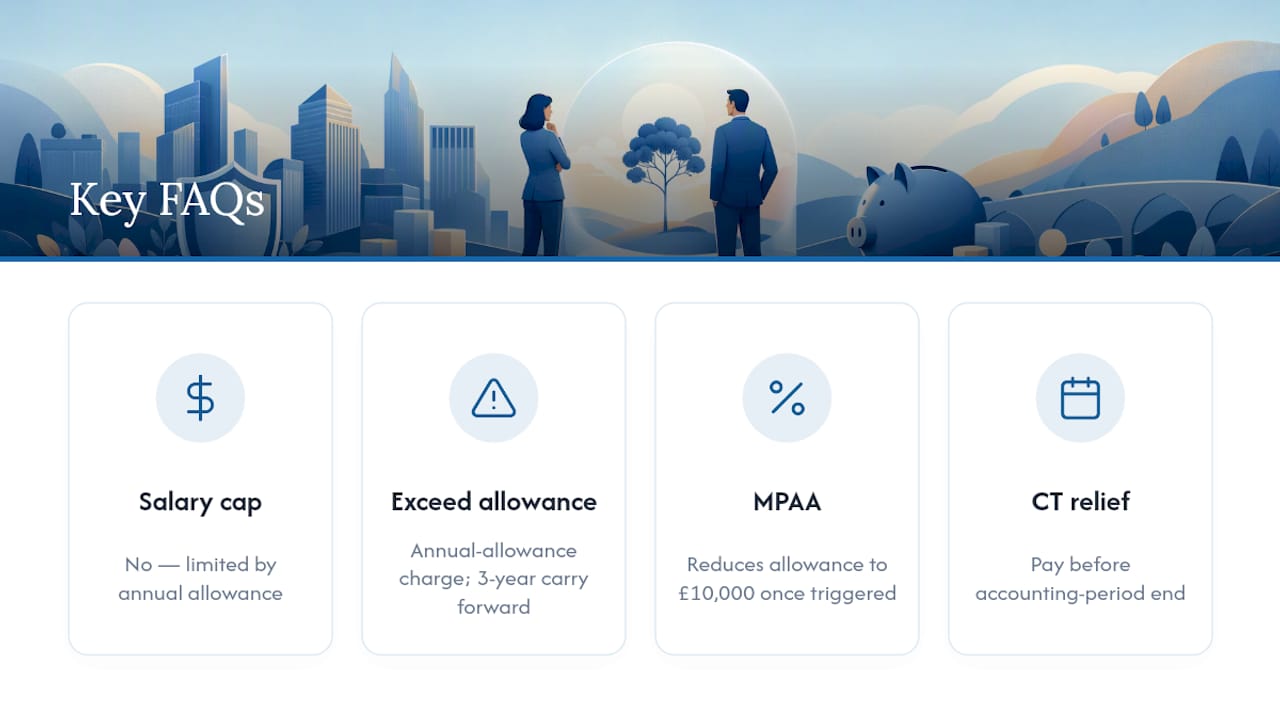
There is no fixed cap on what your company can pay into your pension. What matters is the annual allowance, currently £60,000 for most people, which applies to you as the pension member, not to the company as the payer. Your company can contribute more than your salary, and the payment usually qualifies for corporation tax relief if it meets HMRC’s “wholly and exclusively” test. Go above your annual allowance (including any carried forward from previous years) and you personally face a tax charge, not the company.
Here’s the practical shape of it for the 2026/27 tax year:
- The company gets a corporation tax deduction on the contribution, provided it’s paid before the accounting year end and meets HMRC’s commercial reasonableness test.
- You, the director, carry the annual allowance exposure. Exceed it and HMRC claws back the tax relief through an annual allowance charge.
- Bodies worth bookmarking as you plan: HMRC, The Pensions Regulator, and MoneyHelper for independent guidance, plus SIPP and SSAS providers depending on how much control you want over the underlying investments.
Key Takeaways
Employer pension contributions for company directors are not capped by salary, but they are capped by the member’s annual allowance and must pass HMRC’s wholly and exclusively test to secure corporation tax relief.
PointDetailsAnnual allowance applies to youThe £60,000 standard annual allowance covers all contributions made to you, not the company, in a tax year.Carry forward can unlock moreUnused allowance from the previous three tax years can be added, using the oldest unused year first.Salary doesn’t cap company paymentsEmployer contributions aren’t limited by your salary, but must meet HMRC’s commercial reasonableness test.Timing decides the tax year for reliefContributions must clear before your company’s accounting year end to get relief in that period.Get the structure checked properlyPriceandaccountants reviews carry forward, contribution sizing, and SSAS suitability before you commit funds.
Table of Contents
- Director pension contributions UK: company versus personal payments
- What is the annual allowance and how does carry forward work?
- Does a director’s salary limit how much the company can contribute?
- Corporation tax relief, PAYE and the paperwork you’ll need
- SIPP or SSAS: which pension structure suits a director?
- How do you actually make a company pension contribution?
- Should you pay yourself via salary, dividends, or a company pension contribution?
- What mistakes trigger HMRC scrutiny on director pensions?
- Why we push clients towards employer contributions first
- How Price & Accountants helps directors plan pension contributions
- Frequently asked questions
- Sources
Director pension contributions UK: company versus personal payments
The mechanics differ more than most directors expect, and the difference is where most of the tax efficiency sits.
A personal contribution comes from your own after-tax income, is capped by your relevant UK earnings (broadly, your salary, not dividends), and receives tax relief at source, with higher and additional rate relief claimed through your tax return. If you pay yourself a low salary and take the rest as dividends (a common structure for company directors), your personal contribution allowance shrinks accordingly. Pay yourself £12,570 in salary and you can personally contribute at most that amount and still get full relief.
An employer contribution, by contrast, comes straight from company funds. It isn’t tied to your salary level at all, and it still reduces the company’s taxable profit.
- Personal payment example: A director on a £9,100 salary contributes £5,000 into a SIPP. Relief is limited by that lower earnings figure, so the payment could restrict full tax relief.
- Company payment example: The same company pays £30,000 direct into the director’s SIPP or SSAS as an employer contribution. No earnings cap applies, and the company reduces its taxable profit by £30,000.
Auto-enrolment duties can still apply depending on your PAYE setup. It’s worth checking your obligations with The Pensions Regulator before assuming director-only companies are automatically exempt.
What is the annual allowance and how does carry forward work?
The standard annual allowance is set at a specified level for the 2026/27 tax year, and it captures every contribution made to you, whether from your company, from you personally, or both combined. There’s no separate allowance for employer money. If your company pays in £60,000 and you also pay in £5,000 personally, you’ve breached the limit by £5,000 unless you have unused allowance from earlier years to draw on.
That’s where carry forward comes in. You can use unused annual allowance from the previous tax years, provided you were a member of a registered pension scheme in each of those years. The ordering rule matters: HMRC requires you to use the current year’s allowance first, then the oldest unused year from the three before that, working forward. Get the order wrong and you risk triggering an annual allowance charge unnecessarily.

Then there’s the Money Purchase Annual Allowance (MPAA). Once you’ve flexibly accessed a defined contribution pension, typically by drawing taxable income from it, your annual allowance for future contributions drops sharply, to £10,000. This catches directors out more than any other rule on this list: take a small taxable drawdown from an old pension pot, and suddenly your company’s ability to make large contributions on your behalf is severely restricted.
Here’s a worked example:
- A director has used none of their annual allowance for three years and hasn’t triggered the MPAA. Available carry forward: three years at £60,000, plus the current year, totalling £240,000 in theory.
- The company wants to make a one-off £150,000 contribution to fund retirement ahead of a sale process.
- Applying carry forward correctly (oldest unused year first), the full £150,000 sits within the available allowance, so no annual allowance charge arises.
- The company deducts £150,000 from taxable profit, generating a meaningful corporation tax saving depending on the applicable rate that year.
Before committing to a figure like this, run it through the official pension annual allowance calculator to confirm your own numbers rather than relying on a rule of thumb.
Does a director’s salary limit how much the company can contribute?
No, and this trips up more directors than any other point in this guide. Employer pension contributions aren’t capped by your salary. What caps them is HMRC’s wholly and exclusively test: the contribution must be paid for genuine business purposes, not as a disguised way of extracting profit tax-free.
Under BIM46035, HMRC assesses commercial reasonableness by looking at the whole picture: the director’s role and responsibilities, the level of remuneration package as a whole, whether the payment is proportionate to company profits, and whether a similar payment would be made to an unconnected employee doing comparable work.
A contribution for a working director running a profitable business, on a modest salary and no bonus, is straightforward to justify. A substantial contribution from a company with low profitability, paid to a director who does little day-to-day work, invites scrutiny.
Keep the paper trail tidy:
- Board minutes recording the decision and the commercial rationale.
- Management accounts showing the company could afford the payment without distress.
- A comparison against market remuneration benchmarks for the director’s role.
Corporation tax relief, PAYE and the paperwork you’ll need
Employer contributions reduce the company’s taxable profit for corporation tax purposes, provided the payment clears before the end of the relevant accounting period. Timing is everything: a contribution paid the day after your year end gets relief in the following period, not the one you were trying to reduce.
The good news on National Insurance: employer pension contributions sit outside PAYE and NIC entirely. No employer’s National Insurance, no employee’s National Insurance, and nothing added to the director’s taxable income for income tax purposes at the point of payment. That’s the core of why employer contributions often beat dividends as a way to extract value from the business.
What to keep on file:
- Confirmation from the pension provider showing the payment date and amount.
- A note in the company accounts referencing the contribution and its treatment.
- Documentation of the director’s remuneration package for the year, to support the wholly and exclusively test if HMRC ever asks.
- A check with The Pensions Regulator or MoneyHelper if you’re unsure whether auto-enrolment duties apply to your payroll setup.
Align contribution timing with your accounting period, not the tax year, and you avoid the most common cause of lost relief.
SIPP or SSAS: which pension structure suits a director?
Most directors default to a SIPP (Self-Invested Personal Pension) because it’s cheaper to run and simpler to administer, and for a single director without complex plans, that’s usually the right call. A SSAS (Small Self-Administered Scheme) becomes interesting once the company wants the pension to do more than sit and grow: lend money back to the business, or buy the commercial premises the company trades from.
FactorSIPPSSASBest forIndividual directors, straightforward savingMultiple directors, family companies, complex plansControl & governanceProvider manages scheme; member chooses investmentsDirectors act as trustees with direct controlAllowed investmentsWide range via provider platformWide range, plus loans to the sponsoring employer and commercial propertyCosts & adminLower fees, simpler reportingHigher setup and ongoing admin costsLending to the company / buying propertyNot availableCan loan funds to the business or purchase premises the company occupies
A SSAS can be an effective tool once a company is established enough to justify the running costs, particularly for directors wanting to use pension funds to lend to the business or buy premises. Setup and administration fees mean it rarely pays for itself on a small fund.
Pro Tip: A SSAS tends to earn its running costs once the pension pot reaches a level where property purchase or a company loan is genuinely on the table, not before. Below that, a SIPP usually does the same job for less.
Both structures need registering and running in line with HMRC and The Pensions Regulator requirements, so get advice before choosing between them.
How do you actually make a company pension contribution?
- Get board authorisation. Record the decision and commercial rationale in board minutes, even for a one-director company.
- Decide the amount. Check it against your annual allowance and any carry forward available, using gov.uk’s carry forward guidance or the official calculator.
- Instruct the pension provider. Confirm whether it’s going into a SIPP or SSAS, and check transfer timelines, some providers take several working days to clear funds.
- Record the transaction. Note the payment in company accounts and keep provider confirmation of the date it cleared.
- Confirm it lands before year end. For corporation tax relief in the current period, the payment must clear before the accounting year closes.
A worked example: a company with taxable profit pays a pension contribution into the director’s pension before year end. Taxable profit drops to £50,000, generating a corporation tax saving that depends on the rate applicable that year, while the director’s annual allowance absorbs the £30,000 without a personal tax charge, assuming sufficient headroom exists.
Should you pay yourself via salary, dividends, or a company pension contribution?
Run through this before deciding:
- Cashflow: do you need the money now, or can it sit invested until retirement?
- Earnings profile: low salary and high dividends restrict personal pension relief, making employer contributions more attractive.
- Corporation tax position: a profitable year makes an employer contribution more valuable as a deduction.
- Access needs: pension funds are locked away until retirement age, dividends are not.
- Annual allowance headroom: check you have room before committing to a large one-off contribution.
Talk to an accountant before making a large one-off top-up, especially where carry forward calculations get complicated or the MPAA might already be in play. Getting the sequencing wrong is expensive to unpick.
What mistakes trigger HMRC scrutiny on director pensions?
Watch for these red flags:
- A large one-off contribution with no clear commercial justification relative to company profits.
- Missing board minutes or remuneration documentation to support the payment.
- Using carry forward in the wrong order, applying an older year before the current one.
- Triggering the MPAA unintentionally by drawing income from an old pension pot before making a large new contribution.
Exceed your annual allowance and HMRC issues an annual allowance charge, effectively clawing back the tax relief. Gov.uk’s guidance on unused allowances explains how to check your position and correct it if you’ve already overpaid.
Why we push clients towards employer contributions first
Most director clients we work with default to dividends because that’s what their previous accountant told them years ago, and nobody’s revisited it since. The maths rarely favours that default once profits climb past a certain point: an employer pension contribution avoids National Insurance entirely and still gets a corporation tax deduction, something no dividend can match.
We typically recommend a SSAS only once a company owns or wants to own its premises, or where multiple family directors want pooled control over the fund. Otherwise a SIPP does the job cheaper. For directors weighing this against dividend policy more broadly, our tax planning guide for founders covers the wider remuneration picture.
How Price & Accountants helps directors plan pension contributions
Getting the annual allowance, carry forward and wholly-and-exclusively test right in the same tax year isn’t something to work out from a blog post alone. Priceandaccountants is the alternative to guessing your own numbers and hoping HMRC agrees: we check your carry forward position, model the corporation tax saving, and document the commercial rationale before your company pays a penny.

Our director tax planning work typically covers:
- Reviewing your current profit position and remaining annual allowance headroom.
- Advising on employer versus personal contributions based on your salary and dividend structure.
- Setting up or reviewing SSAS arrangements where property purchase or company loans are on the table.
- Preparing the board minutes and documentation HMRC expects to see if it ever asks questions.
A first call usually covers your profit profile, a quick allowance check, and a recommended contribution plan for the current accounting year. If you’d rather have someone confirm the numbers than run them yourself, our strategic advisory and tax planning service is the natural next step, or get in touch through our accounting services page to start the conversation.
Frequently asked questions
Can my company pay more into my pension than I earn in salary?Yes. Employer contributions aren’t limited by your salary, only by your annual allowance and HMRC’s wholly and exclusively test for corporation tax deductibility.
What happens if I exceed my annual allowance?You face an annual allowance charge, which effectively removes the tax relief on the excess amount. Carry forward from the previous three tax years can often prevent this.
Does the Money Purchase Annual Allowance affect employer contributions?Yes. Once triggered by flexibly accessing a pension, the MPAA reduces your allowance to £10,000, regardless of whether the contribution comes from you or your company.
Is a SSAS worth setting up for a small company?Usually not until the fund is large enough, or the company wants to borrow from the pension or buy its own premises, since SSAS administration costs more than a SIPP.
When must the company pay to get corporation tax relief this year?Before the end of the relevant accounting period. Payments clearing after year end get relief in the following period instead.
This article is general information, not a substitute for advice from a qualified financial advisor. Consult a qualified financial professional about your own circumstances before acting on anything here.
Sources
Recommended
- Enhance Your Pension with Your Limited Company: A Feasible Option? - Price & Accountants
- Step by step pension setup for UK SMEs: 2026 guide - Price & Accountants
- Corporation tax marginal rate: a guide for UK directors - Price & Accountants
- Director Tax Planning Strategies for Tech Founders - Price & Accountants