

Every UK limited company, dormant or trading, must file a confirmation statement at least once every 12 months, within 14 days of the review period ending. File online through Companies House for £50 rather than posting a paper CS01 for £110. File early and your review period simply resets from that new date.
TL;DR:
- Companies must file a confirmation statement at least once every 12 months, and early filing resets the review period to a new date.
- The confirmation statement can only update specific details like SIC code, shareholder info, or registered email, not director appointments or office address changes.
- Online filing costs £50 and is faster, while paper filing costs £110 and requires postal submission, with deadlines within 14 days of the review period end.
- All directors and PSCs must verify their identity through GOV.UK One Login before submitting, or the filing will be rejected.
- Common errors include using incorrect confirmation dates, attempting to change officers through the CS01, or missing identity verification, so thorough pre-submission checks are essential.
Table of Contents
- What is a confirmation statement, and when is it due?
- What can you change on the CS01, and what needs a separate form?
- How do you file a confirmation statement, step by step?
- What does confirmation statement filing cost, and when is the fee due?
- Who needs to verify their identity before filing?
- What are the most common confirmation statement mistakes?
- How should growth companies prepare their records before filing?
- Why timely, accurate filing matters more than directors think
- How Priceandaccountants supports confirmation statement filing
- Sources
What is a confirmation statement, and when is it due?
A confirmation statement isn’t a form for reporting news. It’s a “check and confirm” exercise: you’re telling Companies House that the information already on the register (your SIC code, shareholders, statement of capital) is still correct as of a specific date. It is not the place to bundle in a change of director or a new registered office. Those need separate forms entirely, which we cover below.
Your review period runs for 12 months from either incorporation or your last confirmation statement date. You can find your exact confirmation date on your company’s page on the Companies House register. It’s worth noting that the review period and the payment period are different things.
- The review period is the 12 months you’re confirming information for.
- The payment period is the 12 months tied to when you last paid the fee.
- Companies House sends email reminders if you’ve registered an email address on your account.
- Filing before your review period ends resets the clock from that filing date, which can be useful if you want to shift your annual deadline to a more convenient month.
What can you change on the CS01, and what needs a separate form?
The CS01 covers a specific, limited set of updates. Try to squeeze in the wrong kind of change and Companies House will reject it, costing you time you didn’t need to lose.
You can update these directly on the confirmation statement:
- SIC code (your industry classification)
- Statement of capital
- Trading status of shares
- Shareholder information
- Registered email address, if one hasn’t been provided before
- People with significant control (PSC) exemption statements
You cannot use the CS01 for the following. Each needs its own filing:
- Appointing or removing a director: form AP01 (appointment) or TM01 (termination)
- Changing your registered office address: form AD01
- Adding, amending or removing a person with significant control: form PSC01 and related PSC forms
The correct sequence matters: submit the relevant standalone forms first, let them process, then file your CS01 to confirm the updated position. Filing the confirmation statement before those changes land only means you’re confirming outdated information.
How do you file a confirmation statement, step by step?
Most companies should file online. It’s faster, cheaper, and Companies House processes it in real time rather than waiting for post.
Filing online:
- Set up or log into your Companies House account (a WebFiling account is separate and increasingly being phased into the newer system).
- Locate your company using its registration number and enter your authentication code, a unique code posted to your registered office when the company was formed.
- Complete GOV.UK One Login identity verification steps if you haven’t already done so as a director. Skipping this is one of the most common causes of a stalled filing.
- Review each section: SIC code, shareholder details, statement of capital, and registered email.
- Pay the £50 fee by card and submit. The whole process typically takes around 15 minutes if your records are already accurate.
Filing by paper (CS01):
- Download the CS01 form (PDF) from GOV.UK.
- Complete Part 1 (company details), Part 2 (confirmation date), and work through Parts 3 to 5, using continuation sheets if you have more shareholders or SIC codes than the form allows.
- Sign and date the declaration, then post it with a cheque for £110 to the Companies House address printed on the form.
- Note that restoring a struck-off company requires the paper route, even if you’d normally file online.
Before you submit either version, double check the confirmation date itself. An incorrect date is a surprisingly common rejection reason.
Pro Tip: Take a screenshot of your online submission confirmation, or keep the certificate of posting for paper filings, in a dedicated compliance folder. If Companies House ever queries timing, you want proof in seconds, not a scramble through old emails.
What does confirmation statement filing cost, and when is the fee due?
The fee structure is simple once you separate the review period from the payment period.
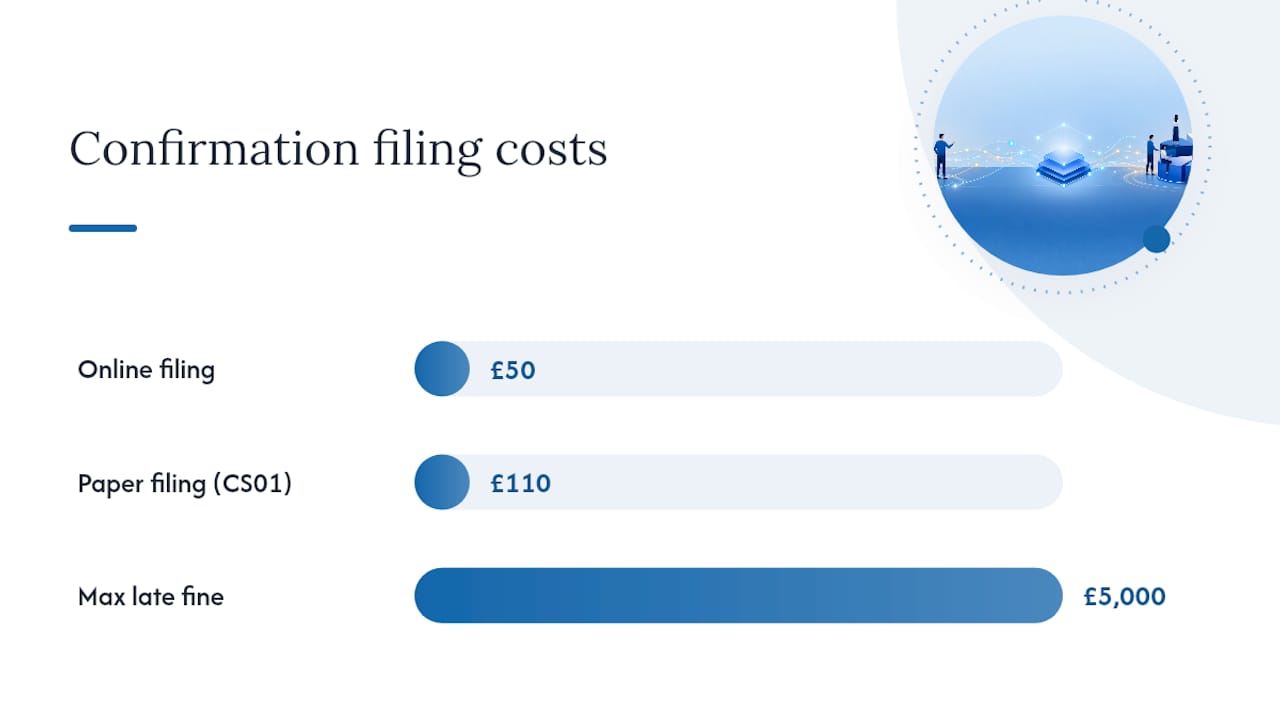
- Online filing: £50
- Paper filing (CS01): £110
- Deadline: within 14 days of your review period ending
Here’s the part that catches people out: you only pay once per payment period. If your company’s circumstances change and you need to file a second confirmation statement within the same 12 month payment period, that second filing doesn’t attract another fee. Directors who file early or file twice in one year sometimes assume they owe a second payment when they don’t.
Miss the 14 day deadline and you’re not just risking a fine of up to £5,000. Persistent failure to file is one of the main triggers Companies House uses to start striking a company off the register entirely, which can freeze business bank accounts and void contracts.
Who needs to verify their identity before filing?
Companies House now requires identity verification tied to GOV.UK One Login, and a confirmation statement won’t be accepted until the relevant people have completed it.
- Every director on the company record needs to verify their identity, either directly through GOV.UK One Login or via an authorised corporate service provider.
- PSCs are subject to the same requirement where they interact with filings.
- The CS01 includes a lawful purpose statement, a declaration that the company’s intended future activities are lawful. Ticking it without understanding what it commits you to is a mistake worth avoiding.
- Get personal verification codes sorted well before your deadline. Leaving this to the last 48 hours is the single most avoidable cause of a missed filing date.
What are the most common confirmation statement mistakes?
Rejections are rarely dramatic. They’re usually small procedural slips that are easy to prevent with a quick pre-submission check.
- Wrong confirmation date. Always check the date the register actually shows before you confirm it.
- Attempting officer or PSC changes on the CS01. These need AP01, TM01, AD01 or PSC01 filed first.
- Missing identity verification. Companies House will hold the filing until every required director has completed GOV.UK One Login checks.
- Incorrect statement of capital. Share allotments or transfers not reflected accurately will cause discrepancies later, particularly during due diligence.
If a filing is rejected, correct the specific field flagged and resubmit rather than starting an entirely new filing from scratch. If you spot an error after acceptance, you can typically correct it on your next confirmation statement or, for serious errors, contact Companies House directly.
Pro Tip: Run through your shareholder register, SIC code and registered email five minutes before you submit, out loud if it helps. Reading each field back catches typos that a quick visual scan misses.
How should growth companies prepare their records before filing?

For an early-stage or scaling company, the confirmation statement is a natural annual trigger to tidy up records that fundraising due diligence will scrutinise closely later.
Work through this before you open the filing service, keeping in mind what every UK invoice must legally include.
- Reconcile your cap table against what Companies House currently shows.
- Confirm share classes, percentages and any recent allotments are recorded correctly.
- Check PSC records reflect the true current ownership and control structure.
- Gather director identity verification codes and confirm your registered email is active.
- Document every change made in the past 12 months with dates, so nothing gets missed.
If your company has multiple share classes, is mid-fundraise, or holds SEIS or EIS advance assurance, get an accountant or outsourced finance director involved before filing. A misaligned statement of capital at the wrong moment can complicate an investment round far more than the £50 filing fee would ever suggest. Our compliance checklist for UK companies covers the wider annual obligations that tend to cluster around the same period.
Why timely, accurate filing matters more than directors think
Investors and their lawyers read the public register before they read your pitch deck. A confirmation statement filed late, or one that shows a stale shareholder list, raises a question before due diligence has even properly started: does this founder run a tight ship?
Treat your CS01 date as an annual governance checkpoint, not just a compliance chore. Review your cap table, your PSC register and your share structure at the same time every year, and you’ll walk into a funding round with records that match what you’re telling investors. Sloppy filings rarely sink a deal alone, but they slow one down, and time is the one thing founders mid-raise never have enough of.
— Rahamut
How Priceandaccountants supports confirmation statement filing
Sorting out a CS01 yourself is entirely possible with a spare afternoon and tidy records. Where Priceandaccountants earns its keep is everything that happens before you hit submit, particularly for companies with cap tables that have grown messier than the shareholder register suggests.

Our team reviews your shareholder schedule against what Companies House actually holds, checks your statement of capital lines up with any recent funding rounds, and flags PSC or director changes that need filing separately before the confirmation statement goes in. For companies with SEIS or EIS positions, we check those alongside the filing rather than as an afterthought. If you’d rather have someone who does this daily handle the whole process, our company accounting services cover confirmation statement preparation as part of ongoing compliance support, and our strategic advisory team can step in for the bigger cap-table or investment-readiness questions. Get in touch and tell us your filing deadline. We’ll take it from there.
Sources
- Filing your company’s confirmation statement
- File a confirmation statement
- CS01 confirmation statement form (PDF)