TL;DR:
- Most UK founders should choose signal tools like KWatch.io or MRRScout for real-time alerts, and databases like Crunchbase or PitchBook for due diligence. The best approach combines live event signals with retrospective data, tailored to specific needs and budgets, while ensuring GDPR compliance. Fast onboarding is available for self-serve tools, whereas enterprise platforms may require weeks to fully implement.
For most UK founders, the right BounceWatch substitute depends entirely on what you need the tool to do: pick KWatch.io or MRRScout for real-time signals and niche discovery; choose Crayon or Klue for internal competitive enablement; reach for Crunchbase or PitchBook when you need retrospective funding and cap-table data.
Use-case shortlist:
Selection methodology: these eight tools were chosen based on SERP consensus, job-to-be-done fit, UK/EU availability, and GDPR compliance posture — a non-negotiable filter for any UK founder processing third-party company data.
TL;DR: If you want outbound timing signals today, trial KWatch.io or MRRScout free tiers first. For funding research, start with Crunchbase’s free plan. Only move to PitchBook or Klue when your team genuinely needs enterprise depth.
| Tool | Best for | Data freshness | Pricing level | Integrations | UK/EU coverage | Time to value |
|---|---|---|---|---|---|---|
| Crunchbase | Funding history, investor lookups | Retrospective | Entry–mid | CRM, CSV export | Global, good UK | Hours |
| PitchBook | Deep due diligence, cap tables | Retrospective | Enterprise — | CRM, Excel | Global | Days–weeks |
| Dealroom.co | European ecosystem intelligence | Retrospective | Mid–enterprise | API, Slack | Strong EU/UK | Days |
| Crayon | Competitor messaging, battlecards | Near real-time | Mid–enterprise | Slack, CRM | Global | Days |
| Klue | Win/loss, internal CI curation | Near real-time | Enterprise | Slack, CRM, Salesforce | Global | Days |
| Tracxn | Sector scanning, emerging markets | Retrospective | Mid | CSV, API | Global, emerging | Days |
| MRRScout | Micro-SaaS and indie startup discovery | Real-time (daily) | Entry | Limited | Global, niche | Minutes |
| KWatch.io | Social listening, brand/competitor alerts | Real-time | Entry–mid | Webhooks, Clay, API | Global | Minutes |
Pro Tip: Treat signal tools and databases as complementary, not interchangeable — a radar for live events paired with a rearview-mirror database for diligence covers the full prospecting cycle without overspending on either.
The core design difference is “action versus analysis.” Signal tools fire when something happens — a funding round closes, a hiring surge starts, a competitor posts on Reddit. Competitive enablement platforms like Crayon and Klue are built for documentation and internal knowledge, not outbound triggers.
Three concrete criteria to apply:
Red flags to watch for: annual contracts with no trial period; pricing that requires a sales call before any figure is disclosed; platforms that cannot confirm GDPR-compliant data processing for UK-based company records. Ask vendors directly: “Where is data stored, and do you have a UK or EU data-processing agreement?” Any hesitation is a signal in itself. For a broader view of vendor contract review, it is worth understanding your legal options before signing.
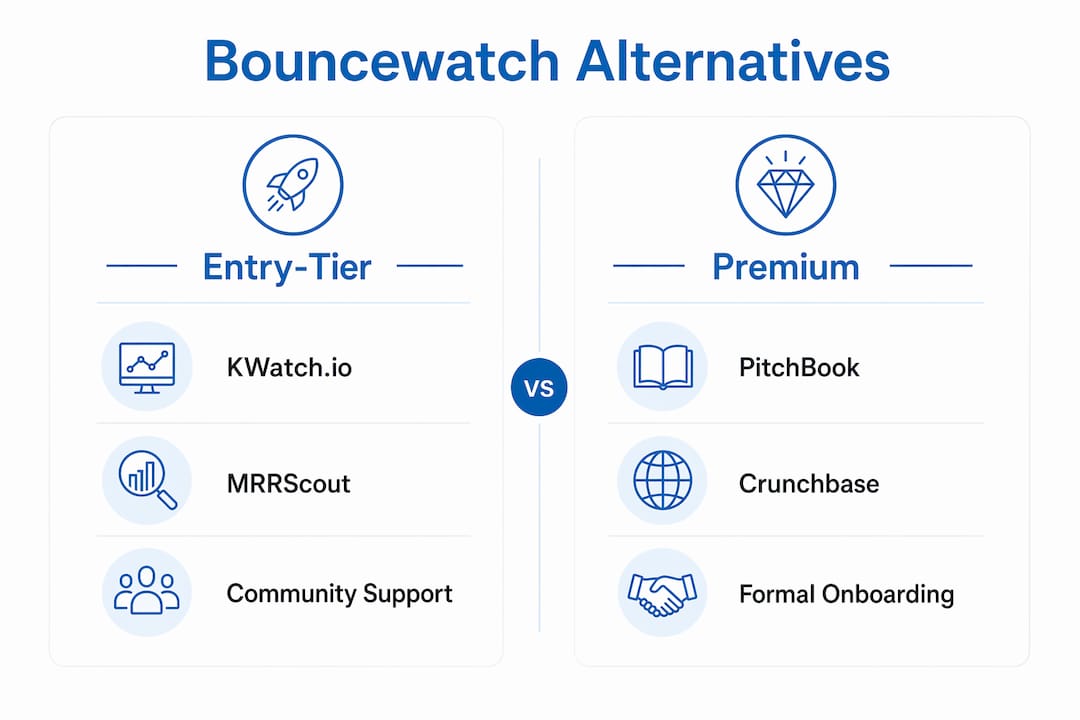
Entry-tier tools (KWatch.io, MRRScout) typically offer community forums, documentation, and email support. Response times vary, but both are founder-built products where the team is reachable. Mid-tier platforms like Dealroom.co and Tracxn provide dedicated onboarding and account management at higher plan levels. Enterprise tools — PitchBook, Klue, Crayon — include named customer success managers, though access often depends on contract size.

The practical gap shows up at implementation. PitchBook’s depth means a new user can spend a week just configuring alerts and exports before getting usable output. KWatch.io, by contrast, has users monitoring competitor mentions within minutes of signup.
Crunchbase consistently draws positive feedback for its free-tier breadth and ease of search, though power users note that funding data can lag by several weeks. PitchBook earns strong marks from institutional investors for deal-level accuracy but attracts criticism for its pricing opacity and long sales cycles. Crayon users in product marketing roles rate its battlecard templates highly; the common complaint is that keeping cards current requires manual effort unless the team commits to a regular update cadence. Klue receives similar praise for its structured knowledge base and win/loss workflows, with enterprise teams noting it integrates well with Salesforce and Slack. MRRScout has a loyal following among indie hackers and micro-SaaS founders who value its NicheScore for surfacing early-stage opportunities larger databases miss entirely.
PitchBook and Crunchbase scale by adding user seats and API access at higher tiers. Crayon and Klue are built for growing go-to-market teams and offer role-based permissions, custom battlecard templates, and CRM integrations that become more valuable as headcount increases. Dealroom.co supports API access for teams that want to pipe ecosystem data into their own dashboards.
The tools with the least headroom are the entry-tier niche products. MRRScout is excellent for a solo founder or small team doing early discovery; it is not a replacement for a structured competitive intelligence programme at Series A. KWatch.io scales reasonably well through its webhook and API layer, letting you pipe social signals directly into sales tools like Clay.
KWatch.io and MRRScout offer monthly rolling plans with no long-term commitment, which suits founders who want to test before committing. Dealroom.co and Tracxn typically require annual contracts at mid and enterprise tiers. PitchBook and Crayon are almost exclusively annual, with multi-year discounts available. Klue follows a similar enterprise model.
One practical point: UK startup compliance obligations mean you should check data-processing addenda before signing any annual contract that involves storing or processing UK company or personal data. A rolling monthly plan also makes it easier to switch if a tool’s data quality does not match the sales pitch.
KWatch.io and MRRScout are self-serve: you can set up monitors and start receiving alerts the same day, with no sales call required. Dealroom.co offers guided onboarding for paid plans, typically a 30-minute setup call followed by a structured walkthrough of search and export features. Crunchbase Pro is largely self-serve with a library of tutorial videos.
PitchBook, Crayon, and Klue all involve a formal onboarding process: a kickoff call, configuration of integrations, and often a training session for the wider team. Expect two to four weeks before the tool is genuinely embedded in your workflow. That lag is worth it for enterprise teams, but it is a real cost for a two-person founding team that needs output this week.

Switching tools or building a new intelligence stack is the right move for prospecting; consider streamlining HR for a growing tech startup to scale rapidly once hires begin. But the signals only convert into funded growth when your financials are investor-ready. Priceandaccountants works with UK tech founders from pre-seed to Series A, handling the R&D tax credits, SEIS/EIS compliance, and strategic advisory that turn a strong pipeline into a fundable business. A typical initial engagement produces a first deliverable — R&D claim scoping or a funding-readiness review — within two to three weeks. If you are ready to speak with an adviser, visit the advisory and tax planning page to book a call.
The strongest approach combines a real-time signal tool for outbound timing with a retrospective database for diligence — no single platform does both well.
| Point | Details |
|---|---|
| Match tool to job-to-be-done | Signal tools (KWatch.io, MRRScout) drive outreach; databases (Crunchbase, PitchBook) support due diligence. |
| Budget before you commit | Entry-tier signal tools cover most daily prospecting needs at a fraction of enterprise database costs. |
| Check GDPR posture first | Ask vendors for a UK or EU data-processing agreement before signing any annual contract. |
| Expect varied onboarding timelines | Self-serve tools deliver value in minutes; enterprise platforms (PitchBook, Klue) take two to four weeks to embed. |
| Priceandaccountants as the financial layer | Priceandaccountants provides R&D tax credits, SEIS/EIS compliance, and strategic advisory to convert pipeline signals into funded growth. |