

Auditing financial services, in the context that matters to you, means running internal financial reviews that prove your management accounts, reconciliations, controls and evidence packs are accurate and continuously audit-ready. It is not the statutory external audit a regulated bank undergoes. For a startup founder, the deliverables are concrete: clean monthly management accounts, reconciliation packs with resolved breaks, tested controls, logged evidence, and a named person accountable for safeguarding and compliance. If you handle client money, CASS 15 governs much of this. Most founders run their ledger through Xero and bring in a partner like Priceandaccountants once the workload outgrows a part-time bookkeeper.
This week, do three things:
- Run a quick health check against your current management accounts and bank reconciliations.
- Name one person as your safeguarding or compliance owner, even if that is you for now.
- Pull together your three most important evidence packs: bank reconciliations, contract-level revenue schedules, and board or governance minutes.
Key Takeaways
Audit-readiness for a tech or fintech startup means continuously maintained management accounts, reconciliations and evidence packs, not a one-off event before a funding round.
PointDetailsDefine scope correctlyInternal financial auditing covers bookkeeping, reconciliations and controls, not statutory external audit.Name an owner nowAssign a designated safeguarding or compliance lead even before formal obligations apply.CASS 15 changes the barFirms safeguarding client money need monthly returns and an independent annual compliance audit.Automate reconciliation earlyTag transactions at source and reduce spreadsheet dependence to cut remediation costs later.Get a professional health checkPriceandaccountants offers a fixed-fee health check that maps gaps before they become expensive.
Table of Contents
- What internal financial auditing actually covers
- What controls and evidence should you have ready?
- CASS 15 and what safeguarding audits demand
- How long does audit-readiness take, and what does it cost?
- Which tools cut audit friction the most?
- How Priceandaccountants supports audit-ready finance
- Ready for an audit-readiness health check?
- Frequently asked questions
- Sources
What internal financial auditing actually covers
Internal financial services auditing, in this guide’s sense, is bookkeeping, management accounts, bank reconciliations, controls testing, break logs and recordkeeping, held to a standard that would survive scrutiny from an investor, a board member or a regulator. It does not mean the statutory external audit that a regulated bank or insurer undergoes. Confusing the two is a common early mistake, and it leads founders to either over-engineer processes they do not yet need or under-prepare for the ones they do.
The artefacts that matter are unglamorous but non-negotiable: a monthly trial balance, profit and loss and balance sheet, bank reconciliations with a break-resolution log attached, contract-level deferred revenue schedules, and governance minutes recording who approved what and when.
Xero sits at the centre of most startup setups as the source-of-truth ledger, pulling in bank feeds and reconciling transactions automatically where rules are set up well. The failure mode is predictable: teams keep a spreadsheet “just in case,” that spreadsheet quietly becomes the real record, and nobody can trace a number back to its origin six months later.
Several groups rely on these outputs, often for different reasons:
- Founders and the finance lead, to run the business day to day.
- The board and investors, to judge financial discipline before the next funding round.
- Banking and payment partners, who want to see reconciled, well-governed accounts.
- Regulators, where safeguarding obligations apply under frameworks like CASS 15.
What controls and evidence should you have ready?
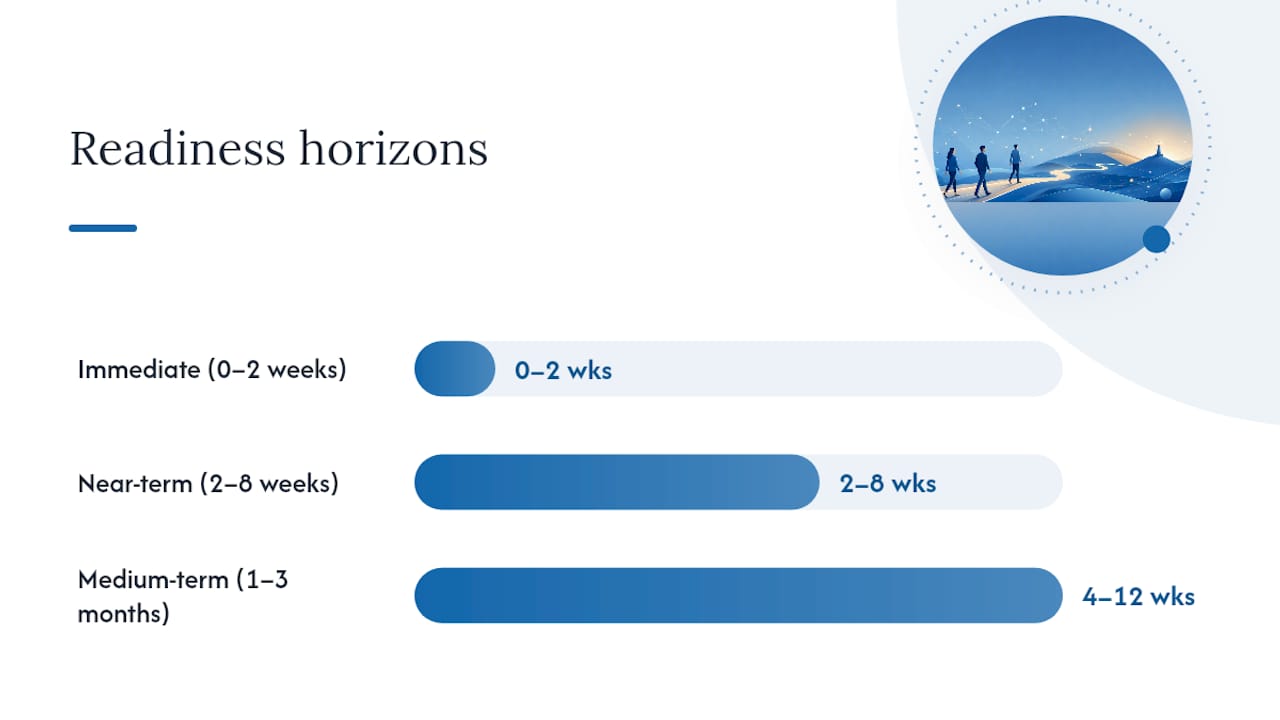
Readiness is not a single event. Break it into three horizons and work through them in order.
Immediate (0 to 2 weeks):
- Name a designated safeguarding or compliance owner, even on an interim basis.
- Build a bank account map showing which entity owns which account and why.
- Start a documented break-resolution log for anything unreconciled beyond a few days.
Near-term (2 to 8 weeks):
- Standardise monthly reconciliation templates so every month follows the same structure.
- Collect acknowledgement letters from banking partners confirming account status and terms.
- Write down your reconciliation methodology so it survives staff turnover.
Medium-term (1 to 3 months):
- Formalise governance minutes and approval records for anything touching client or company funds.
- Test segregation of duties, especially around who can authorise top-ups, transfers or refunds.
- Set automated reconciliation thresholds so exceptions get flagged rather than buried.
Controls worth testing specifically include bank-feed integrity (does Xero actually match what the bank statement says), authorisation rules for transfers, and how exceptions get escalated rather than quietly cleared. Evidence should always be time-stamped: a reconciliation with no date attached is close to useless if a partner or the FCA later asks when a break was identified and resolved. Firms with safeguarding duties add monthly returns and versioned policy documents to that list.
Pro Tip: Automate your highest-volume reconciliation points first, and keep a single canonical reconciliation run that ties directly back to Xero rather than a parallel spreadsheet version nobody trusts.
CASS 15 and what safeguarding audits demand
If your fintech touches client money, CASS 15 changes what “audit-ready” means. The rule set requires firms to keep client funds separate from company funds, run due diligence on banking partners, apply concentration limits so funds are not overexposed to a single institution, and file a monthly safeguarding return showing total safeguarded funds and where they sit.
- Arrange an independent annual audit of your safeguarding arrangements.
- Maintain always-on evidence packs: account structures, acknowledgement letters, reconciliations, break logs and governance minutes.
- Reduce spreadsheet dependence in favour of automated, system-to-system reconciliation.
- Assign board-level ownership of safeguarding, not just an operational lead.
Firms subject to CASS 15 must produce that monthly return and commission an independent annual compliance audit, a workload that surprises many teams who assumed a light-touch annual check would suffice. Platforms such as LiquidityDirect from BNY illustrate one way firms consolidate safeguarding account structures and reporting, though it is one implementation among several rather than the only route.
Pro Tip: Where practical, consolidate safeguarding reporting with a single resilient banking partner. Fragmented accounts across multiple providers multiply your monthly reporting burden for no operational benefit.
How long does audit-readiness take, and what does it cost?
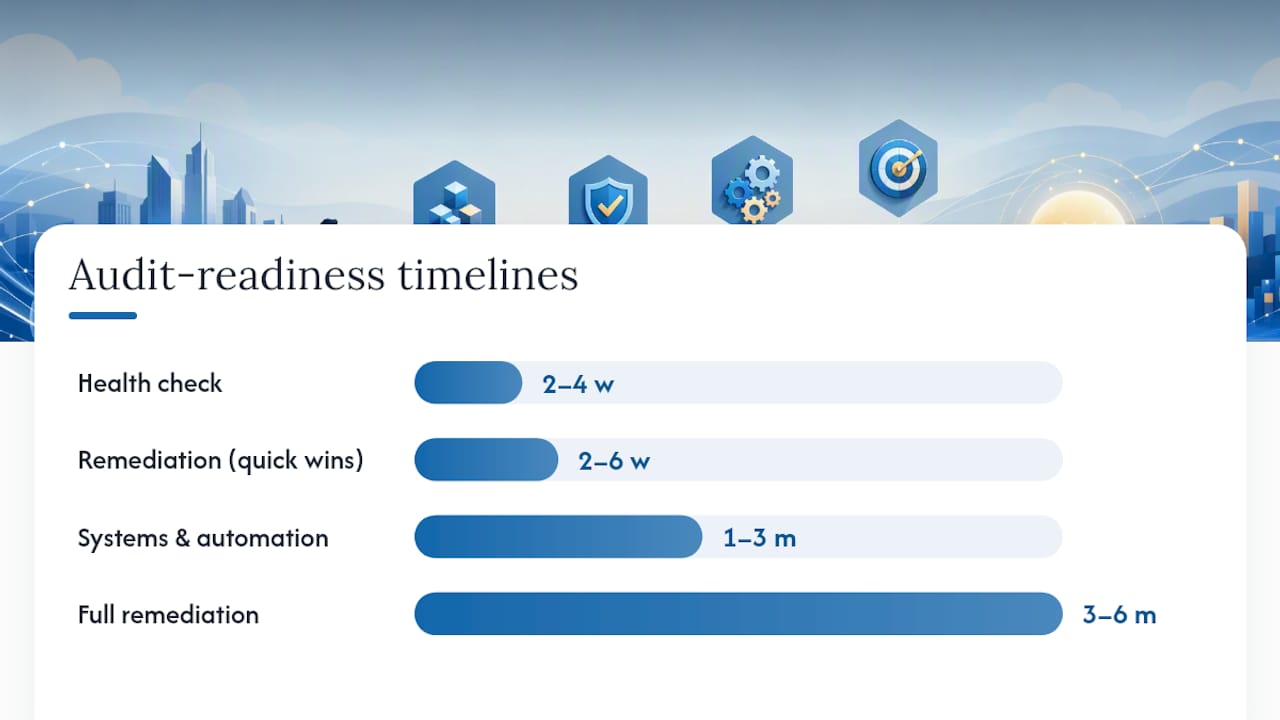
Timelines depend heavily on how far behind your bookkeeping already is, but a rough shape holds across most startups.
- Health check (2 to 4 weeks): a review of your current ledger, reconciliations and controls, producing a gap map and a prioritised list of fixes.
- Remediation, quick wins (2 to 6 weeks): fixing broken reconciliations, tidying the chart of accounts, closing the most glaring control gaps.
- Systems and automation (1 to 3 months): connecting bank feeds properly, automating reconciliation, cutting spreadsheet reliance.
- Full remediation to audit-readiness (3 to 6 months): applies mainly to multi-entity or multi-currency businesses with more complex revenue recognition.
Cost bands vary by stage. Seed-stage bookkeeping remediation tends to sit at the lower end of monthly retainer pricing; a Series A audit-readiness package, given the GAAP-level controls investors expect at that milestone, costs more and takes longer. Ongoing outsourced FD or controller support is typically a monthly retainer scaled to transaction volume and entity count.
Bring in your finance lead, an outsourced FD such as Priceandaccountants, and engineering or ops where integrations need building, deciding based on growth speed, investor expectations, and how complex your revenue recognition and cross-border payments already are.
Which tools cut audit friction the most?
The tools that matter fall into a few categories: cloud accounting (Xero as the ledger), automated bank-feed reconciliation, contract-level revenue recognition tools for accrual accounting, treasury platforms, and centralised safeguarding account platforms like LiquidityDirect for firms with safeguarding duties.
- Keep one system of record; treat every other tool as feeding into it, not replacing it.
- Version your evidence packs so you can show exactly what changed and when.
- Standardise identifiers (customer ID, contract ID, payment reference) across every system that touches money.
- Set clear rules for capturing exchange rates on multi-currency balances, since inconsistent rate capture is a common source of unexplained variances.
Prioritise the reconciliation-critical flows first: payments, bank feeds, custodian statements. Onboarding and consent logs matter too, but they rarely block an audit the way an unreconciled bank account does.
Pro Tip: Tag every transaction at source with the identifiers an auditor will ask for later. Reconstructing that data manually months afterwards costs far more time than tagging it correctly the first time.
How Priceandaccountants supports audit-ready finance
Priceandaccountants runs a consistent sequence with tech and fintech clients: a health check against current management accounts and controls, a remediation roadmap ranked by risk, automation support built around Xero, and ongoing management accounts paired with advisory FD input as the business scales.
- Health check identifies the gaps that would embarrass you in front of an investor or auditor.
- Remediation work is milestone-driven, so you see progress rather than an open-ended engagement.
- Ongoing support runs as a retainer, scaled to your transaction volume and entity complexity.
Engagements typically start with a fixed-fee health check, move into milestone-based remediation, then settle into an ongoing retainer once your books are stable. Before an initial scoping call, gather your last three months of management accounts, your current bank reconciliation process, and a list of who currently owns compliance decisions internally.
Why audit-readiness is not a compliance chore
Founders tend to treat audit-readiness as paperwork you do once, right before a funding round or a regulatory deadline. That is backwards. The firms that struggle are almost always the ones that built their ledger around whatever was fastest at the time, then discovered at Series A that a spreadsheet nobody can explain has been sitting underneath their revenue numbers for a year. Fixing that after the fact costs more, in both money and investor confidence, than building it properly from month one. Priceandaccountants has seen this pattern often enough that the health check is deliberately the first step, not an afterthought…
Ready for an audit-readiness health check?
If your reconciliations still live half in Xero and half in a spreadsheet only one person understands, that is exactly the gap a health check exists to close. Priceandaccountants runs fixed-fee health checks specifically for tech and fintech founders, mapping the shortest route from where your books are now to where an investor, partner or regulator needs them to be.

Before booking a scoping call, gather your last three months of management accounts and a note of who currently signs off on transfers and reconciliations. From there, explore Priceandaccountants’ accounting services or head to the main site to arrange a health check and see exactly where remediation should start.
Frequently asked questions
Does auditing financial services mean the same as a statutory audit?No. In this context it means internal reviews of your management accounts, reconciliations and controls. Statutory external audits apply to regulated institutions like banks and are a separate process entirely.
Do all fintechs need to comply with CASS 15?Only firms that safeguard client money fall under CASS 15. If you never hold client funds, the monthly return and independent annual audit requirements do not apply, though good reconciliation discipline still matters.
How much does an audit-readiness health check cost?Costs scale with your entity’s complexity and transaction volume. A fixed-fee health check is usually the starting point, with remediation and ongoing retainer costs following once gaps are mapped.
Can Xero alone make us audit-ready?Xero is a strong source-of-truth ledger, but readiness depends on how disciplined your reconciliation process, controls and evidence logging are around it, not the software alone.
When should we move from a bookkeeper to an outsourced FD?Typically when monthly close gets harder to hit, deferred revenue grows more complex, or investors start expecting GAAP-level reporting ahead of a funding round.
Sources
Recommended
- Common fintech accounting mistakes UK founders must fix - Price & Accountants
- Why prepare for audit: a UK tech founder’s guide - Price & Accountants
- Accounting due diligence for UK tech startups: A founder’s guide - Price & Accountants
- How to streamline bookkeeping in UK fintech startups: cut time 40% - Price & Accountants